
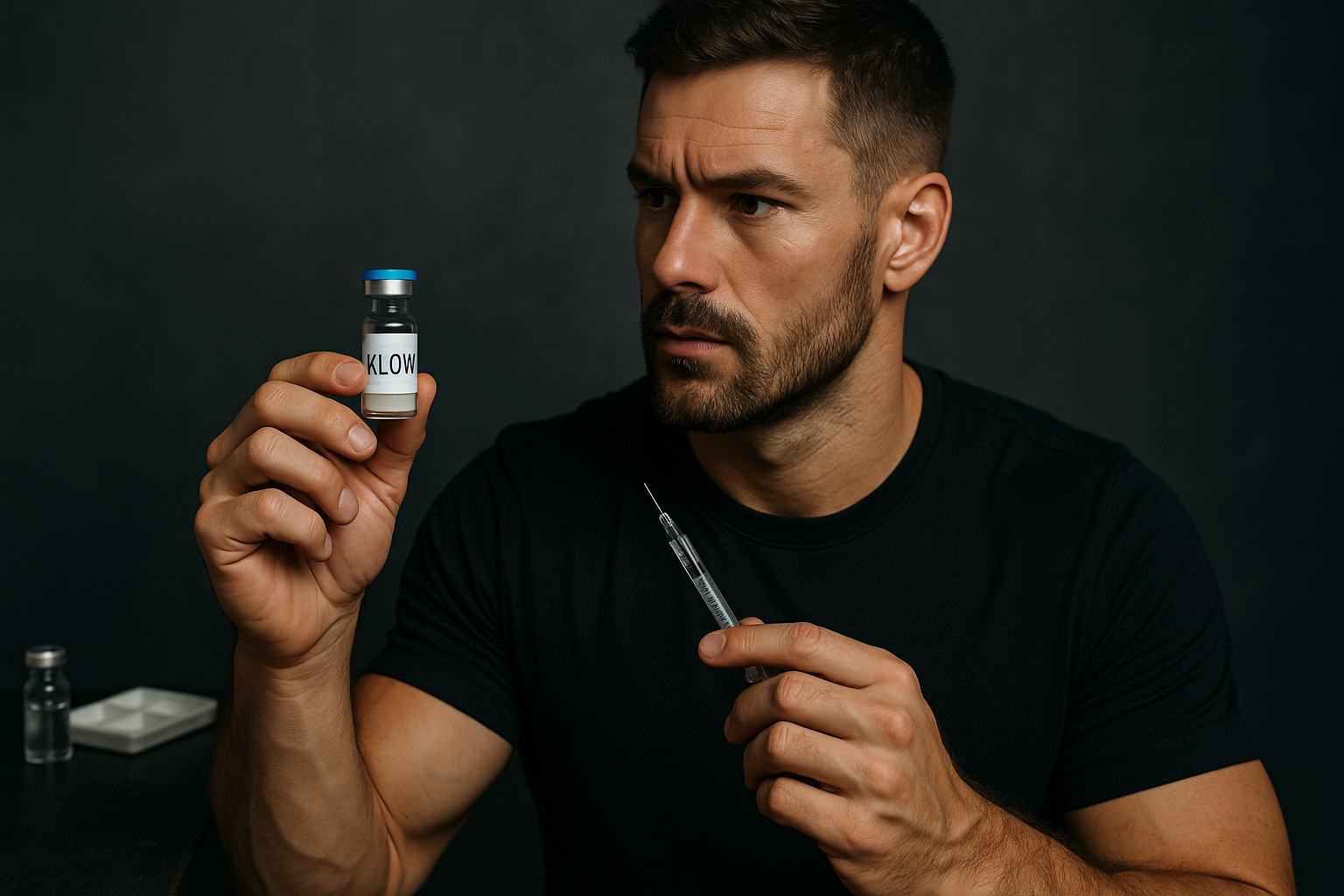
If you’ve been searching for “what is the klow peptide”, you’re probably running into confusing terminology (KLOW vs “KLOW 80”), dosing charts, reconstitution instructions, and a lot of anecdotal “before and after” claims. This safety-first KLOW guide consolidates the full user journey in one place: what KLOW is commonly described as, what people use it for (and how to set realistic expectations), practical safety considerations (including the klow peptide injection site and possible klow peptide side effects), plus what you should verify with a clinician before starting.
Important: Peptides and injections carry medical risks. This article is educational and not medical advice. Dosing, timing, and reconstitution should be done only with guidance from a licensed healthcare professional. Charts/calculators vary by product concentration and clinician protocol.
What Is KLOW (and What’s in the Blend)?
KLOW is commonly described online as a 4-peptide complex—often discussed in the same conversations as regenerative healing, inflammation support, and connective-tissue recovery. While formulations can vary by supplier, the blend is frequently referenced as combining:
- BPC-157
- GHK-Cu (copper peptide)
- TB-500
- KPV
For a detailed overview of the blend composition as it’s commonly described, see KLOW overview: blend composition (BPC-157, GHK-Cu, TB-500, KPV).
How KLOW is commonly described (BPC-157, GHK-Cu, TB-500, KPV)
Because KLOW is typically marketed as a multi-peptide “complex,” users often seek it for broader “recovery support” narratives. It’s worth emphasizing: online benefits are frequently user-reported, and real-world outcomes can vary widely based on the person, the underlying issue, product quality, and whether a clinician supervises use.
What “KLOW” means vs “KLOW 80” (terminology/label differences)
When people search “klow 80 peptide protocol” or mention “KLOW 80mg,” they’re usually referring to a product label/concentration that may bundle a specified amount of peptide(s) (or a specific per-vial target). However, there is no universal standard for what “KLOW 80” means across all sellers.
What to confirm before you use any KLOW-labeled product:
- Exact contents (which peptides and their labeled amounts)
- Total vial strength and reconstitution concentration (mg per mL after adding bacteriostatic water or saline, depending on the product)
- Clinician dosing plan (what they want the final dose to be, and why)
- Expiry/storage instructions
In other words, “KLOW 80” is best treated as a label/format to verify—not a guaranteed dosing standard.
Potential Benefits (What Users Claim vs What to Look For)
Search intent for KLOW is often mixed: people want to know what it is, then they immediately jump to goals, dosing, and safety. Here’s the honest way to approach potential benefits—especially if you care about safety.
Commonly reported goals (recovery/inflammation/skin-gut support/weight-management claims)
Users commonly discuss KLOW in connection with:
- Recovery support (especially around training strain, soreness, and general tissue repair)
- Inflammation narratives (people often look for reductions in “irritation” or improved comfort, but outcomes vary)
- Skin/gut-related support claims (these are frequently mentioned online, but credibility depends on individual evidence and medical context)
- Metabolic/weight-management claims (you’ll see this in forums, but it’s not the same as proven clinical efficacy for weight loss)
Many of these goals overlap with how the individual peptides are discussed elsewhere online—so if you want a framework for evaluating plausibility and safety, it helps to learn the safety and side-effect patterns for each component.
How to set realistic expectations (timeframes vary; avoid guarantees)
Because KLOW is a multi-peptide blend, people often expect noticeable changes quickly. In reality:
- Time-to-effect varies based on dose, condition, adherence, and individual biology.
- “Feeling something” doesn’t equal clinical improvement.
- Forum timelines are not reliable evidence; they’re anecdotes.
If you’re using KLOW for a specific issue, align expectations with your clinician and define a safety-monitoring plan (more on the safety checklist below).
KLOW Dosage & Timing (Safety-First Guidance)
This is where many SERP pages fall short: they post charts/copy-paste dosing without teaching how to interpret those numbers responsibly. You’ll see searches like klow peptide dosage chart calculator and “80mg protocol.” Here’s the safety-first way to think about it.
Dose chart + calculator: how to interpret them responsibly
If you use a klow peptide dosage chart calculator, treat it as a math tool, not medical direction. Dosing calculators commonly fail because:
- The product’s labeled strength differs from what the calculator assumes
- Users calculate based on an incorrect assumption about dilution volume
- Clinician targets are individualized and may not match a generic chart
- Injection method and measuring technique affect delivered dose
Responsible interpretation checklist:
- Start with the exact vial concentration after reconstitution (mg/mL), as stated by the supplier/label and/or your prescriber.
- Confirm whether the chart uses mg or mcg, and whether it assumes a specific dilution volume.
- Use your clinician’s prescribed target dose and convert it using the vial concentration you actually have—not a “typical” one.
- Never increase frequency or volume to chase results without medical guidance.
Reminder: charts/calculators vary by product concentration and clinician protocol. Always follow a licensed prescriber.
How often to take klow peptide (general decision factors; require clinician)
“How often to take klow peptide” searches are common because users want a schedule. However, frequency is highly individual and should be determined by a clinician who can evaluate:
- Your goal (recovery vs inflammation narratives vs other considerations)
- Any medical conditions, current medications, and allergy history
- Injection tolerance and risk of local reactions
- How you respond and whether side effects appear
In practice, any “general schedule” you see online is usually not personalized medical advice. The safety approach is: start under supervision, monitor reactions closely, and adjust only with clinician oversight.
KLOW 80mg protocol: what to confirm before using
If you’re specifically looking for klow 80 peptide protocol, confirm these details first—because “80mg” might refer to different things depending on the labeling:
- Is 80mg the total amount per vial, the per-peptide amount, or a target after dilution?
- What is the final reconstituted concentration your plan is based on?
- What injection volume does the clinician want (units/mL based on your syringe markings)?
- What is the stop/hold rule if you develop persistent injection-site pain or rash?
Even if two products both say “KLOW 80,” they may not be interchangeable. Treat labeling differences as a safety issue.
How to Reconstitute KLOW Peptide (Process Overview)
This section targets the second major SERP intent: “how to reconstitute klow peptide.” The goal is to make the process safe in principle—while still stressing that you must follow the specific supplier instructions.
Reconstitution basics (using sterile technique; follow supplier instructions)
In general, peptide reconstitution should be treated as a sterile compounding step:
- Wash hands and set up a clean work area.
- Confirm the exact solvent recommended for your product (commonly bacteriostatic water or saline—use what your label prescribes).
- Use sterile supplies (needle/syringe and sterile vial access method as instructed).
- Inject solvent into the vial as directed (avoid aggressive shaking if the manufacturer advises against it).
- Mix according to label guidance (some products specify gentle swirling; others may specify minimal handling).
- Label the vial with date/time, storage conditions, and expiration window if provided.
Do not improvise. Different peptide formulations can have different requirements. Always follow the product’s written instructions and your clinician’s protocol.
Common administration mistakes to avoid
- Wrong dilution math (leading to an unintended delivered dose)
- Skipping proper sterile technique (increasing infection risk)
- Using beyond the labeled storage window or incorrect temperatures
- Forgetting to check vial concentration before calculating dose
- Assuming all “KLOW” vials are identical (they are not)
If you want to build your safety framework around injection-risk thinking, you may find this broader safety perspective helpful: Peptides Bodybuilding: Safety-First Side Effects Checklist, Real Expectations.
Injection Site & Administration Considerations
People search klow peptide injection site because they’re trying to minimize irritation and do things “correctly.” The most accurate answer is: injection sites depend on the clinician’s instructions, your comfort, and the injection technique being used.
Where injections are typically performed (high-level; emphasize provider guidance)
For subcutaneous or intramuscular injections (depending on the prescriber’s plan), common injection strategies include areas with adequate tissue and consistent accessibility. The safest guidance is to:
- Use the route and site plan your clinician specifies
- Rotate sites to reduce irritation
- Avoid injecting into areas with active redness, swelling, or suspected infection
If you are unsure about your injection route (SQ vs IM) or site selection, pause and ask your prescribing clinician—don’t guess from forum posts.
Injection-site reactions to watch for
Some local effects can happen with peptide injections. Monitor for:
- Temporary redness or mild tenderness
- Small lumps that gradually resolve
- Minor bruising
- Itching localized to the injection area
Seek medical advice promptly if you notice:
- Persistent or worsening pain beyond a short window
- Spreading redness, warmth, swelling
- Pus or signs of infection
- Rash beyond the injection site, hives, facial swelling, wheezing, or other allergic-type symptoms
Injection safety is also where a clinician’s experience matters. If you want a broader “what to watch” checklist, see the internal link above on peptides bodybuilding safety-first monitoring.
KLOW Side Effects & Safety Checklist
Now for the central safety intent: klow peptide side effects. The key is separating (1) common, minor effects from (2) warning signs that deserve clinical attention.
Common/possible side effects (from reported experiences)
While side effects vary and not everyone experiences them, people often report possible issues such as:
- Mild injection-site discomfort (tenderness, redness)
- Headache (reported in many peptide categories)
- GI upset in some users (nausea or discomfort)
- Fatigue or sleep changes (anecdotal; not guaranteed)
- Allergic-type reactions (less common, but serious when present)
Because KLOW is a multi-peptide blend, side effects could theoretically relate to any component. For component-specific safety education, you may also find value in reading: GHK-Cu Peptide Side Effects: Safety, Dosage Chart.
When to stop and seek medical advice
Stop use and seek medical advice if you experience:
- Signs of infection (fever, spreading redness, pus, severe warmth)
- Persistent injection-site pain that doesn’t improve
- A rash/hives, swelling of lips/face, breathing difficulty, or other allergic-type symptoms
- Any new, severe, or worsening symptoms
Peptides bodybuilding safety-first checklist (tie-in)
If you’re using KLOW in a fitness or performance context, use this practical checklist:
- Medical screening: disclose your full health history and medications to your clinician.
- One variable at a time: avoid stacking multiple new peptides simultaneously if you can.
- Document responses: track dose, timing, injection site, and any symptoms.
- Respect sterile technique: infection prevention matters more than “optimization.”
- Don’t chase changes: if side effects occur, don’t increase frequency to “push through.”
- Use clinician check-ins: especially for longer runs or if you have any concerning symptoms.
For more general peptide education (different but useful safety context), you can also browse: What Is GHRP-2? Benefits, Side Effects, and Dosage Per Day and GHRP-6 Side Effects + Dosage Per Day Safety Guide.
KLOW vs GLOW (GlOW/GLOW Terminology + Differences)
Searchers frequently type glow vs klow peptide and glow vs klow peptide because the names sound similar. This is partly why misinformation spreads.
Glow vs klow peptide: why users mix these up
“GLOW” (or “glow peptide”) is often used as a shorthand term on the internet, but it may refer to different products or blends depending on seller and labeling. Meanwhile, KLOW is typically associated with the BPC-157/GHK-Cu/TB-500/KPV style multi-peptide complex described above.
So if you see “glow vs klow peptide,” interpret that as: double-check the label. Don’t rely on name similarity.
Which one to ask your clinician about (based on goals and risk tolerance)
The safest decision framework isn’t “KLOW vs GLOW” by name—it’s based on the exact ingredients, your goals, and your risk profile. Before choosing any peptide blend, ask your clinician:
- What exact compounds are in the product?
- What are the known or plausible risks relevant to those compounds?
- What route of administration is planned and why?
- What monitoring plan should you follow?
- What would be a “stop rule” for side effects?
If you want a single “ask list” to use with a clinician before injecting any peptides, start with your injection-site safety monitoring and component safety education links referenced earlier.
Before & After: What’s Credible and What’s Not
Searches like klow peptide before and after pictures reflect a natural desire to see results. But “before/after” is also one of the most easily confounded forms of evidence.
How to evaluate “before and after” pictures responsibly
When you review klow peptide before and after claims:
- Look for documentation quality: same lighting, similar posture, similar camera distance.
- Check timeframe honesty: vague time windows are less informative than specific durations.
- Watch for confounders: diet changes, training changes, hydration, sleep, and concurrent supplements.
- Consider measurement over aesthetics: objective measures (e.g., function, validated metrics) are stronger than visual-only claims.
- Don’t infer causation: improvement might be coincidental to other changes.
What evidence standards to apply
Use a simple rule: if the claim doesn’t include product identity, approximate dosing context, timeframe, and side-effect monitoring, treat it as anecdotal—not evidence.
For long-term safety, “evidence” should also include what happened when side effects occurred—not just photos.
FAQ: KLOW Peptide Questions (Quick Answers)
What is the klow peptide?
KLOW is commonly described as a multi-peptide complex, often listed as BPC-157, GHK-Cu, TB-500, and KPV. Exact ingredients and amounts can vary by product—always verify the label and clinician plan.
What are the most common klow peptide side effects?
Reported experiences often include mild injection-site discomfort (redness/tenderness), headache, or mild GI upset. Stop use and seek medical care for persistent/worsening symptoms, infection signs, or allergic-type reactions.
How do I reconstitute klow peptide safely?
Follow the product’s specific instructions exactly. In general, reconstitute using sterile technique, confirm the correct solvent and dilution volume, and label/storage instructions. Don’t use improvised steps.
Where is the klow peptide injection site, and what reactions are normal?
Injection site depends on the route and clinician guidance (SQ vs IM). Normal reactions may include temporary tenderness or mild redness. Seek medical advice if pain persists, redness spreads, or signs of infection/allergy appear.
How often to take klow peptide?
There’s no universal schedule. Frequency should be determined by a licensed healthcare professional based on your goal, health history, product concentration, and safety monitoring plan.
Is glow vs klow peptide the same thing, and what’s the difference?
They may not be the same. “Glow/GLOW” and “KLOW” names are often mixed online, so the difference depends on the actual ingredients and label of the specific product. Ask a clinician to confirm composition before use.
Conclusion: Your Next Safety-First Step
KLOW is most commonly discussed as a 4-peptide complex (often BPC-157, GHK-Cu, TB-500, KPV), and the internet commonly pairs it with searches about klow peptide injection site, klow peptide side effects, reconstitution, and klow 80 peptide protocol. The biggest “outcome multiplier” you control is safety: verify the exact label, reconstitute with sterile technique exactly as directed, and use a clinician-defined dosing plan rather than relying on a generic klow peptide dosage chart calculator.
Next step: If you haven’t already, gather your product’s exact label (peptide names + strengths), your intended goal, and any medical history/medications—then book a clinician consult to confirm route, dosing, and a clear stop/monitoring plan.