
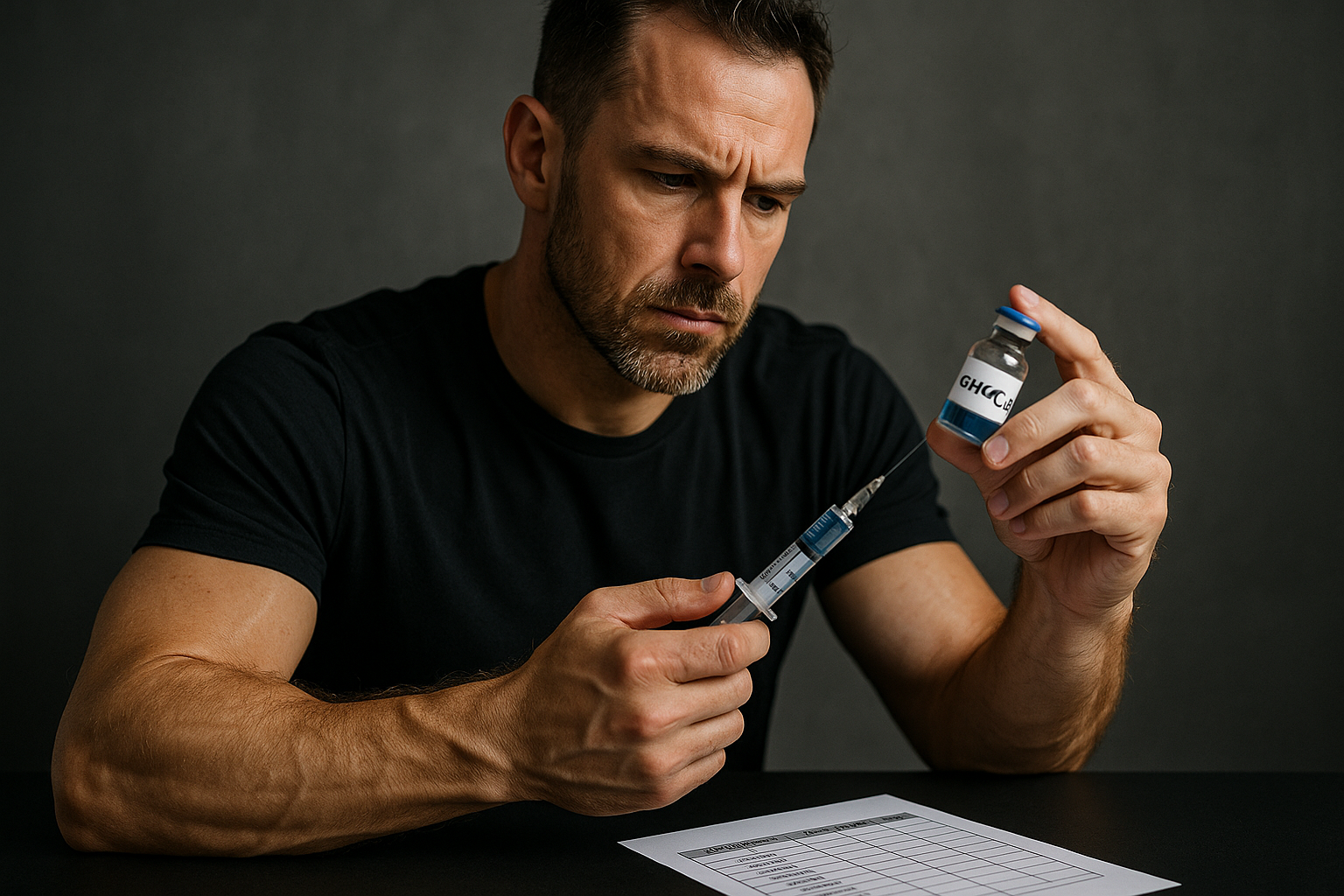
GHK-Cu peptide side effects are one of the biggest deciding factors for people researching this “anti-aging” copper peptide. In this guide, we’ll separate what research suggests from what users report, then translate that into a practical safety-and-dosing interpretation framework—without assuming the kind of results you see in marketing or social media.
Quick take: The most commonly discussed ghk-cu peptide injection side effects are localized (burning/irritation, redness, swelling), but systemic allergic-type reactions are also possible. Evidence for benefits (like collagen/skin remodeling) is still limited and doesn’t fully answer injection-route and real-world safety questions.
Important: This is not medical advice. GHK-Cu is not a substitute for medical care. Talk with a licensed clinician before using any peptide, especially if you have allergies, skin conditions, autoimmune disease, are immunocompromised, or take medications.
What GHK-Cu is (and how it’s used)
GHK-Cu as a copper peptide complex (plain-language overview)
GHK-Cu refers to a complex of the naturally occurring peptide GHK (glycyl-histidyl-lysine) bound to copper. It’s discussed most often in the context of skin and wound-healing biology because GHK-related pathways are associated with processes like cell signaling, extracellular matrix activity, and collagen-linked responses.
In research and product discussions, you’ll often see it used for skin appearance, tissue support, and “regenerative” claims. However, published studies vary by route (topical vs other administration approaches), endpoints (collagen markers vs patient-centered outcomes), and population. That matters for safety interpretation.
GHK-Cu peptide side effects (top concerns)
This section focuses on the questions behind “ghk cu peptide side effects” and “side effects of ghk cu peptide” searches—especially when the product is administered via injection.
Commonly discussed injection-related issues (irritation/burning)
Across user reports (and what clinicians typically watch for with injected compounds), the most frequently reported ghk-cu peptide injection side effects are local to the injection site:
- Burning or stinging during or shortly after injection
- Redness, warmth, or mild swelling
- Itching or tenderness
- Small lumps or temporary discoloration
- Bruising (especially if technique causes minor trauma)
Why this matters: Burning and irritation are not automatically “danger,” but they can be a signal of irritation from formulation factors (for example, vehicle/pH, concentration, or sterility/administration quality). If symptoms escalate, persist, or spread, that changes the risk profile.
Allergic/overreaction red flags (skin/systemic symptoms)
Even if most people report mild local effects, it’s important to know what would suggest an allergic-type or more serious reaction. Stop use and seek medical help urgently if you see:
- Hives or widespread rash
- Facial/lip/tongue swelling
- Wheezing, trouble breathing, or chest tightness
- Fever or rapidly worsening symptoms
- Severe redness, spreading warmth, or signs of infection
- Blistering or skin breakdown at the injection site
Medical safety note: Systemic reactions are less commonly reported than local irritation, but they’re the ones you never want to “wait out.”
“Why does ghk-cu burn so much?” — likely causes to consider
A recurring theme in “ghk cu peptide reddit” discussions is: “it burns a lot.” It’s tempting to interpret burning as “it’s working,” but that’s not a safe assumption.
Potential reasons burning happens (conceptually) include:
- Formulation/vehicle effects: Certain diluents, pH, or concentrations can irritate tissue.
- Irritation vs allergy: Burning can be purely irritant or part of a hypersensitivity response—watch for patterns and severity.
- Injection-site factors: Tissue sensitivity varies by body area, depth, and technique-related trauma.
- Sterility and contamination risk: Poor handling can increase infection risk (which may start as localized pain and worsening redness).
Responsibility reminder: Because we don’t know your exact product, purity, concentration, storage history, and handling practices, we can’t translate these possibilities into instructions. If burning is intense, worsening, or accompanied by rash or swelling, discontinue and get medical advice.
Evidence overview: what the research suggests
If you’re looking for “proof,” it helps to know what outcomes have actually been studied and what hasn’t.
Skin remodeling / collagen-related findings from published studies
Peer-reviewed literature and reviews discuss GHK-Cu’s potential roles in tissue signaling and skin biology. For example, studies summarized in NIH/PMC-hosted articles discuss regenerative and protective actions and highlight effects consistent with improved skin/tissue markers in certain contexts.
External authority (research): Regenerative and Protective Actions of the GHK-Cu Peptide in published research
Another NIH/PMC source discusses GHK as an anti-aging peptide and reviews possible mechanisms relevant to skin and extracellular matrix activity:
External authority (research): The potential of GHK as an anti-aging peptide (NIH/PMC)
How to interpret this: Mechanistic plausibility and selected findings don’t automatically prove that injectable real-world dosing reliably produces the “before/after” outcomes many people search for.
What research does NOT yet establish (limits, population scope, route differences)
- Route mismatch: Many findings are not directly transferable from topical or other settings to injection.
- Dose-response clarity: “Works” at one studied amount doesn’t mean another product concentration or handling protocol is equivalent.
- Short-term vs long-term safety: Limited high-quality data makes it hard to quantify rare or delayed risks.
- Generalizability: Population, age, baseline skin/tissue conditions, and comorbidities differ from real-world users.
This is why “is ghk-cu peptide safe?” doesn’t have a simple yes/no answer—safety depends on product quality, route, individual health, and monitoring.
Is GHK-Cu safe?
“Is ghk-cu peptide safe” is one of the most common search queries, and the honest answer is: we don’t have enough injection-focused, long-term safety data to call it universally safe. People may experience mild irritation, but there are credible pathways for more serious reactions.
Safety checklist before considering any peptide use
Use this checklist to reduce avoidable risk (and to help you ask better questions of a clinician):
- Product verification: Can you confirm source, concentration, and quality testing (e.g., sterility/endotoxin where relevant)?
- Allergy history: Any prior peptide, copper, or formulation ingredient reactions?
- Skin health: Active infection, dermatitis, eczema flares, or open wounds at the site?
- Immune status: Are you immunocompromised or on immunosuppressants?
- Medication interactions: Discuss with a clinician if you take blood thinners, steroids, or immunomodulating meds.
- Monitoring plan: Know what “worse” looks like and when you’ll stop and seek care.
Who should avoid peptides unless supervised (general caution)
- Anyone with a history of severe allergic reactions
- People with active infections or uncontrolled inflammatory skin conditions
- Pregnant or breastfeeding individuals (safety not established—requires clinician guidance)
- Anyone with significant medical complexity (autoimmune disease, immunodeficiency, etc.) without professional oversight
Internal policy context: Peptide sourcing and compounding practices can change. If you want to understand how regulations and compounding rules might shift, see Peptide Regulatory Reclassification 2026: What Changes for Compounding.
How to use / injection basics (non-instructional safety framing)
Because you searched “how to use ghk-cu peptide injection” and “injection,” you’re likely looking for practicalities. We’ll address the common questions and risk framing—but we won’t provide step-by-step injection protocols.
Reconstitution: what users ask about (ghk cu peptide reconstitution)
“ghk cu peptide reconstitution” usually refers to how a dried peptide is prepared for administration. The core safety points to know:
- Concentration accuracy matters: Incorrect concentration can change both tolerability and expected exposure.
- Sterility and handling matter: Improper handling increases contamination/infection risk.
- Consistency matters: Storage and mixing quality can affect stability.
- Formulation variability exists: Different manufacturers/compounding labs may use different vehicles.
If you’re getting significant burning, it may be related to formulation/handling factors—not necessarily “dose effectiveness.” Consider the possibility of irritation due to vehicle or concentration differences.
Injection guidance users search for (common questions + safety constraints)
People often search for “how to use ghk-cu peptide injection” alongside dosage charts. Instead of a protocol, focus on the questions you should be able to answer with a clinician or with lab documentation:
- What is the product’s stated concentration and purity?
- Is it intended for that route by the manufacturer/compounding documentation?
- What sterility testing and quality controls are documented?
- What local reactions are considered expected vs concerning?
- What would be your stopping criteria if burning/redness worsens?
Practical tip: Many “help me interpret my GH-Ku injection dosage chart” issues come from mismatched assumptions between label concentration and how a user calculates dose. A clinician can help reduce math mistakes.
GHK-Cu dosage: how to interpret dosage chart searches
Search intent here is obvious: “ghk-cu peptide injection dosage chart,” “ghk cu peptide dosage chart,” and “ghk cu peptide injection dosage per day.” But dosage charts online often blend:
- different product concentrations
- different routes
- different intended uses
- user calculations that may not match documentation
Responsible approach: Treat any chart you find as an interpretation aid, not as medical guidance.
Dosing chart vs label vs studies (why numbers vary)
Two users can see the same “chart number” but receive different actual exposure because of:
- Different vial strength (mg per vial, mg/mL, etc.)
- Different diluent volume used during reconstitution
- Different injection volume assumptions
- Different intended outcomes (cosmetic skin vs other goals)
That’s why “ghk-cu peptide injection dosage per day” should be approached as: What does your product label actually say, and what dose range has been clinically studied for a similar route?
“GHK-Cu injection dosage per day” — how to approach responsibly (what to look for)
If you’re trying to reconcile chart claims with evidence, look for documentation that includes:
- Product-specific concentration (not just “GHK-Cu” on a forum)
- Route-matched context (injection vs topical studies)
- Time window (how long side effects and benefits were monitored)
- Outcome measures (skin markers vs subjective “looks better” reports)
- Adverse event reporting (how often irritation occurred, and severity)
If the source only provides forum dosing and before/after photos without safety details, assume the evidence quality is low.
Legality & anti-doping status (WADA)
When athletes search “is ghk-cu banned by wada,” they’re often trying to reduce career risk. The key point: WADA rules can change, and “not listed” in one period doesn’t guarantee “safe” in the next.
Is ghk-cu banned by wada? — explain how to verify and why policies change
To verify current status:
- Check the latest WADA Prohibited List for your competition category and year.
- Consider consulting a sports medicine professional or team anti-doping officer.
- If you’re using compounded or non-approved products, additional risk may apply due to contamination/adulteration and documentation gaps.
Anti-doping disclaimer: Claims like “GHK-Cu is banned” or “not banned” can become outdated. Always verify using the latest WADA Prohibited List or consult a qualified professional.
Before & after pictures and Reddit: how to evaluate claims
“ghk cu peptide injection before and after pictures” and “ghk cu peptide reddit” are popular because people want visual proof and real-world experiences. Here’s a framework to evaluate what you’re seeing.
“GHK-Cu peptide injection before and after pictures” — what to look for
When you see before/after claims, check:
- Timeframe transparency: weeks vs months; consistent lighting; similar angles
- Controls: Were other skincare changes made (retinoids, moisturizers, sun exposure)?
- Adverse events shown: Does the poster mention burning, redness, or reactions?
- Disclosure: Product source and concentration included?
Without these, before/after photos can’t reliably tell you about safety or effectiveness.
“GHK cu peptide reddit” — separating anecdote from evidence
Reddit-style anecdotes can help you understand what people report, like “burning is common” or “I didn’t notice anything.” But they’re weak on:
- denominator bias (only people with strong stories post)
- missing details (dose accuracy, purity, injection conditions)
- no standardized adverse event tracking
How to use anecdotes responsibly: Treat them as hypotheses for what to ask a clinician, not as proof that the approach is safe.
When to stop and seek medical help
Use this as a practical “stop and get help” guide if you decide to proceed with any peptide-related product or injection—especially if you’re experiencing ghk-cu injection side effects that are worsening.
- Severe or escalating pain at the site
- Rapidly spreading redness or warmth
- Pus, blistering, or skin breakdown
- Fever or feeling systemically unwell
- Hives, swelling, trouble breathing (seek emergency care)
- Symptoms that don’t improve over a short expected window or keep getting worse
Medical disclaimer (repeat): If you experience severe local reactions, signs of allergy, infection, or worsening symptoms, stop use and seek medical care immediately.
How we evaluate claims (evidence vs anecdote)
To help you make better decisions, Forged Alpha evaluates GHK-Cu-related claims using a simple approach:
- Evidence-first: We anchor biology and safety discussion to peer-reviewed research (NIH/PMC where possible) and clearly label what’s supported vs what’s uncertain.
- Dosing realism: We treat “dosage charts” as variable and dependent on product concentration, route, and purity—so we don’t present dosing as universal.
- Anecdotes second: We use user reports (including “ghk cu peptide reddit” themes) to identify common side effects patterns, then we cross-check whether those patterns have plausible safety explanations.
- Safety framing: We prioritize red flags and stop criteria rather than “how to get the best results” narratives.
FAQ
1. What are the most common ghk cu peptide side effects?
The most commonly discussed ghk-cu peptide side effects are local injection-related irritation such as burning/stinging, redness, swelling, itching, and tenderness. Less common but more serious are signs of allergy (rash/hives, swelling, breathing difficulty) or infection (worsening redness, fever, blistering).
2. Is GHK-Cu peptide safe, and who should avoid it?
Is ghk-cu peptide safe? We can’t claim universal safety, especially for injection use, because injection-route, long-term safety data is limited. Avoid unless supervised by a clinician if you have a history of severe allergic reactions, active infections, complex medical conditions, or you’re pregnant/breastfeeding.
3. How to use ghk-cu peptide injection safely (what should I consider before starting)?
Focus on safety documentation: product concentration and purity testing, route intent, sterility/handling controls, allergy/skin health factors, and a plan to stop if symptoms worsen. Consult a licensed clinician—this guide is not step-by-step injection instructions.
4. What does ghk-cu peptide reconstitution mean, and why does it matter?
GhK cu peptide reconstitution refers to mixing/preparing the peptide so it’s ready for administration. It matters because accurate concentration, stability, and sterility/handling can influence both tolerability (including ghk-cu peptide injection side effects like burning) and infection risk.
5. Is ghk-cu banned by WADA?
“Is ghk-cu banned by wada?” can’t be answered reliably without checking the latest WADA Prohibited List for the current year and competition context. Policies can change—verify directly with WADA and/or consult a sports medicine professional.
6. Why does ghk-cu burn so much during or after injection?
Burning can be caused by local irritation from formulation factors (vehicle/pH/concentration), injection-site sensitivity, or (less commonly) an allergic-type response. If burning is intense, worsening, or accompanied by rash/systemic symptoms, stop use and seek medical care.
Conclusion: what to do next if you’re considering GHK-Cu
If your main goal is minimizing risk, start by treating GHK-Cu peptide side effects as a decision framework: watch for local irritation patterns, know the allergy/infection red flags, and don’t treat any ghk-cu peptide injection dosage chart as universally applicable. Before you proceed, verify product documentation and discuss your plan with a licensed clinician.
Next step: If you’re also evaluating other peptides for fitness or appearance goals, consider building a broader safety and legality checklist first—see Peptides Like BPC-157: Evidence, Safety, and Legality for Athlete Recovery.
Final medical & dosing disclaimer: Side effects vary by individual and product quality. Stop use and seek medical help for severe local reactions, signs of allergy, infection, or worsening symptoms. Dosage is not universal; it depends on product concentration, purity, and route, and evidence is limited. Consult a licensed clinician before using peptides.
Note: Some readers ask about safety and legality together. If you participate in organized sport, verify the current WADA Prohibited List—“banned” status can change over time.