
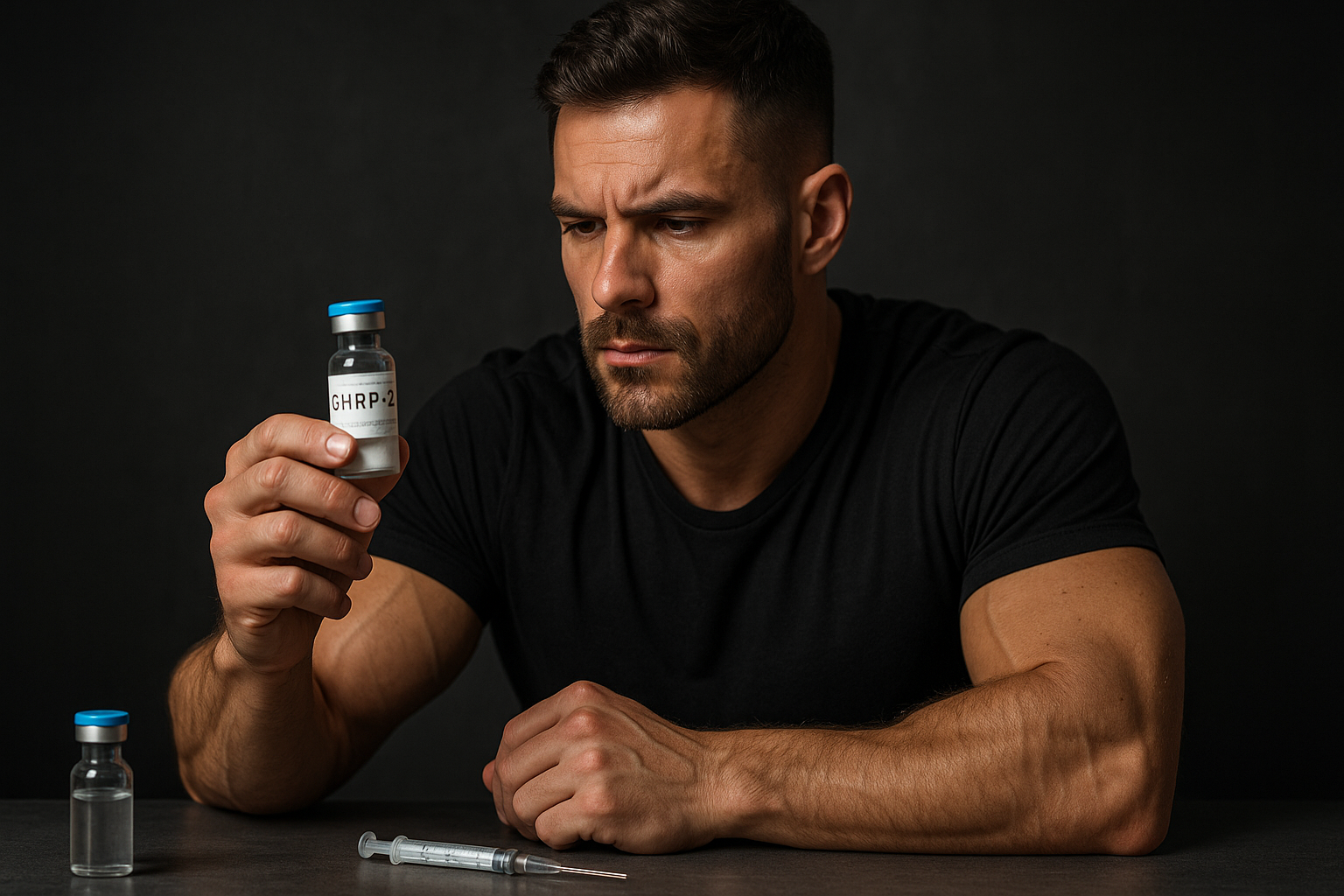
If you’ve searched what is ghrp 2 or typed ghrp-2 dosage per day, you’re probably trying to understand two things fast: (1) what GHRP-2 actually does in the body, and (2) whether the commonly shared “GHRP-2 before and after” stories are grounded in anything more than marketing and gym anecdotes.
GHRP-2 (often written ghrp-2 peptide) is a synthetic compound designed to interact with the ghrelin system—a pathway connected to growth hormone (GH) release. The catch: most consumer/bodybuilding claims go beyond what research cleanly supports, while ghrp 2 side effects (especially appetite-related changes and tolerability issues) are the area where “real world” reports are often most consistent.
Important: This article is educational only and not medical advice. GHRP-2 is not a generally approved treatment for most consumer uses. If you have endocrine/metabolic conditions, prior hormone-related issues, or you take medications, talk with a qualified healthcare professional first.
What is GHRP-2?
GHRP-2 stands for Growth Hormone Releasing Peptide-2. It’s commonly discussed in performance and bodybuilding circles because it’s classified as a GH secretagogue—meaning it can stimulate pathways that influence growth hormone release.
How it works (ghrelin agonist; GH secretagogue receptor concept)
Mechanistically, GHRP-2 is a synthetic agonist that acts through the ghrelin/GH secretagogue receptor concept. A useful scientific overview is provided by B. Laferrère’s review on PMC, which describes GHRP-2 as a synthetic agonist of ghrelin that binds to the growth hormone secretagogue receptor (GH-releasing pathway). You can read the source here: GHRP-2 is a synthetic agonist of ghrelin (research review).
In plain English: the ghrelin system is involved in appetite regulation and signaling that can affect GH release. That matters because it helps explain why people often talk about ghrp-2 peptide benefits in terms of body composition and recovery—while also reporting appetite and hunger-related effects.
What it’s used for (research context vs bodybuilding use)
In research and clinical contexts, GH secretagogues have been studied for their ability to influence growth hormone dynamics. In bodybuilding and fitness communities, GHRP-2 is most commonly used with goals like:
- supporting lean mass or muscle-building efforts
- potential improvements in training recovery
- indirect “metabolic” effects via hormones and nutrient partitioning
It’s crucial to separate what the mechanism suggests from what’s proven for healthy lifters. Many bodybuilding outcomes are plausible in theory, but not all are supported with strong, consistent human evidence in the same way you’d expect from an approved medical therapy.
GHRP-2 peptide benefits (what evidence supports)
When people search for ghrp-2 peptide benefits, they’re often looking for a list of “promises.” A more evidence-first approach is to identify what’s mechanistically reasonable and where the evidence is thinner.
Growth hormone (GH) release mechanism (tie to the cited research)
The strongest evidence-based angle for GHRP-2 is its role as a GH secretagogue within the ghrelin pathway. The PMC review described above frames GHRP-2’s activity through ghrelin receptor signaling and GH release dynamics. That’s the mechanistic foundation behind the “it increases GH” idea you’ll see everywhere online.
What this means practically: If a compound increases GH signaling in the short term, it may influence downstream processes related to tissue remodeling and recovery. However, translating that into dramatic physique changes in healthy people is where hype often outpaces evidence.
Body composition / performance claims: what’s plausible vs unproven
You’ll commonly see claims that the benefits of ghrp 2 include noticeable fat loss and muscle gain. Mechanistically, GH signaling can interact with metabolism, and GH-related signaling can influence how the body handles nutrients.
But here’s the evidence limitation: bodybuilding “before and after” transformations depend heavily on variables that GHRP-2 alone can’t control—diet, training intensity, total calories, protein intake, sleep, and time. In other words:
- Plausible: small or indirect support for training outcomes via hormone signaling
- Unproven (as an expectation): consistent, reliable “X pounds of muscle” or “Y% fat loss” results
If you’re evaluating ghr p-2 before and after posts, treat them as “possible outcomes,” not proof. Anecdotes can’t establish causality or safety.
Appetite/food intake considerations (based on the “ghrelin-like” mechanism)
Because GHRP-2 relates to the ghrelin system, one of the most discussion-heavy areas around ghrp 2 side effects is appetite. Many users report hunger changes or altered meal timing.
That matters because appetite changes can cut both ways:
- If your diet is already dialed in (enough protein, controlled calories), appetite shifts may be manageable.
- If your calories or macros aren’t consistent, appetite-driven eating can make fat loss harder—even if training is strong.
So rather than treating appetite as a “good” or “bad” effect, use it as a monitoring signal: if hunger changes cause you to miss your calorie/protein targets, your “before and after” results may reflect behavior changes as much as any hormone signaling.
GHRP-2 side effects and safety considerations
If you’re searching ghr p-2 side effects or specifically ghrp-2 side effects, you’re doing the right thing. GH secretagogues aren’t candy—risk depends on dose, purity, individual physiology, and health history.
Commonly discussed side effects (neutral, non-alarming wording)
Across community discussions and general GH secretagogue themes, the most commonly talked-about GHRP-2 side effects tend to include:
- Appetite changes (increased hunger or altered satiety)
- Transient discomfort (for example, mild nausea or stomach-related upset—varies by person)
- Fluid retention or “bloating feeling” (some report this as part of hormone-related changes)
- Headaches or feeling “off” (not universal; individual tolerance varies)
These are commonly discussed reports, not guaranteed experiences. Still, it’s exactly why “start low and monitor tolerance” comes up in harm-reduction conversations.
Who should be extra cautious (general safety note)
You should be especially cautious if you have any conditions involving hormones, glucose regulation, or metabolism, such as:
- diabetes or prediabetes
- insulin resistance
- endocrine disorders (thyroid issues, pituitary-related conditions, etc.)
- current use of medications that affect glucose, hormones, or appetite
Even if you feel healthy, endocrine changes can be unpredictable. Because GHRP-2 interacts with pathways tied to GH release and ghrelin signaling, a clinician’s input is important.
Red flags: when to stop and seek medical advice
Because we’re dealing with hormone-signaling compounds, there are some “don’t wait it out” symptoms to respect. Consider stopping use and seeking medical advice if you experience:
- severe or persistent headaches
- significant changes in vision
- fainting, chest pain, or severe shortness of breath
- rapid unexplained swelling or severe abdominal discomfort
- symptoms of high/unstable blood sugar (especially if you have risk factors)
If you do pursue any peptide use, keep records of dose timing, symptom timing, sleep, and meals so you can identify patterns quickly.
GHRP-2 dosage per day (how people approach it)
Searches like ghrp-2 dosage per day are common for a reason—but dosing is also where misinformation spreads fast. There isn’t one universal “correct” number for everyone, and you should avoid treating online dosing templates as medical prescriptions.
Why dosing guidance is variable (research vs real-world use)
Dosage variability happens because:
- Research doses may be designed for specific endpoints in controlled settings
- Real-world users may adjust dose based on subjective appetite response, tolerance, and training schedule
- Purity and concentration vary by sourcing
That’s also why two people can take “the same amount” on paper but end up with different systemic exposure.
Cycling/stacking: what’s commonly done (reported, not endorsed)
In bodybuilding communities, it’s common to see reports of cycling or stacking GHRP-2 with other peptides. However, stacking increases uncertainty (multiple variables, more side-effect potential, harder attribution).
From a risk-management perspective, if you change multiple variables at once—dose, timing, co-administered compounds—you also make it harder to spot ghrp 2 side effects early.
Risk management: start low, monitor tolerance
Without giving medical-style “dose instructions,” the practical safety framework most experienced, responsible users follow looks like this:
- Prioritize quality and accuracy (third-party testing; verify concentration and purity where possible).
- Start conservatively and reassess based on tolerance, appetite response, and overall wellbeing.
- Track symptoms and performance (energy, sleep quality, training output, GI comfort, appetite and cravings).
- Don’t ignore metabolic signals—especially if you notice unusual thirst, frequent urination, or persistent appetite surges.
If something feels “off,” treat that as data. Your goal is minimizing avoidable risk—not chasing a specific “schedule” at all costs.
What to expect: GHRP-2 before and after
“GHRP-2 before and after” is one of the highest-intent searches because people want reassurance. The most honest answer is: results vary widely, and photos don’t prove causality.
Why results vary (adherence, baseline, diet/training)
Even when two people both use GHRP-2, their outcomes can diverge due to:
- Baseline body fat and lean mass
- Diet consistency (calorie control, protein intake, fiber)
- Training program (progressive overload, intensity, recovery)
- Sleep and stress
- Appetite changes affecting adherence
So if your “after” results look modest—or if you gain fat unexpectedly—it doesn’t automatically mean the peptide “does nothing.” It may mean your appetite and calorie balance moved more than your training plan could compensate for.
How to interpret photos/results responsibly
When you see transformations, look for context:
- Was bodyweight trending up or down?
- Were macros and steps adjusted?
- How long was the timeline?
- Did they report side effects or appetite changes?
Best practice: treat “before and after” as a starting point for questions, not as evidence of what you’ll experience.
GHRP-2 reddit: what users report (anecdotes vs evidence)
Searching ghrp-2 reddit usually leads you to threads about appetite, injection experience, perceived recovery, and whether people “felt” growth hormone changes. That information can be useful for identifying patterns—but it’s still anecdotal.
Themes from community reports (summarize patterns)
Across common community discussion patterns (not as medical claims), you’ll often see:
- Appetite shifts are mentioned frequently—some like it for gaining, others dislike it during cut phases.
- Short-term “noticeability” varies: some feel changes quickly, others report minimal subjective effects.
- Tolerance matters: people discuss adjusting timing to reduce unpleasant sensations.
- Attribution problems: many report changes but can’t separate the peptide effect from diet/training changes.
Here’s the key takeaway: GHRP-2 reddit can help you anticipate “what people struggle with,” but it cannot confirm safety or efficacy for you personally.
Legality, regulation, and quality issues
Even if you’re focused on ghrp 2 peptide benefits, the real-world risk often starts before the first injection: quality and sourcing.
The importance of sourcing/quality testing (general statement)
Purity, concentration accuracy, and contamination risk can vary dramatically between suppliers. Because peptides are not universally regulated like approved pharmaceuticals in many jurisdictions, always consider:
- third-party testing availability
- clear documentation of concentration/lot details
- quality control processes and transparent labeling
When purity and accuracy aren’t guaranteed, your “real dose” may not match your expectation—making ghrp-2 side effects harder to predict.
Peptide regulatory reclassification (Forged Alpha internal link)
Regulatory rules around compounding and peptide sales can shift. If you want an up-to-date overview that may affect how products are obtained and labeled, read: Peptide Regulatory Reclassification 2026: What Changes for Compounding.
FAQ: GHRP-2 questions people actually ask
What is GHRP-2 used for?
In bodybuilding and fitness communities, people use GHRP-2 to potentially influence GH release and downstream outcomes like recovery and body composition. Research discussions focus on its role as a GH secretagogue through the ghrelin receptor pathway.
What are the most commonly reported GHRP-2 side effects?
Commonly discussed ghrp-2 side effects include appetite changes, possible GI discomfort, headaches, and occasional “bloat” sensations. Individual tolerance varies, and quality/sourcing affects risk.
What benefits of GHRP-2 are supported by research vs anecdotal reports?
Supported: the mechanism concept that GHRP-2 can stimulate the ghrelin/GH secretagogue pathway linked to GH release (see the PMC review). Anecdotal: dramatic “before and after” physique changes, specific fat-loss/muscle-gain outcomes, and reliable time-to-results claims.
What is the typical GHRP-2 dosage per day people use (and why does it vary)?
Because dosing guidance varies by source and because research vs real-world practices differ, there isn’t a single universal “correct” ghrp-2 dosage per day. People also adjust based on appetite response, tolerability, and perceived effects. This is exactly why starting conservatively and monitoring matters.
Does GHRP-2 increase appetite/food intake?
It can. Because it interacts with ghrelin-related signaling, appetite and hunger changes are one of the most frequently discussed experiences—though not everyone responds the same way.
What should I look for when interpreting GHRP-2 before and after results?
Look for timeline length, diet adherence (calories/macros), bodyweight trend, and whether side effects like appetite changes were discussed. Photos alone can’t confirm what caused the change.
Conclusion: a practical next step if you’re considering GHRP-2
If your goal is to evaluate what is ghrp 2 responsibly, anchor your expectations to the strongest evidence point: its GH secretagogue mechanism via the ghrelin receptor pathway. Then treat ghrp-2 peptide benefits and GHRP-2 before and after stories as variable and highly dependent on diet, training, and tolerance—especially because ghrp-2 side effects and appetite changes are common themes.
Next step: If you want broader context on peptides commonly discussed for performance and weight management (and how to separate evidence from marketing), start with Best Peptides for Muscle Growth in 2026: A Complete Guide for Men, then cross-check safety and quality considerations against the regulatory overview linked above.
Quick safety reminder: This is educational content, not medical advice. Consult a qualified healthcare professional—especially if you have metabolic/endocrine conditions or take medications.