
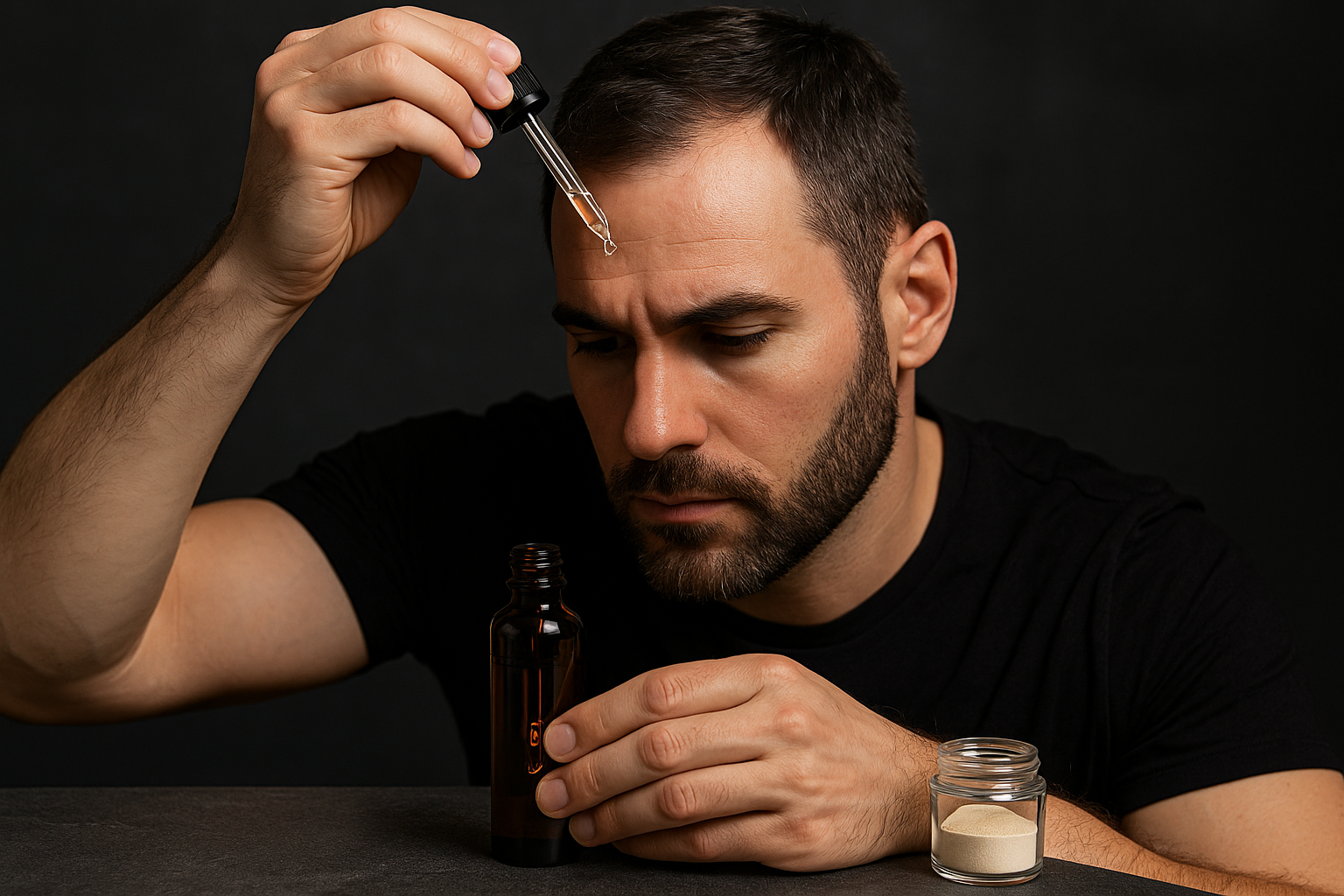
GHK copper (GHK-Cu / copper peptide) is one of the most searched peptide forms for ghk cu copper peptide for hair growth—especially in “serum” and “powder” formats. The common question is whether it can help with ghk cu copper peptide hair growth serum results and what people mean by ghk-cu 50mg copper peptide dosage.
Quick, evidence-first take: Research on GHK-Cu suggests it may have regenerative/protective effects in tissue models and may influence pathways related to stress responses and repair. But hair outcomes in humans vary, and dosing depends heavily on whether you’re using an oral product, a topical serum, or a powder—so it’s not as simple as “take 50 mg and grow hair.”
Important medical note (please read): This content is for informational purposes only and is not medical advice. Hair loss causes vary (and some are treatable), so consult a dermatologist/clinician before starting any peptide/supplement—especially if you’re pregnant/breastfeeding, have a chronic illness, take medications, or have copper metabolism concerns. If adverse effects occur (including what some people call “copper uglies”), discontinue use and seek medical advice.
What is GHK-Cu (GHK copper) and how does it work?
GHK-Cu basics (glycyl-histidyl-lysine + copper complex)
GHK-Cu is short for glycyl-histidyl-lysine (GHK) complexed with copper. In other words, it’s a small peptide bound to copper—often marketed as a “copper peptide.” For more background on the ingredient identity, see: Copper peptide GHK-Cu (definition/background).
In hair/scalp products, you’ll commonly see it described as a “bioactive” ingredient in serums, while supplement-oriented sellers may offer it as a ghk cu copper peptide powder or encapsulated form.
Key biological pathways discussed in the research (high-level)
One of the most cited peer-reviewed resources frames GHK-Cu as having regenerative and protective actions. The PMC article below summarizes findings from preclinical research and related molecular observations:
Regenerative and Protective Actions of the GHK-Cu Peptide in … (peer-reviewed research)
While this doesn’t translate into a guaranteed hair-growth outcome, the “how it might work” discussion generally includes:
- Cell stress and protective signaling: GHK with/without copper is reported to affect gene expression patterns related to stress responses.
- Tissue repair/rebuilding support: Research narratives often describe GHK-Cu as influencing pathways involved in maintenance and recovery processes.
- Copper-related biology: Copper participates in normal biological functions; pairing it with GHK is part of the marketed rationale.
Important distinction: That mechanistic framing supports “possible support,” not “proven treatment.” Hair loss has multiple drivers (androgen-mediated patterns, inflammatory scalp issues, nutrient deficiencies, telogen effluvium triggers, etc.). A copper peptide may not address the root cause for every person with ghk cu copper peptide for hair loss.
GHK-Cu for hair growth: what people use it for
Hair growth vs hair loss intent (what the terms commonly mean)
Search intent around ghk cu copper peptide for hair growth typically falls into two buckets:
- “Thickening” and regrowth support: People may be hoping to improve density, reduce shedding, or support a healthier-looking scalp environment.
- “Hair loss” recovery: People use “hair loss” terms when their pattern is progressing and they’re searching for anything that might help (including maintenance-focused regimens).
A practical way to think about it: many users want a scalp-support ingredient. But if your hair loss is androgenic, telogen effluvium, traction-related, autoimmune, etc., the best “next step” may be treating the underlying cause—then layering supportive products.
Topical serum vs oral/liposomal formats—how use differs
In SERP results, you’ll see lots of “hair growth serum” pages for topical products. That matters because dose, absorption, and side effects can differ between topical and oral use.
- Topical serum (including “hair & scalp serum”): You’re applying an active ingredient to the scalp. The goal is often local tolerance and direct exposure where hair follicles are.
- Oral supplements / capsules / tablets / “liposomal” claims: These rely on systemic absorption and metabolism. If you see “50mg,” it may refer to the amount of GHK-Cu in the serving—but that doesn’t automatically mean it’s equivalent to a topical concentration.
- Powders (often “GHK-Cu powder”): Users may dissolve, mix into carriers, or fill capsules. “mg” labeling can be confusing if you don’t know whether it’s a raw peptide weight, a complex weight, or a formulation-specific serving.
If your target query is ghk cu copper peptide hair growth serum, focus on label clarity for the topical version (concentration, application instructions, and compatibility with your scalp).
Dosage guidance (including “50mg” queries)
Interpreting “50mg” (what it typically means vs product label formats)
Searches like ghk cu 50mg copper peptide dosage are common because many listings show “50mg” as a headline number.
However, the number you’re seeing can mean different things depending on the product:
- Oral products: “50 mg” often refers to the amount of GHK-Cu per serving/capsule. That’s a systemic dose concept.
- Topical serums: “50 mg” might be listed as total content in a bottle, not “per day applied.” In other words, mg ≠ mg/day unless you know your application amount and product concentration.
- Powders: “50 mg” could refer to a recommended scoop amount for a user-made solution or capsule fill. Again, that assumes the label is consistent and the serving size is clear.
Bottom line: Don’t treat “50 mg” as a universal standard. Use it to compare products only within the same form factor (oral vs topical vs powder) and then follow label directions or clinician guidance.
How to choose a starting dose by form (powder/tablet/oral vs topical)
Because the SERP landscape is heavily product-led and light on dosing context, here’s a more responsible framework you can apply regardless of brand:
-
Start low and confirm tolerance (especially with copper-containing ingredients).
With topical products, this can mean using a smaller amount or applying less frequently at first. With oral products, this can mean using a reduced serving if the label allows or discussing with a clinician. -
Separate “total bottle content” from “daily applied dose.”
If you’re looking at a ghk cu copper peptide hair growth serum, find the concentration (or at least how the manufacturer instructs usage: number of pumps/ml per application, once vs twice daily, etc.). -
For ghk-cu copper peptide powder, clarify the mixing/capsule strategy.
If a powder is meant for suspension, you need to know the intended final concentration and how the manufacturer expects you to measure it. -
Be cautious about stacking copper sources.
If you also take a multivitamin, mineral supplement, or copper-containing product, you may increase total copper exposure. This is where clinician input becomes important.
If you want a deeper safety/dosing reference from Forged Alpha, you can cross-check here: GHK-Cu Peptide Side Effects: Safety, Dosage Chart.
Consistency, duration expectations, and when to reassess
Hair is slow-growing and shedding/regrowth timelines vary by cause. So for ghk-cu copper peptide for hair growth, a safer expectation is:
- Assess trends, not instant results. Look for gradual changes in scalp feel, shedding patterns, and density.
- Reassess after a reasonable trial. Don’t base your decision on a few days or a single wash.
- Stop if side effects appear. That includes irritation, unusual symptoms, or anything consistent with intolerance—especially if you encounter what people call “copper uglies.”
“Copper uglies” and other copper-peptide concerns (what to watch)
What “copper uglies” refers to (user-reported phenomenon; keep cautious)
“Copper uglies ghk-cu” is a phrase that shows up in forums and user discussions. It generally refers to a cluster of user-reported adverse-feeling experiences after starting copper-containing peptides.
What’s important: This is not a standardized medical term. People describe symptoms like fatigue, headaches, nausea, flushing/skin reactions, or “feeling off.” Those reports vary widely and are influenced by the person’s baseline health, product quality, dosing, and scalp/systemic tolerance.
So treat “copper uglies” as a warning flag label, not as a diagnosis.
When to avoid/stop and discuss with a clinician
Consider stopping and getting medical input if you experience:
- Persistent GI upset (especially with oral products)
- Unusual neurologic symptoms (severe headache, dizziness beyond mild irritation)
- Skin reactions beyond mild tingling (burning, hives, swelling)
- Any concern about copper balance (known copper metabolism disorders or prior clinician guidance restricting copper)
If you’re dealing with scalp inflammation or dermatitis, a topical peptide can also irritate. In that case, it may not be the right tool until your dermatologist addresses the inflammation.
Safety, side effects, and contraindications (important)
Copper-related cautions (general, non-alarming)
Because GHK-Cu contains a copper component, safety considerations revolve around copper tolerance and individual risk factors. In general, copper-related ingredients may be contraindicated for certain people, and total dietary/supplement copper can matter.
Practical safety steps:
- Don’t combine multiple copper-containing supplements without understanding total exposure.
- If you have a liver condition, kidney disease, or known mineral metabolism issues, ask a clinician before using.
- Use third-party testing where possible and follow label instructions exactly.
Red flags and medication interactions to consider
Peptides and supplements can interact indirectly by changing your supplement stack or by irritating sensitive skin. Red flags include:
- Symptoms that escalate quickly after each dose (suggests intolerance)
- Signs of allergic reaction (rash, facial swelling, difficulty breathing)
- Any condition where copper balance is medically monitored
Medication caution: We can’t list every possible interaction here. If you take prescriptions (especially for endocrine, skin, or mineral-related conditions), talk to a clinician/pharmacist before starting.
For a dedicated safety breakdown and dosing chart-style reference, see: GHK-Cu Peptide Side Effects: Safety, Dosage Chart.
How to evaluate products (serum/powder) without marketing hype
What to look for on labels (form, concentration, instructions)
When you search ghk cu copper peptide hair growth serum, you’ll see a lot of “hair growth” language. Your job is to reduce uncertainty by checking the basics:
- Form: Is it topical serum, oral capsule/tablet, or ghk cu copper peptide powder?
- Concentration clarity: Look for mg per serving (oral) or concentration per ml (topical). If the label only says “50mg” but doesn’t tell you application amount, interpret cautiously.
- Usage directions: How much to apply and how often? This connects “content mg” to “real-world daily exposure.”
- Other actives: Many serums bundle peptides with additional ingredients that may irritate your scalp (fragrance, alcohol, high-strength acids). Check for comedogenic or allergenic triggers if you have sensitive skin.
- Quality signals: Third-party testing, clear batch/lot info, and transparent sourcing.
Example of the “mg confusion” issue: A bottle might list “50mg GHK-Cu” total. If you use 1/4 of the bottle over two months, your daily effective exposure is far lower than someone assuming “50mg per day.”
Avoiding “too-good-to-be-true” claims
Be skeptical of claims like:
- “Clinically proven to regrow hair for everyone” (rarely substantiated)
- “Instant results in days” (hair biology doesn’t work that way)
- “No side effects ever” (not credible for copper-containing products)
If a product’s marketing doesn’t address dosing context, ingredient form, or safety, it’s likely optimized for conversion—not user outcomes.
Note on comparisons: You may see brand comparisons such as “neurogan ghk cu copper peptide hair & scalp serum.” Use those pages only to understand how different brands formulate GHK-Cu (e.g., concentration, vehicle, application method). Don’t treat brand mentions as evidence.
Bottom line: is GHK-Cu worth considering?
Best-fit use-cases (hair support + skin support framing)
GHK-Cu may be a reasonable supportive ingredient to consider if:
- You’re specifically exploring ghk cu copper peptide for hair growth as a scalp-support element (often topical).
- You can follow a cautious starting approach, monitor tolerance, and stop if you experience adverse effects.
- You understand that hair loss causes vary and you’re not relying on a peptide alone to fix a medical driver.
Also, the same research narratives include “protective” and “regenerative” themes that people often translate into skin-focused interest. But keep your expectations grounded: the strongest claim you can make is possible support, not guaranteed regeneration.
Decision checklist (safety first)
- Form match: Are you using a topical serum for the topical goal you have?
- Label clarity: Can you tell how much GHK-Cu you’re exposed to per day (not just total bottle content)?
- Copper caution: Do you have any condition or clinician guidance regarding copper?
- No stacking blindly: Are you combining copper sources or multiple active peptides without understanding total exposure?
- Tolerance monitoring: If you experience irritation or any “copper uglies ghk-cu” style symptoms, do you have a plan to stop and seek advice?
- Hair-loss context: Have you ruled out common causes (and/or consulted a dermatologist) so you’re not ignoring a fixable root problem?
FAQ about GHK-Cu copper peptide (hair growth serum, powder, and dosing)
1. What is GHK-Cu copper peptide and what does “GHK copper” mean?
GHK-Cu is a peptide sequence (glycyl-histidyl-lysine, “GHK”) complexed with copper (“Cu”). It’s marketed as a copper peptide used in topical serums and sometimes in oral or powder formats. Background: Copper peptide GHK-Cu (definition/background).
2. How should I interpret “GHK-Cu 50mg dosage” on supplement labels?
3. Does GHK-Cu copper peptide work better as a hair growth serum (topical) or as an oral supplement?
There isn’t a one-size-fits-all “better” option. Topical use targets the scalp environment, while oral use affects systemic exposure. The right choice depends on your product form, tolerance, and hair-loss cause. If your intent is specifically ghk cu copper peptide for hair growth serum, start by selecting a topical product with clear concentration and directions.
4. What are potential side effects or safety concerns with GHK-Cu copper peptide?
Potential concerns are related to copper-containing ingredients and individual intolerance. Skin irritation can happen with topical products, and GI or systemic symptoms can occur with oral products. If you experience persistent symptoms (including what people call “copper uglies ghk-cu”), stop and consult a clinician.
5. What does “copper uglies GHK-Cu” refer to and how should I respond if I experience issues?
It’s a user-reported phrase for feeling unwell after starting copper-peptide products. Because it isn’t a formal medical diagnosis, treat it as a tolerance warning: discontinue the product, monitor symptom resolution, and seek medical advice—especially if symptoms are severe or recur.
6. What should I look for when buying GHK-Cu copper peptide powder or hair & scalp serums?
Look for (1) clear dosing instructions, (2) transparent concentration per application/serving, (3) product form clarity (topical vs oral vs powder), and (4) quality signals like third-party testing and batch/lot transparency. Avoid products that make extreme claims without safety or dosing context.
Conclusion / next step: If you’re exploring ghk cu copper peptide hair growth serum, your best next move is to (1) confirm the label’s form and real daily exposure (not just “50mg” headlines), (2) start with a tolerance-first approach, and (3) prioritize a dermatologist-guided plan for the underlying cause of your hair loss. For additional safety/dosing context, review GHK-Cu Peptide Side Effects: Safety, Dosage Chart.