
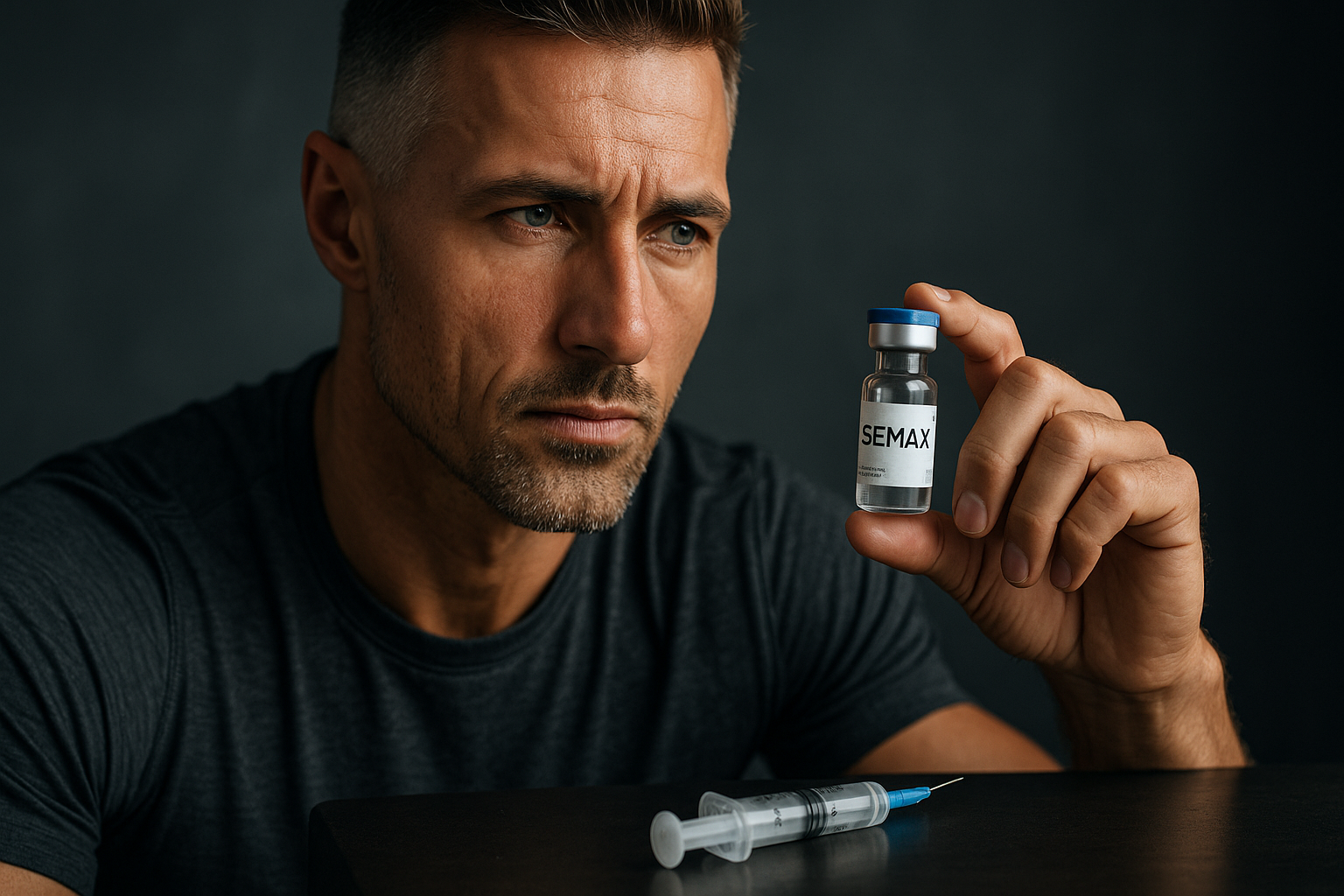
If you’re searching for “what is semax peptide used for”, you’re probably seeing it discussed as a neuro-focused peptide—often alongside keywords like cognition, attention, and neuroprotection. Semax is a synthetic peptide that’s primarily discussed in neurological/cognitive contexts, with some research pointing to effects on gene expression and cellular stress pathways. However, dosing, purity, and administration route can meaningfully change risk—and “what people do” online (including Reddit threads) is not the same as what’s proven clinically.
In this guide, we’ll break down what Semax is, what the research suggests it does, what it’s used for (and how that’s discussed clinically), why Semax half life and Semax peptide dosing questions come up, and how to interpret Semax vs Selank comparisons—without mixing anecdotes with evidence. We’ll also cover n-acetyl semax amidate so you don’t get pulled into confusing variant claims.
Quick note: This article is educational and not a prescription. Do not use it to self-administer any peptide. Semax is a medication/peptide discussed for neurological purposes; consult a qualified healthcare professional—especially if you’re pregnant/breastfeeding, have neurological conditions, or take other medications.
What is Semax?
What the peptide is (heptapeptide; ACTH-derivative context)
Semax is commonly described as a heptapeptide and an ACTH-derivative (an ACTH-related peptide design). It’s mentioned in the literature as a synthetic compound explored for effects on the nervous system.
For background reading, see: Semax overview (heptapeptide medication; background).
How Semax is commonly administered (high-level overview of formats discussed online)
Online discussions often mention different administration approaches, most notably:
- Nasal formats (frequently discussed for convenience)
- Injectable formats (discussed, but with added sterility/safety considerations)
Important: Technique and product quality matter. Route-specific risks (for example, sterility concerns with injections, local irritation with intranasal approaches, and variability across sources) are real. If you’re considering Semax, you should discuss safety and supervision with a clinician or pharmacist.
What does Semax peptide do? (evidence-based overview)
Neuroprotective and gene-expression-related findings (cite PMC)
When people ask “what does semax peptide do”, the most defensible angle is its biological plausibility around neuroprotection and cellular stress responses. A frequently cited review-style paper discusses how Semax can affect the expression of genes involved in survival pathways and how it has been studied in models relevant to neuronal injury.
See the external source here: peer-reviewed findings on Semax gene expression and neuroprotective effects.
How to interpret this responsibly:
- Research often shows potential neuroprotective effects in preclinical models (not instant proof of human outcomes).
- Mechanisms discussed include changes in gene expression related to neuron survival and responses to stressors.
- “Neuroprotection” does not automatically mean “it improves memory for everyone.” Human results can differ.
Potential effects: cognition/learning/attention (summarize what sources claim without overstating)
Because Semax is frequently marketed or discussed as a “cognitive” or “nootropic-adjacent” peptide, you may see claims about:
- Learning or memory support
- Attention and reduced mental “fog”
- General brain resilience under stress
Here’s the key: these themes usually come from a mix of mechanistic rationale, preclinical work, and limited human evidence depending on the product and study design. If you’re evaluating Semax for cognition, it’s safer to think in terms of “what research suggests is possible” rather than guaranteed benefits.
What is Semax used for?
Conditions where it’s used/considered (used in Eastern Europe / discussed clinically)
For the query “what is semax peptide used for”, you’ll notice it’s commonly referenced as being used or explored for neurological indications—most often framed around:
- Neurological conditions
- Brain-related recovery or functional support
- Cognitive function themes
Some publicly available references note its context as a medication with usage/discussion in specific regions (including Eastern Europe), which is a reason it appears in broader online “nootropic” conversations. See: Semax overview (heptapeptide medication; background) for general context.
Important: “Used for” online can mean “discussed clinically” or “available through certain channels,” not necessarily what’s approved and standardized everywhere. Always check local regulations and clinical guidance.
Who should be cautious (general risk categories; no personal medical advice)
Peptides are not vitamins. Semax should be approached cautiously if you fall into any of these groups:
- Pregnant or breastfeeding (insufficient safety data)
- History of adverse reactions to peptides/biologics
- Neurological conditions where changes to neuronal pathways could matter
- Use of other medications (especially if they affect the nervous system)
- Bleeding disorders or complex medical histories (ask your clinician)
If you want a responsible framework for evaluating peptide-related claims and safety variability, you can also compare how other peptides are discussed on Forged Alpha (for example, dosing and safety framing in similar categories): peptide side effects and dosing chart approach.
Semax vs Selank (what’s different)
Similarities people compare (nootropics/stress/cognition themes)
Searches like “semax vs selank reddit” and “semax selank reddit” suggest that people often compare both in a broader “brain performance” context.
Common overlap in how users discuss them:
- Stress and nervous system “tone”
- Cognition and mental clarity themes
- “Nootropic-style” self-experimentation
It’s reasonable that people compare them, because many nootropic communities cluster peptides around similar lived outcomes (calm, focus, motivation). But similarities in user goals don’t guarantee similarity in mechanisms, evidence quality, or safety profiles.
Why “Semax vs Selank” discussions on Reddit don’t equal clinical evidence
Reddit threads are anecdotal. That means they may be useful for spotting patterns (like “people report X at Y dose”), but they do not establish:
- correct dosing
- consistent purity/strength
- route-specific safety
- causality (placebo and expectation effects are real)
- long-term outcomes
Evidence vs Anecdote (match your expectations to reality):
- Evidence = peer-reviewed mechanisms, study design, measurable endpoints, and limitations clearly stated.
- Anecdote = personal experiences that vary widely and can be influenced by dosing differences, product quality, and prior sleep/stress/stacking variables.
If your goal is to learn what Semax is used for and what it might do, anchor your understanding in mechanisms and study summaries (like the PMC research link above), not only community posts.
Semax dosing, dosing schedules, and half-life (how to think about it safely)
Semax peptide dosing discussions (what to look for; key variables)
Search intent for “semax peptide dosing” and “semax peptide dosage chart” is usually “how much, how often, and what timeline.” The hard truth is that peptide dosing is not always standardized across sources, and online “charts” can reflect:
- Different product strengths (units, concentration, and labeling accuracy)
- Different formulations (salt forms, buffers, excipients)
- Different administration routes (nasal vs injectable)
- Stacking practices (people combine peptides and other nootropics)
- Different study assumptions (what a trial used vs what a clinic “does”)
Because of these variables, the safest way to use dosing information is to treat it as discussion points, not a protocol. If you’re comparing what you find online, ask:
- Does the source clearly state route and formulation?
- Does it cite study context or clinical supervision?
- Is safety data included (side effects, contraindications, monitoring)?
- Is the product verified for purity?
To see how Forged Alpha approaches dosing/safety framing in other peptides (without hype), explore: peptide dosing protocols and safety considerations.
Semax half life: what the concept means and why it varies
People also search for “semax half life” and “dosage chart” style content together, because half-life helps them estimate duration.
Here’s what “half-life” means in practical terms: it’s the time it takes for the amount of a substance in the body to reduce by about half (as measured under specific conditions). In peptides, “half-life” can vary based on:
- Route of administration (nasal vs injectable)
- Formulation and excipients
- Measurement method (assay type, sampling window)
- Individual biology (metabolism, clearance, health status)
Why you may see conflicting numbers online: not all sources use the same experimental model or reporting standards. Some discussions may generalize from limited data or use estimates.
Practical takeaway: treat half-life as a conceptual guide—not a guarantee of effect duration. If you see dosing schedules tied tightly to a single “half-life” number, verify the source methodology or ask a clinician what evidence applies to your situation.
N-acetyl Semax amidate (and why it appears in searches)
What the variant is in plain terms
You may see “n-acetyl semax amidate”, “n-acetyl-semax amidate”, or related searches like “na semax reddit” and “na-semax reddit”. The “n-acetyl” and “amidate” labels indicate a specific chemical variant (a different form/structure compared with standard Semax).
Why this matters: changes in structure can affect stability, breakdown, absorption, and potentially the biological activity profile. That means you should be cautious when people discuss “Semax dosing” and apply it to “amidate” forms.
Separate “Semax” from “amidate” in claims to avoid confusion
A common SERP issue is conflation: people mix “Semax” and “n-acetyl Semax amidate” as if they’re interchangeable. They’re not guaranteed to be.
Rule of thumb for consumers: if a source doesn’t clearly state which variant is being discussed (Semax vs n-acetyl Semax amidate), treat the information as uncertain. Evidence and dosing discussions may not transfer across forms.
For additional credibility around Semax as an ACTH-derivative heptapeptide, this research/overview PDF is often used in scientific contexts: Semax is a heptapeptide derivative of ACTH (research PDF).
Evidence vs Anecdote: a dedicated guide for Semax vs Selank and dosing Reddit threads
Because multiple high-volume searches include Reddit (for example, “semax vs selank reddit”, “sem ax and selank reddit”, and “reddit semax”), it helps to have a mental checklist. Use this to separate signals from noise.
- Look for repeated patterns across many users (e.g., “many report nasal irritation” is a safety signal; still not proof, but more credible than one-off stories).
- Check for route + formulation (people frequently omit these, which makes dosing comparisons unreliable).
- Ignore exact “dosage charts” unless they are tied to evidence or clinical supervision.
- Watch for stacked protocols (users may combine Semax with other peptides/nootropics, blurring causality).
- Prioritize mechanism-backed claims when possible (gene expression, neuroprotective stress pathways—supported in peer-reviewed sources).
When you align expectations with evidence quality, you reduce the risk of overinterpreting variability—especially for questions like “what does semax peptide do” and “what is semax used for.”
Practical takeaways and next steps
If you’re considering Semax: questions to ask a clinician/pharmacist
If you plan to discuss Semax with a qualified professional, bring the following:
- Which variant? Semax vs n-acetyl semax amidate
- Which route? nasal vs injectable (and why)
- What evidence base? Ask what human data exists for the specific intent you care about (cognition, neuroprotection, etc.)
- What monitoring? Ask what side effects to watch and whether any labs or follow-up are appropriate
- Drug interactions based on your current medication list
It also helps to compare how other peptides are approached on Forged Alpha from a safety lens—e.g., timing and practical peptide safety considerations.
Red flags (unverified sources, unclear dosing, missing safety info)
Be extra skeptical if you see any of the following:
- No mention of route or product strength/concentration
- Guaranteed outcomes (“100% increases cognition”)
- Exact dosing protocols presented as universal and safe
- Confusing variant swaps (Semax vs amidate treated as identical)
- Evidence-free “half-life” numbers used to justify schedules
Safety disclaimer (please read): Semax is a medication/peptide discussed for neurological/cognitive purposes. Dosing, purity, and administration route can materially affect risk. This article does not provide a prescriptive dosing protocol for self-administration. Consult a qualified healthcare professional before use—especially if you’re pregnant/breastfeeding, have neurological conditions, take concurrent medications, or have a history of adverse reactions. Online sources (including Reddit) are anecdotal and not a substitute for clinical guidance. If discussing nasal vs injectable routes, sterility, technique, and product quality should be clinician-supervised.
FAQ
What is Semax peptide used for?
Semax is discussed in neurological/cognitive contexts and is often framed around neuroprotection and brain-related functional support. Its usage context is described in public references as a heptapeptide medication, with the specifics depending on region and clinical protocols.
What does Semax peptide do in the body?
Research discussions commonly point to Semax affecting gene expression related to neuron survival and stress responses, with preclinical work exploring neuroprotective effects. The exact outcomes in humans can vary and aren’t guaranteed.
What is Semax half life?
“Half-life” refers to the time required for the body level of a substance to drop by half under specific measurement conditions. For peptides, reported half-life can vary with route, formulation, and study methods—so online numbers may not translate cleanly to your situation.
How should Semax peptide dosing be approached safely?
Dosing should be treated as a clinician-supervised decision. Look for clear information about the specific variant (Semax vs n-acetyl semax amidate), administration route, product concentration/quality, and any safety/monitoring plan. Avoid adopting “dosage chart” protocols from unverified sources.
How does Semax compare to Selank?
People compare them because both are discussed in nootropic/stress/cognition communities. However, that doesn’t mean they have identical mechanisms or evidence quality. Reddit comparisons are anecdotal; evidence should be evaluated separately for each compound.
What is n-acetyl Semax amidate, and how is it different from Semax?
n-acetyl semax amidate refers to a chemical variant of Semax with additional structural modifications (“n-acetyl” and “amidate”). It may differ in stability, breakdown, or activity profile. Don’t assume dosing or outcomes transfer directly between variants.
Conclusion: what to do next
If your goal is to understand what is semax peptide used for, the strongest approach is to anchor your expectations in mechanism-oriented evidence (like gene expression/neuroprotection discussions) and treat online dosing/half-life “charts” as unstandardized. Next step: decide which variant and route you’re actually researching (Semax vs n-acetyl semax amidate, nasal vs injectable), then bring your questions to a qualified clinician and request a safety/monitoring plan.
If you want to broaden your peptide literacy using the same evidence-versus-anecdote framework, explore Forged Alpha guides like SS-31 Peptide Dosage Protocol: Evidence, Safety Side Effects and GHK-Cu Peptide Side Effects: Safety, Dosage Chart WADA.