
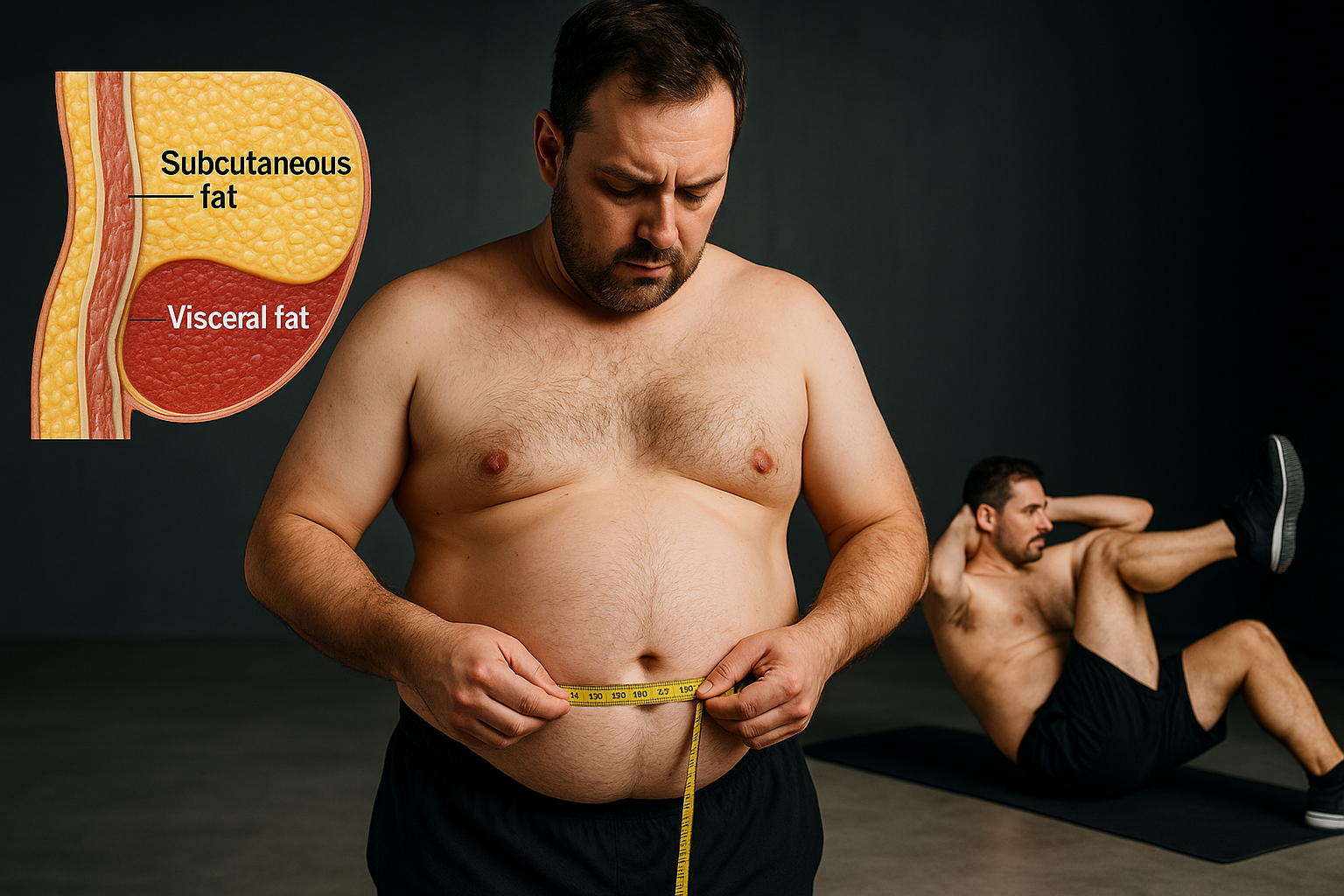
“Why do men get belly fat?” is usually not a single reason—it’s a mix of physiology, daily habits, and age-related changes that lead to fat accumulating around the abdomen. The key is that not all belly fat is the same: some is more metabolically risky (often deeper/visceral), and that affects what “works” for you.
In this guide, you’ll learn the types of belly fat men, how to measure your risk with a waist check, and then follow a practical low belly fat workout for men (with lower belly fat exercises men can actually do). You’ll also get realistic expectations—because you can’t spot-reduce fat from your lower abdomen.
What belly fat in men actually is (types + health risk)
When people say they have “belly fat,” they usually mean one (or both) of two different fat compartments. The distribution matters for health risk and for how your workouts translate into results.
Types of belly fat men: visceral vs subcutaneous
- Visceral fat: Stored deeper in the abdomen, closer to internal organs. This type is more strongly associated with metabolic risk (think: insulin resistance and higher cardiometabolic risk).
- Subcutaneous belly fat: Stored under the skin. It can still affect appearance and comfort, but it’s generally less metabolically risky than visceral fat.
So when you’re asking “what causes belly fat in men,” remember this: you’re not just trying to make your waist look smaller—you’re trying to reduce the overall fat burden (and especially the more risky type, when it’s present).
How to tell if your belly fat is more risky (waist measurement reference)
You usually can’t directly measure visceral fat at home, but a waist measurement is a useful screening tool. According to the Mayo Clinic, for men, a waist measurement of more than 40 inches (102 cm) signals an unhealthy amount of belly fat and a higher risk of health problems.
How to measure (simple and consistent):
- Stand upright and relax your abdomen.
- Measure around your waist at about level with your navel (or the highest point of your waist).
- Take the measurement at the end of a normal breath.
- Record it and repeat 1–2 times per week (same time of day) to track trends.
If your waist is above a high-risk threshold, or it’s steadily increasing despite “trying,” that’s your cue to focus on an evidence-based fat-loss plan and consider discussing options with a clinician.
Why do men get belly fat? Common causes
When searching “why do men get belly fat,” most people are looking for the root cause—especially if the scale isn’t exploding or if fat seems to “collect” only in the abdomen. Here are the most common drivers.
What causes belly fat in men: energy balance, activity, and aging
The most fundamental cause of fat gain is chronically positive energy balance (more calories in than out). But in real life, men often notice belly fat increasing for reasons that change the balance without dramatically changing eating habits.
- Lower daily movement: Less walking, fewer steps, more sitting.
- Loss of muscle with age: Lower muscle mass can reduce metabolic rate, making it easier to store fat.
- Training that doesn’t support fat loss: Some men do lots of “sweaty” workouts but don’t create a consistent calorie deficit or fail to build/maintain strength.
- Smaller appetite control: Portions, calorie density, and late-night intake can quietly increase total calories.
As visceral fat accumulates, it can contribute to worse metabolic signaling. Research summarized by the NIH (PMC) highlights how abdominal visceral fat accumulation is linked with metabolic issues—so it’s worth treating as more than a cosmetic problem.
Reasons for belly fat in men: diet patterns, alcohol, sleep, stress
If you’re trying to figure out what causes fat belly in men, these lifestyle factors are frequent culprits:
- High-calorie eating patterns: Frequent restaurant meals, sugary drinks, snacks, and “liquid calories.”
- Alcohol: Can increase overall calorie intake and may impair fat oxidation and recovery.
- Poor sleep: Short sleep can worsen hunger hormones and reduce self-control around food.
- Chronic stress: Stress can increase cravings and lead to more snacking and less consistent training.
- Inconsistent protein and fiber: Lower satiety makes it harder to stay in a deficit.
You don’t need perfection—just steady improvements you can repeat.
Hormone/metabolic factors that can contribute (high-level)
Hormones can contribute to why men store fat in the abdomen, but the details vary. In general terms, changes in metabolic hormones and insulin sensitivity with age and lifestyle can make abdominal fat more likely.
If you suspect hormones are a major factor—especially if weight changes are rapid or accompanied by symptoms—get a clinician assessment rather than guessing. If you’re interested in the hormone angle, Forged Alpha also covers related context in estrogen and weight gain (high vs low estrogen, HRT considerations, and what to do next).
Can you target lower belly fat with workouts? (realistic expectations)
Let’s address the main expectation gap: most men want a lower belly solution. The biology doesn’t fully cooperate.
Spot reduction: what’s possible vs what isn’t
You can’t spot-reduce fat from one specific area (like the lower abdomen). Fat loss happens systemically when your body uses stored energy, and fat distribution is influenced by genetics, hormones, and fat-cell behavior.
What workouts can do:
- Build and condition the core so your midsection looks firmer.
- Improve posture and bracing, which can change how your lower belly “sits.”
- Support fat loss by increasing total training quality and improving body composition over time.
What to focus on instead (overall fat loss + core training)
To get a “lower belly fat” look, your best strategy is:
- Overall fat loss (waist reduction is the metric).
- Lower belly fat exercises men can use to strengthen the core and improve bracing.
- Consistency over intensity spikes.
That’s why this article gives you a plan that combines whole-body fat-loss support with lower belly fat workout for men sessions that are realistic and form-focused.
Low belly fat workout for men (beginner-friendly plan)
Below is a 20–30 minute circuit you can do 2–3x per week. The goal is to strengthen your trunk, train the abs through controlled movement, and support overall conditioning. It’s not magic—and it’s not spot reduction—but it’s a solid way to build your “core work” foundation while you work on fat loss.
How to use this (quick workflow):
1) Measure your waist weekly.
2) Run this plan for 4 weeks.
3) Progress reps/sets and keep recovery reasonable.
4) Re-check waist trend—adjust calories/activity if needed.
Lower belly fat workout for men (20–30 min): circuit format
Warm-up (4–6 minutes):
- Brisk walk or marching in place: 2 minutes
- Dead bug (slow): 6 reps/side
- Glute bridge: 10 reps
- Side plank (knees or full): 20–30 seconds/side
Circuit (2–4 rounds): Rest as needed to keep quality. Aim to finish within 20–30 minutes.
- Hollow body hold or “dead bug” (focus: bracing) — 20–40 seconds
- Hanging knee raises or captain’s chair knee raises (knees up with control) — 8–12 reps
- Reverse crunch (posterior pelvic tilt; don’t yank) — 10–15 reps
- Pallof press (anti-rotation for trunk stability) — 10 reps/side
- Farmer carry (tight abs, tall posture) — 30–60 seconds
- Mountain climbers (slow/control) — 20–30 seconds
Cool down (1–2 minutes): gentle hip flexor stretch + slow diaphragmatic breathing (focus on relaxing the ribs and belly after bracing).
Lower belly fat exercises men: recommended movements (non-magic, form-focused)
These movements are common lower belly fat exercises men use because they train the trunk through positions that help you control pelvic tilt and rib position—important for making your core work feel “targeted” even though fat loss is not localized.
- Reverse crunch: emphasizes tilting the pelvis instead of just flexing your spine.
- Knee raises: keeps tension on the abs while controlling momentum.
- Pallof press: strengthens anti-rotation (often a weak link for men’s posture and bracing).
- Farmer carry: trains “brace under load.”
- Dead bug / hollow variations: builds core control without straining your back.
Form cues that matter:
- Keep ribs “down” (don’t flare your chest).
- Move slowly enough that your abs—not momentum—do the work.
- If your lower back takes over, scale the movement (shorter range, slower tempo, or easier variation).
Lower belly fat workout progression (weeks 1–4)
Use this progression to keep your lower belly fat workout men plan improving without burning out.
How to progress reps/sets and manage recovery
Week 1: 2 rounds of the circuit. Stop 1–2 reps before form breaks.
Week 2: 3 rounds OR add 1–2 reps to the reps-based moves (keep holds the same time).
Week 3: 3–4 rounds. Add tempo: 2 seconds on the way out, 2 seconds on the way back (where it fits).
Week 4: keep the same round count, but aim for cleaner bracing and consistent breathing. If you feel beat up, repeat Week 3.
Recovery rule: If your core soreness is sharp or lasts longer than ~48–72 hours, reduce rounds by 1 next session or use easier variations.
Common form mistakes and how to fix them
- “Lower belly burning” but back pain: You’re probably arching or rushing. Slow down and reduce range.
- Knee raises with swinging: Use a smaller range and pause at the top for 1 second.
- Reverse crunch turning into hip flexor work: Focus on tilting the pelvis; keep upper back stable.
- Pallof press wobbling: Slow down, tighten glutes, and keep ribs stacked over pelvis.
- Mountain climbers too fast: Do controlled reps instead of sprinting.
If you want a simple “check,” ask: Can I keep my lower back quiet while my abs stay engaged? If yes, you’re progressing in the right direction.
When to get medical help / red flags
Belly fat reduction efforts should not replace professional medical advice—especially if you have symptoms, known metabolic disease, or you’re considering medications/peptides.
Get medical help sooner if:
- Your waist is persistently high (use the Mayo Clinic 40-inch/102 cm reference as a screening guide).
- You have symptoms like unexplained fatigue, frequent urination, excessive thirst, or shortness of breath.
- You have a sudden or rapid increase in belly size.
- You have a history of diabetes, fatty liver, sleep apnea, or cardiovascular disease risk.
If you’re considering medication options, talk with a clinician about risks and eligibility. For example, Forged Alpha provides additional context on weight-management medications like semaglutide and weight management and on longer-term considerations such as tirzepatide side effects.
Medication note: This is not medical advice; discuss with a clinician. Risks/side effects vary by individual.
FAQ
What causes belly fat in men most commonly?
The most common drivers are an imbalance between calories consumed and calories burned, reduced daily activity (sitting), age-related muscle loss, and lifestyle factors such as diet patterns, alcohol, poor sleep, and stress.
Are there different types of belly fat men (visceral vs subcutaneous)?
Yes. Visceral fat sits deeper in the abdomen near organs and is generally more associated with metabolic risk. Subcutaneous fat lies under the skin and is typically less risky than visceral fat.
What causes fat belly in men if I’m not gaining weight elsewhere?
Even without major scale changes, waist gain can happen due to fat distribution shifts, reduced activity, posture changes, increased stress/sleep disruption, and changes in insulin sensitivity with age. Waist measurement trend is often more informative than weight alone.
Is there a low belly fat workout for men that actually works?
A workout can’t spot-reduce fat, but a low belly fat workout for men can help you lose overall body fat and strengthen the core for better bracing and appearance. The plan above supports both—fat-loss context plus targeted core training.
What are the best lower belly fat exercises men can do?
Effective options include reverse crunches, knee raises (controlled), Pallof presses, and dead bug/hollow variations. Pair them with carries or conditioning for overall results.
How do I know if my belly fat is more visceral than subcutaneous?
You can’t perfectly separate types at home, but a waist measurement is a practical screening tool. If your waist is high (for men, Mayo Clinic references >40 inches/102 cm), your risk of visceral-related metabolic issues may be higher.
Conclusion: your next step
If you want answers to “why do men get belly fat,” start with the facts: types of belly fat men (visceral vs subcutaneous) differ in risk, and you can’t spot-reduce lower belly fat with exercises alone. But you can reduce waist size by combining overall fat-loss habits with a consistent low belly fat workout for men plan that trains the core through controlled, form-first movements.
Next step: Measure your waist today, then run the 4-week circuit progression above 2–3x/week. Re-check your waist each week—adjust food intake and daily activity if the trend isn’t moving.