
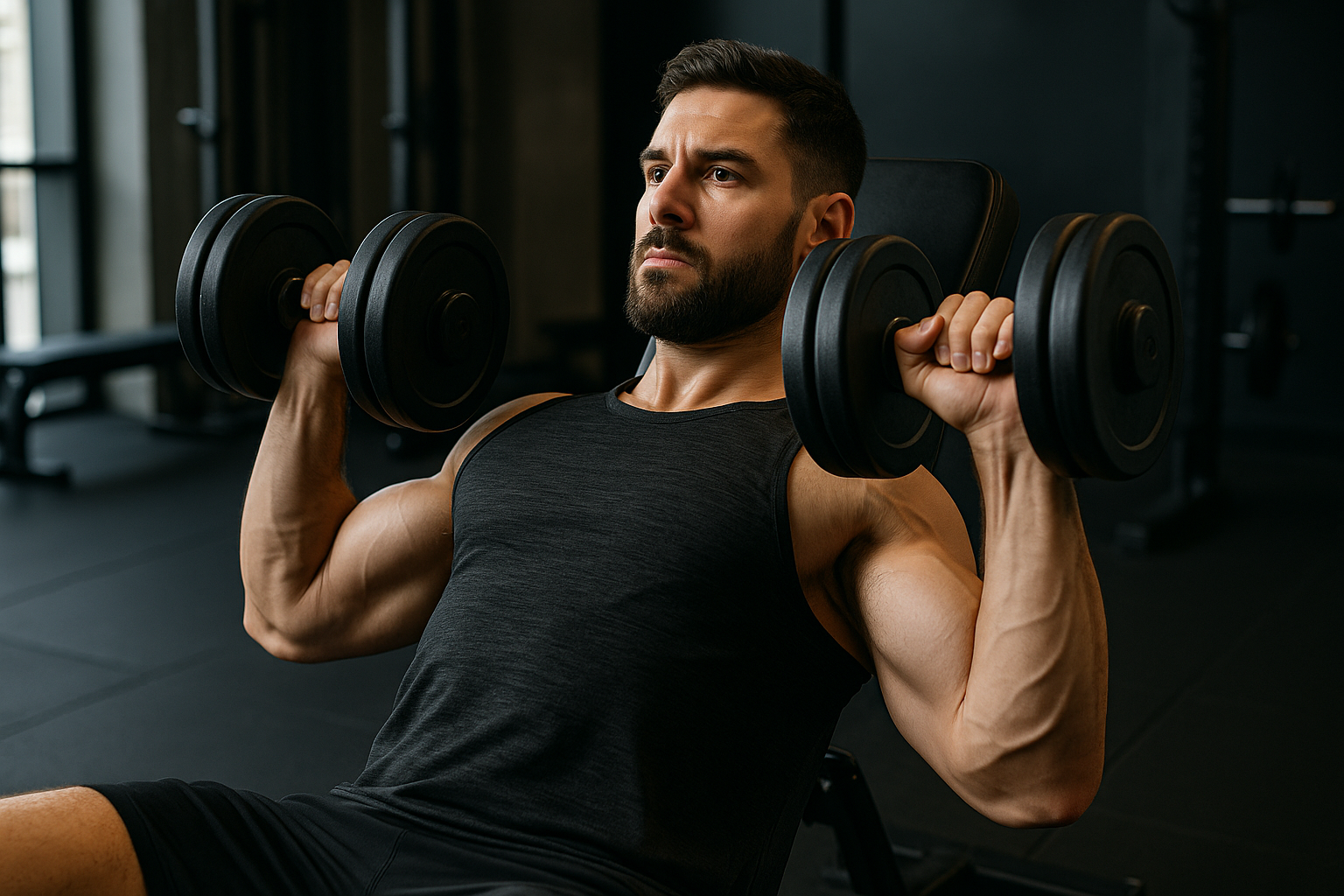
You came here for a dumbbell workout you can actually run at home—no machines, no guessing, and no vague “do this for 5 sets.” Below you’ll get a complete dumbbell workout builder: two time-capped upper-body sessions (15 and 20 minutes), a lower-body plan built around hinge + squat patterns, and a simple progression system (reps → weight → swap) so you keep making gains.
Quick safety note: Stop if you feel sharp pain. If you have a pre-existing injury (shoulder, back, knee) consult a qualified healthcare professional or qualified trainer before performing these exercises. Use controlled reps; dumbbells increase instability, so form beats weight.
Dumbbell Workout Overview (What you can train + how to set it up)
A well-built dumbbell workout can train everything: chest (pressing), back (rows/hinge-supported work), shoulders (lateral delts + rear delts), arms (curls/presses), and legs (goblet/squat pattern + dumbbell rdl workout for the posterior chain and hamstrings).
How to choose weight, reps, and rest (beginner-friendly)
- Pick a “hard but clean” weight: Your last 1–2 reps of a set should feel challenging with perfect form.
- Use reps that fit the goal:
- Hypertrophy: 8–12 reps
- Strength/overload: 5–8 reps (use fewer reps, slightly heavier)
- Technique/shoulders: 10–15 reps for laterals and rear delts
- Rest times: 45–75 seconds for most sets. For hinge patterns (like RDLs), rest closer to 75–90 seconds.
- Tempo: 2 seconds down, controlled pause if needed, then press/pull up.
Dumbbell-only training rules (range of motion + control)
- Full, repeatable ROM: Use the same depth/position each session so progression is real.
- Lock in your “tension points”: Pause briefly where you feel the target muscle working (bottom of a row, stretched position on press, bottom of a lateral raise, etc.).
- Stability matters: Keep ribs down on pressing and brace during rows/RDLs. Dumbbells let you train with a slightly different path—don’t compensate with momentum.
- Shoulder safety: For pressing, don’t flare excessively; keep scapulae controlled (think “set the shoulder blades” first).
20-Minute Upper Body Dumbbell Workout (No machine required)
This is your go-to 20 minute upper body dumbbell workout when you want muscle stimulus without spending half your day in the gym. It pairs efficient supersets with the exact dumbbell angles that matter: incline dumbbell press chest workout, row pattern work for back, plus a dedicated rear delt dumbbell workout and a brachialis-focused arm block.
Warm-up (3–5 minutes): 1–2 easy sets each of: incline/flat dumbbell press (light), one-arm row (light), and 10 slow bodyweight scap push-ups or band pull-aparts if you have them.
Chest + shoulders: incline dumbbell press chest workout + lateral raises
- Super Set A (work 2 rounds):
- Incline Dumbbell Press (incline dumbbell press chest workout) — 8–12 reps
- Dumbbell Lateral Raise Workout (slight forward lean, soft elbows) — 12–20 reps
Form cues: On incline press, track dumbbells toward mid-chest; stop just before shoulders roll forward. For laterals, lift out and up with control—no shrugging through the entire rep.
Back: dumbbell pull workout (row pattern) + rear delt dumbbell workout
- Super Set B (work 2–3 rounds based on time):
- One-Arm Dumbbell Row (dumbbell pull workout) — 8–12 reps/side
- Rear Delt Fly / Rear Delt Raise (rear delt dumbbell workout) — 12–20 reps
Form cues: Brace your torso, keep elbow slightly in-line (not flaring wildly). On rear delts, think “elbows go back and out,” not “hands swing.”
Arms: brachialis dumbbell workout (hammer curl focus) + optional chest tricep dumbbell workout finisher
- Super Set C (work 2 rounds):
- Hammer Curl (brachialis dumbbell workout) — 8–12 reps
- Overhead Dumbbell Triceps Extension — 10–15 reps
Optional finisher (only if you have 2–3 minutes left): Chest + triceps style pump:
- Close-Grip Dumbbell Press (flat or slight incline) — 10 reps
- Then 10–12 bodyweight or light dumbbell skull crushers/pressdowns if comfortable
Keep this session honest: If you can’t hit the top end of the rep ranges with clean reps, keep weight the same next time and build reps first.
15-Minute Upper Body Dumbbell Workout (Quick session)
If you’re pressed for time, the goal is minimal effective sets. Here’s a time-capped 15-minute upper body dumbbell workout that rotates emphasis while still hammering the major patterns: press, pull, shoulders, arms.
Minimal effective set (pick 4 exercises, rotating emphasis)
Do 2 rounds total (about 15 minutes including transitions):
- Incline Dumbbell Press — 8–12 reps
- One-Arm Dumbbell Row — 8–12 reps/side
- Dumbbell Lateral Raise — 12–20 reps
- Hammer Curl (brachialis focus) — 8–12 reps
Rest: 45–60 seconds between movements. If you’re moving slowly, cut to 30–45 seconds after you’ve nailed the form.
Optional swap based on weak points: If your shoulders lag, replace curls with rear delt raises for that day (still keep hammer curls on another arm day).
Lower Body with Dumbbells (Squat + hinge + glute emphasis)
Dumbbells are excellent for legs because they force you to stabilize. You’ll train dumbbell workout squats for the quad pattern and a dumbbell rdl workout for hamstrings/posterior chain.
Dumbbell workout squats (quad-focused)
- Goblet Squat — 8–12 reps (2–4 sets)
- Bulgarian Split Squat — 8–10 reps/side (2–3 sets)
Form cues: Sit between your knees, keep weight mid-foot, and keep your chest tall. On split squats, don’t let the front knee cave inward—push it out slightly.
Dumbbell rdl workout (posterior chain/hamstrings)
- Romanian Deadlift (RDL) — 8–12 reps (3–4 sets)
Form cues: Hinge at the hips, keep a soft knee bend, and slide the dumbbells down close to your legs. Stop when you feel hamstrings stretch—not when your back rounds.
Dumbbell only glute workout (glute-biased finishing move)
- Glute Bridge or Hip Thrust (dumbbell on hips if possible) — 10–15 reps (2–3 sets)
- Optional: Single-leg bridge — 8–12 reps/side
Why this matters: If you’re doing RDLs, your glutes get help—but adding a glute bridge/hip thrust gives you a direct finishing stimulus for hip extension.
Chest + Triceps Dumbbell Workout (Targeted superset option)
This block is built for time efficiency and a very common goal: chest tricep dumbbell workout sessions where pressing volume carries over to the arm work.
Incline/flat press + triceps pressdown pattern using dumbbells
- Superset (3 rounds):
- Incline Dumbbell Press — 8–12 reps
- Overhead Triceps Extension — 10–15 reps
Tip: If elbows get cranky, swap the finisher for a neutral-grip “dumbbell floor press” with a focus on triceps lockout—or reduce range slightly.
Rep scheme for hypertrophy vs strength emphasis
- Hypertrophy focus: 8–12 reps, 60–75s rest, 2–3 sets total per movement pattern.
- Strength emphasis: 5–8 reps, slower tempo on the way down, 75–90s rest, 3–5 sets.
How to Progress Your Dumbbell Workout (Weeks 1–4 template)
This is where most dumbbell workout guides fail: they give exercises but not progression. Use this simple, repeatable system so your dumbbells keep earning their keep.
Add reps first, then load (simple progression)
Pick a target rep range (example: 8–12). Then progress like this:
| Week | What to do | Example (Incline DB Press 8–12) |
|---|---|---|
| 1 | Start at the lower end of the range with clean form | 8 reps for 2–3 sets |
| 2 | Try to add +1 rep per set (or one extra set total) | 9 reps per set |
| 3 | Push toward the top end | 10–11 reps per set |
| 4 | If you hit the top of the range for all sets, increase weight next cycle | 12 reps → add 1–5 lb next time |
Simple rule: Reps are your first priority; load comes after you own the reps.
When to deload or swap variations (avoid plateaus)
- Swap only one variable: If performance stalls for 2–3 sessions, switch variation (e.g., replace lateral raises with rear delt focus OR swap row to a different angle) but keep rep targets similar.
- Deload guideline: Every 4th–6th week (or if your joints feel beat up), cut sets in half and keep form strict.
- Don’t chase fatigue: If you can’t control the dumbbells, you’re not training strength—you’re training instability.
Form Cues + Common Mistakes (quick checklist)
Shoulder safety on pressing (path + scap control)
- Mistake: Letting shoulders roll forward at the top. Fix: keep scapula “set,” control the dumbbell path, and stop shy of painful range.
- Mistake: Flaring elbows aggressively on incline/flat press. Fix: use a comfortable angle—often slightly in front of your body, not straight out 90°.
- Mistake: Bouncing reps. Fix: slow down the negative and keep ribs down.
Back safety on rows/RDL (brace + hinge)
- Mistake: Using your back to “yank” the weight. Fix: brace first, then pull elbows back; think “row to pocket,” not “row to shoulders.”
- Mistake: RDL turning into a squat or rounding at the bottom. Fix: hinge back with a soft knee bend and stop at hamstring tension.
- Mistake: Losing position mid-set. Fix: if your form breaks, reduce weight and finish the set with control.
If you want more structured dumbbell-only programming: check out Dumbbell Only Workout: 5 Day Dumbbell Workout Split from Muscle & Strength.
Dumbbell-only full plan structure (brief weekly blueprint)
Not sure how to schedule it? Use a simple rotation that fits most home schedules:
- Day 1: 20-minute upper body (press + pull + rear delts + brachialis)
- Day 2: Lower body (dumbbell workout squats + dumbbell rdl workout + glute finish)
- Day 3: 15-minute upper body (minimal set)
- Day 4 (optional): Chest + triceps dumbbell workout (superset emphasis)
- Day 5 (optional): Mobility + light carries/extra rear delts
For recovery and adherence, pay attention to sleep and nutrition. If you want support outside the gym, read Mens Sleep Optimization: A 14-Night Plan for Falling Asleep, Staying Asleep and pair training with 7 Cheap High Protein Snacks for Muscle Gain (Portable Bodybuilding Snacks).
FAQ
What is the best dumbbell workout if I only have one pair of dumbbells?
Use the time-capped structure: press + row + lateral/rear delts + arms. For example, start with the 15-minute upper body dumbbell workout (incline press, one-arm row, lateral raise, hammer curl). Then add a lower session with dumbbell workout squats and dumbbell rdl workout. With one pair, progression comes from reps, tempo, and adding sets—not from heavier weights alone.
How do I structure a 20-minute upper body dumbbell workout for muscle gain?
Warm up 3–5 minutes, then run 3 supersets inside the time cap: (1) incline press + lateral raises, (2) row + rear delts, (3) brachialis hammer curls + triceps overhead extension. Use 2 rounds if you’re new, 2–3 rounds if you can recover well.
Are dumbbell RDLs (dumbbell rdl workout) effective without a barbell?
Yes. Dumbbells challenge balance and often let you find a comfortable hinge range. Key is controlled hip hinge technique: brace, soft knee bend, dumbbells travel close to your legs, and you stop when hamstrings take over (not your low back).
How often should I do a dumbbell-only glute workout to see results?
Typically 1–2 times per week is enough. Pair your glute-focused finishing move (glute bridge/hip thrust) with hinge work (RDLs) so your weekly posterior chain volume is consistent without overdoing fatigue.
What exercises should I prioritize for rear delts using dumbbells (rear delt dumbbell workout)?
Prioritize movements that keep the rear delts loaded through a controlled arc: rear delt fly/raise (hinge-supported), and possibly a cable-like row variation where you control shoulder blade movement. Keep reps higher (12–20) and avoid yanking with momentum.
How can I progress my dumbbell workout each week without changing exercises too often?
Stick to the same exercises for 4 weeks. Progress with: reps first, then weight, then (only if needed) a small variation swap (e.g., change row angle or swap lateral raise style). This prevents “resetting” your progress every session.
Conclusion: your next step
Start simple: run the 20-minute upper body dumbbell workout once this week, add the lower body session with dumbbell workout squats + dumbbell rdl workout, and track reps for every set. Your next step is straightforward: pick a target rep range (like 8–12) and follow the progression rule—add reps, then add load.