
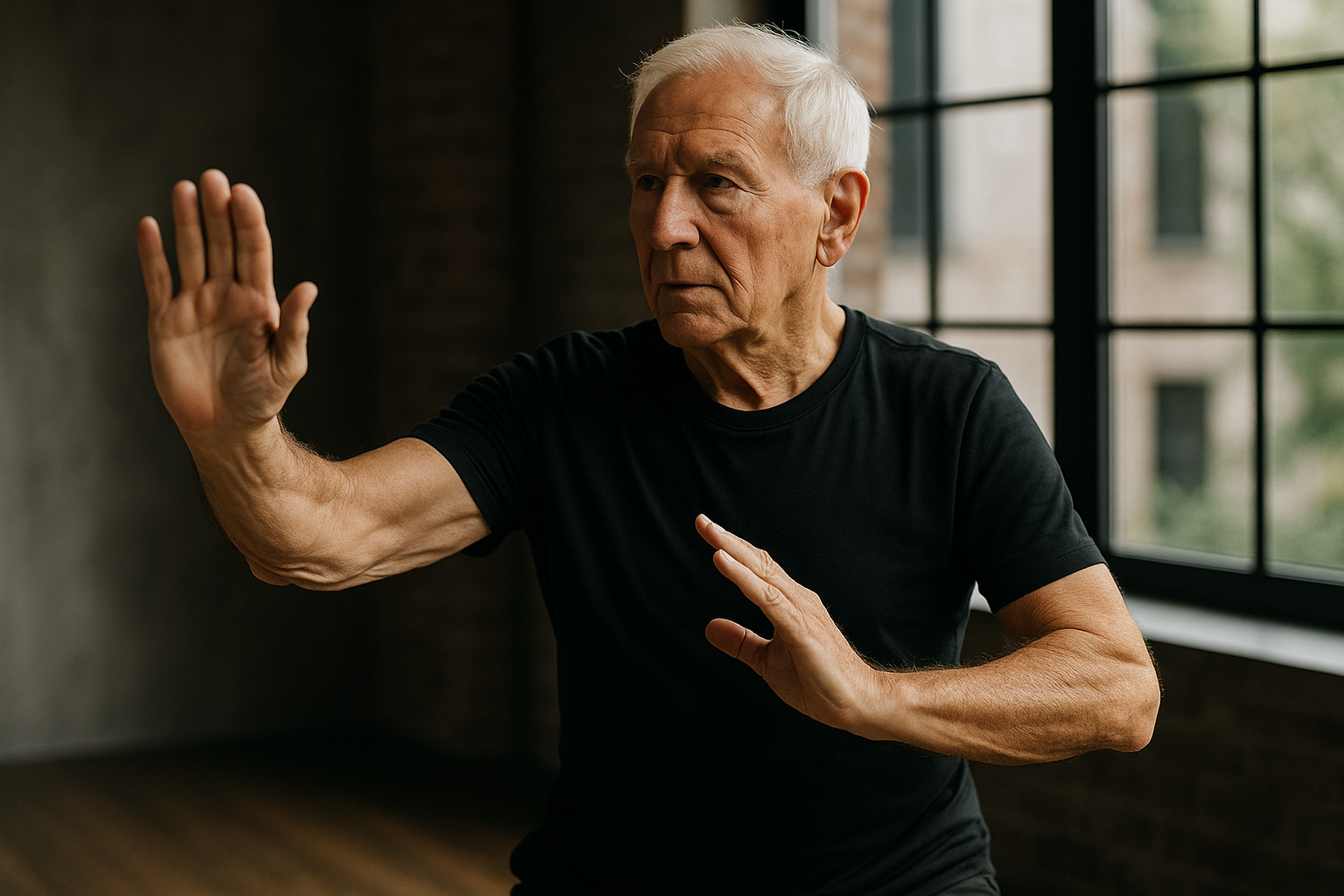
Tai chi for the elderly is a low-impact, beginner-friendly movement practice that can support balance, mobility, and relaxation—without the pounding you get from many workouts. If you (or a caregiver) are looking for a safe place to start, this guide gives you a clinician-style safety checklist plus a simple progression you can follow for the next 6 weeks.
Quick preview: You’ll learn what tai chi is, the main benefits older adults commonly look for, who should check with a clinician first, and a practical 10–20 minute routine with 3 starter moves. You’ll also get a “first 2 weeks → weeks 3–6” plan designed to reduce fall risk and make gentle practice sustainable.
Medical & safety note (please read): This article is not medical advice. Consult a clinician before starting tai chi if you have a condition affecting balance, mobility, dizziness, recent falls, or significant pain. Stop exercise if you feel dizzy, get chest pain, severe shortness of breath, or pain that’s worsening—and seek medical attention if symptoms persist.
What Tai Chi Is (and Why It Works for Older Adults)
Tai chi is a mind-body practice built around slow, controlled movement and steady breathing. Sessions often include shifting weight, gentle steps, and coordinated arm movements—done at an intensity that’s usually considered mild exercise.
Low-impact, controlled movement vs. higher-intensity workouts
For many older adults, the biggest barriers to exercise are joint stress, fear of falling, and difficulty maintaining balance during higher-intensity workouts. Tai chi is different: the movements are typically low-impact, and you can scale the range of motion and stance width to match your ability.
That’s why tai chi for seniors is frequently recommended as a gentle movement option—especially when your goal is functional fitness (things like standing steadier, moving more freely, and staying calm).
Common outcomes older adults look for (balance, mobility, stress reduction)
Older adults usually start tai chi for a mix of practical and emotional reasons:
- Balance and stability (confidence when standing, turning, or walking)
- Mobility for older adults (hips, ankles, and upper body moving comfortably)
- Stress/anxiety support through slower breathing and mindful focus
Evidence reviews and senior health resources commonly frame tai chi as supportive for older adults’ health promotion and balance-related outcomes. For a research anchor, see the peer-reviewed overview: Peer-reviewed overview: Tai Chi for Health Promotion of Older Adults.
Benefits of Tai Chi for the Elderly (Evidence-Informed Overview)
Tai chi isn’t a “magic cure,” but it may help support several areas that matter for everyday aging. Below are the benefits most aligned with balance and fall prevention, mobility, and emotional well-being.
Balance and stability (why it matters for fall risk)
Falls are often linked to a combination of balance, reaction time, leg strength, and confidence. Tai chi trains you to:
- shift weight smoothly
- maintain posture during movement
- practice controlled turns and steps (only as tolerated)
Many senior-focused health resources highlight that practicing regularly can improve balance and stability. You can also read the accessible summary from AARP: Tai chi health benefits for older adults or Healthline: Tai Chi for Seniors—moves for balance and stability.
Mobility and joint friendliness
Because tai chi is typically a low-impact exercise with slow movement, it can be easier on sore knees, stiff hips, and “stiff-on-waking” joints. Mobility improvements often come from consistent practice of:
- ankle and hip range-of-motion
- controlled trunk rotation (within comfort)
- upper-body coordination without jerking
Important: If you have arthritis or joint pain, the goal is comfortable movement, not pushing through flare-ups. Adjust stance width, reduce range, and focus on pain-free form.
Stress/anxiety and relaxation support
Older adults often feel “wired and tired” or experience stress related to health changes and reduced independence. Tai chi’s slow pacing and mindful attention can support relaxation. While tai chi shouldn’t replace mental health care, it may help you build a calming routine that also supports physical stability.
Safety First: Who Should Check With a Clinician Before Starting?
Tai chi is often considered safe for many older adults when done properly, but it’s not automatically safe for everyone. Before starting tai chi for the elderly, consider a clinician check if you have:
- recent falls or near-falls
- dizziness/vertigo, fainting history, or unexplained imbalance
- uncontrolled blood pressure or heart rhythm issues
- new or worsening neurologic symptoms (numbness, weakness)
- significant pain that limits walking or standing
- severe shortness of breath with mild activity
When to pause/modify (dizziness, pain spikes, unstable conditions—general guidance)
Use “safety stopping rules” from day one:
- Stop immediately if you feel dizzy, lightheaded, or unsteady.
- Stop if pain spikes (sharp pain or pain that increases as you continue).
- Stop if breathing feels strained (especially chest pain or severe shortness of breath).
- Pause or regress if you can’t hold your stance safely for more than a few seconds.
General guidance: if symptoms persist after the session, seek medical advice rather than “working through it.”
Get instructor guidance if mobility/balance is limited
If your balance is shaky or you need a wider stance just to stand comfortably, consider starting with:
- a senior-focused tai chi class with a qualified instructor
- one or two private sessions for form and safety
- caregiver-assisted practice where the caregiver is trained on what to watch for
Instructors can also show you how to keep weight centered and how to scale turns and steps so you avoid high fall-risk positions.
Environment setup (chair support, non-slip surface, stable supervision)
This is where many “benefits-only” guides fall short. Your environment can make or break safe beginner tai chi.
Use this safety checklist:
- Non-slip surface (avoid slick floors; use non-slip footwear or supportive shoes)
- Nearby stable support: a chair with solid legs and/or a countertop or wall
- Clear space: remove trip hazards (cords, rugs, clutter)
- Good lighting so foot placement is visible
- Supervision early on: caregiver present for first sessions if balance is limited
- Footwear: avoid barefoot practice if you have balance concerns
Caregiver tip: Stand slightly to the side (not blocking the person’s line of movement) and be ready to steady the torso/upper arm if needed—without pulling or yanking.
The Tai Chi Beginner Routine for Seniors (First 10–20 Minutes)
This starter routine is built for consistency. It’s short enough to do on “low motivation” days and structured to reduce fall risk.
How often to practice (simple schedule guidance)
For most beginners:
- Weeks 1–2: 3 days per week (or 4 shorter sessions if energy allows)
- Weeks 3–6: 4 days per week
Session length: 10–20 minutes total.
Pick a time when you’re not rushed (morning stiffness often improves with gentle movement).
Warm-up and cool-down basics (breathing, gentle range-of-motion)
Warm-up (3–5 minutes):
- Standing posture reset: feet hip-width (or wider if needed), knees soft, ribs stacked over pelvis.
- Breathing: slow inhale through the nose, slow exhale through the mouth. Keep shoulders relaxed.
- Gentle head turns: small range left/right while standing tall (hold support if needed).
- Arm circles (small): 5–8 slow circles forward, then backward.
Cool-down (2–3 minutes):
- Slow breathing for 30–60 seconds.
- Relaxation check: unclench hands, drop shoulders, notice tension melting.
- Gentle march in place (only if stable) for 20–30 seconds.
Then do the 3 starter moves below.
3 Simple Starter Moves (Beginner-Friendly, Balance-Focused)
These are intentionally “small and controlled.” In early beginner tai chi, the safest form is the one you can repeat without wobbling.
Common rule: If you feel unsteady, widen stance slightly, reduce range, and keep a hand hovering near a chair or wall.
Move 1 — “Weight shift” style (standing, small range)
Goal: train balance and confidence by shifting weight without losing your stance.
- Stand near a chair/wall. Feet flat, about hip-width (or slightly wider).
- Keep knees soft and posture tall.
- Shift a little weight toward your right foot (10–20% of your body weight), then back to center.
- Shift slightly toward your left, then back to center.
- Repeat for 6–10 slow shifts.
How to modify: Do it with fingertips lightly touching the chair back for support. Reduce the range if you feel your feet “want to slide.”
Move 2 — “Slow arm sweep” style (controlled upper body)
Goal: practice relaxed movement and coordination without forcing big steps.
- Start in the same stable stance as Move 1.
- Inhale gently as your arms rise slightly in front of you (like a soft arc, not a lift).
- Exhale as your arms lower slowly, keeping shoulders down.
- Continue 6–10 cycles at a comfortable pace.
Caregiver watch-outs: Ensure elbows aren’t locking; watch for shoulder tension and any forward head posture.
How to modify: Keep arms at chest height instead of reaching higher. If turning your torso causes discomfort, keep the movement mostly in the shoulders.
Move 3 — “Step and turn” style (only as tolerated)
Goal: introduce safe stepping and turning mechanics—without rushing.
- Stand near the chair/wall.
- Make a small step forward or to the side (whichever is easier), then bring your foot back to your starting position.
- To add a turn: turn your upper body slightly while keeping your feet planted, then take a small step to follow if needed.
- Do 4–6 controlled step/turn attempts.
How to modify (important): If you’re unsure, skip turning and only practice small forward steps. Turning should come last and only if weight-shifts feel stable.
Common form mistakes to avoid for seniors (rushing, overreaching, losing stance)
- Rushing: speed increases wobble. Slow down until you can control posture.
- Overreaching arms: reaching too far can destabilize your center of mass.
- Narrow stance without control: use a wider stance to start if needed.
- Holding your breath: keep breathing smooth through the movements.
- Big turns early: practice small turns only after steady weight shifts.
Progression Plan (Weeks 1–2, 3–6)
This plan is designed for gradual improvement while respecting fatigue, stiffness, and balance variability—because “the best routine” is the one you can safely repeat.
How to increase time/intensity safely
Weeks 1–2 (foundation):
- Practice: 3 days/week
- Time: 10–15 minutes/session
- Moves: 2 rounds of Moves 1–2, and 1 short round of Move 3 (or skip Move 3 if unstable)
- Volume: start with fewer reps (e.g., 6 shifts per side) and add 1–2 reps only if stable
Weeks 3–6 (build control):
- Practice: 4 days/week
- Time: 15–20 minutes/session
- Moves: 3 rounds of Moves 1–2; 2 short rounds of Move 3 only if it feels safe
- Intensity: increase by time under control, not by faster movement
How to adapt for arthritis, stiffness, or limited mobility (general adaptations)
Use these “arthritis-friendly” adaptations:
- Reduce range: smaller arm sweeps and shorter steps
- Wider stance: more stability for knee/ankle comfort
- Chair-supported options: practice arm sweep seated, or do weight shift with fingertips on the chair
- Warm first: spend extra minutes on breathing and gentle mobility before moving into weight shifts
- Split sessions: if 20 minutes is too much, do 10 minutes morning + 10 minutes later
If joint pain flares, treat it like feedback. Pause Move 3, reduce range, and focus on Moves 1–2 until comfortable again.
When to Take It to a Class or With an Instructor
Once you can do the beginner routine without wobbling, a class can accelerate learning—especially for safe posture, pacing, and turning mechanics.
What to look for in a senior-focused tai chi class
- Senior-friendly pacing: instructors demonstrate slow speed and emphasize stability
- Support options: class allows wall/chair support and offers modifications
- Form coaching: they correct stance, posture, and breathing
- Safety culture: they talk about stopping if dizzy/painful and avoid forcing risky ranges
- Small groups: easier supervision and more individualized cues
Caregiver note: If you attend with your loved one, ask the instructor how they want you to support supervision—steadying, not pulling, and what “red flags” to watch for.
FAQ: Tai Chi for Seniors (Quick Answers)
How often should an elderly person practice tai chi to see balance benefits?
Most beginners benefit from 3 days per week in the first 2 weeks, then 4 days per week as tolerated. Aim for 10–20 minutes per session. Consistency matters more than long sessions.
Is tai chi safe for seniors with arthritis or joint pain?
It may be safer than many high-impact workouts because tai chi is typically low-impact and slow. However, safety depends on your pain level and balance. Use reduced range of motion, wider stance, and chair support when needed. Check with a clinician if pain is significant or you’ve had recent falls.
Can tai chi help prevent falls, and how should I practice if my balance is shaky?
Tai chi may support fall prevention by improving balance, stability, and controlled movement. If your balance is shaky, start with Moves 1–2, keep a hand near a chair/wall, use a wider stance, and skip turning steps until weight-shifts feel steady.
What is the best tai chi for beginners (and how do I choose a class)?
For beginners, look for senior tai chi or beginner sessions that emphasize stability and offer modifications. Avoid classes that move quickly or don’t discuss safety. Resources like AARP’s tai chi overview can help you understand what to expect.
How long does it take to notice improvements in mobility or stability?
Some people notice improved steadiness within a few weeks of consistent practice. More noticeable mobility and confidence gains often appear over 6–12 weeks, depending on baseline ability, consistency, and whether pain limits movement.
What should I do if I feel dizzy or pain during a tai chi session?
Stop immediately. If you feel dizzy, don’t “push through.” Sit down safely and contact a clinician if symptoms persist. For pain, reduce range or regress to chair-supported movements. For severe symptoms like chest pain or severe shortness of breath, seek urgent medical care.
Conclusion: Your Next Step for Tai Chi for the Elderly
Tai chi for the elderly can be a smart, sustainable way to build balance and confidence—especially when you start with a safety-first routine and progress slowly. If you want one “do this today” action:
- Set up a safe practice space (non-slip surface + chair/wall nearby).
- Do 10–15 minutes of Moves 1–2 using only comfortable range.
- Log how steady you felt (and whether you needed support), then repeat 2 more times this week.
If you’re also working on overall consistency with exercise habits, you might find this helpful: 5 mistakes holding you back from reaching your fitness goals.
Reminder: If you have conditions affecting balance, recent falls, dizziness, or significant pain, talk with a clinician and consider starting with a senior-focused instructor.
Optional credibility note: This guide’s balance and older-adult framing aligns with accessible senior resources (Healthline, AARP) and a peer-reviewed overview of tai chi for older adults (PMC article).