
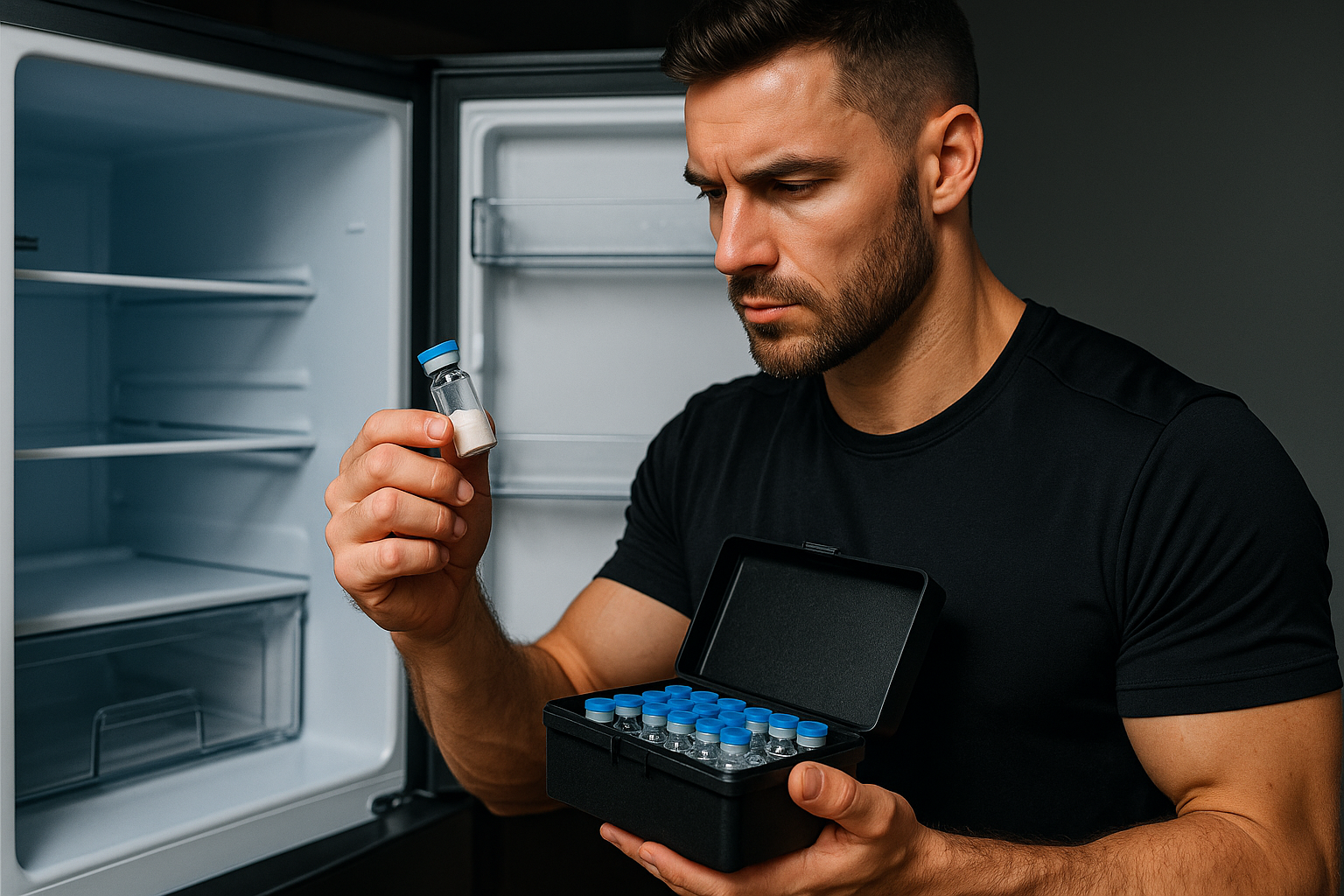
Peptide storage isn’t complicated—but it is detail-driven. The safest approach depends on whether your peptide is lyophilized (freeze-dried) vs reconstituted, the required peptide storage temperature, and how you protect fragile vials from heat, light, contamination, and repeated freezer/fridge door cycling.
In this guide, you’ll get a practical decision framework based on storage state + temperature target + container type, plus checklists to reduce handling time and prevent common failure modes. (General info only—always follow your specific product label, SDS, and clinician guidance.)
For broader safety context around peptides, also review Peptides Bodybuilding: Safety-First Side Effects Checklist, Real Expectations.
What “peptide storage” depends on (lyophilized vs reconstituted)
When people search “peptide storage,” they often assume there’s one universal method. In reality, peptide storage temperature and container choice change based on the peptide’s preparation state:
- Lyophilized peptide storage: typically supplied as a dry powder in a vial (often under vacuum or dry conditions).
- Reconstituted peptide storage: the powder has been dissolved into a solution (water/saline/buffer—depends on the product), making it more sensitive to handling, contamination risk, and solution stability.
Lyophilized peptide storage basics (what to protect and why)
Lyophilized peptides generally need protection from:
- Temperature swings (frequent warming/cooling can stress the formulation).
- Moisture exposure (the “dry” state matters).
- Light (some formulations can be light-sensitive).
- Cross-contamination (handling with clean tools/gloves and minimizing vial openings helps).
Follow your manufacturer’s directions for temperature and handling. As a general best-practice reference for handling and temperature principles, see Peptide storage and handling guidelines (GenScript).
Reconstituted peptide storage basics (how handling changes)
Once a peptide is reconstituted, you’re no longer just protecting a dry product. You’re protecting a solution, which can be more vulnerable to:
- Contamination (every puncture/transfer can introduce microbes if procedures are not sterile).
- Stability limits (solution components and the peptide’s chemical behavior can affect longevity).
- Unnecessary temperature cycling (moving in/out of the fridge/freezer repeatedly may stress stability).
Key idea: storage method should minimize how long vials sit at unsafe temperatures and minimize how often you open and handle them.
Peptide storage temperature guide (practical ranges)
There is no single “perfect” temperature for every peptide. Always treat the label/SDS as the authority for your specific product.
That said, most peptide storage workflows fall into a practical decision pattern:
- Freezer storage (commonly -20°C): many lyophilized products and some reconstituted workflows use freezer regimes, often to reduce degradation risk.
- Ultra-cold freezer storage (commonly -80°C where applicable): some peptides may be specified at lower temperatures for best stability.
- Fridge storage (commonly 2–8°C): sometimes used after reconstitution if the product label allows it for a limited period.
Important: do not “upgrade” temperature beyond the label (e.g., moving a vial to a colder storage method when the manufacturer says a different regime). Some products may specify a range rather than a single number.
When to use freezer storage vs fridge storage
Use this simple rule of thumb—always confirm the exact requirement for your peptide:
- Choose freezer storage when your peptide label indicates long-term storage at lower temperatures and especially when you need stability over time.
- Choose fridge storage when your peptide label allows refrigerated conditions after reconstitution and your plan includes minimizing the time vials spend out of the fridge.
- Prefer single-use retrieval: get what you need, then close the door promptly to reduce temperature cycling.
If you’re specifically using a regimen that involves refrigeration, it can help to understand product-specific fridge-life safety considerations. For an example of how fridge safety is discussed in a peptide context, see CJC-1295 peptide fridge life safety.
Temperature stability and avoiding unnecessary temperature cycling
Temperature cycling is one of the most common “silent” mistakes. You can’t always see stability loss, but repeated transitions can increase risk.
To avoid it:
- Plan your retrieval: decide how many doses/vials you need before opening the door.
- Minimize door-open time: organize your layout so vials are reachable without rummaging.
- Use a “staging” area: set up your workspace so the vial comes out, you complete prep quickly, then it returns immediately (per label guidance).
- Use consistent placement: keep vials in the same zone of the fridge/freezer where temperatures are most stable (avoid the door shelf if possible).
Best peptide storage containers (vials, boxes, cases)
When readers search peptide storage container or peptide storage box, they’re usually trying to solve a practical problem: protecting vials while keeping your system organized. The “best” container is the one that matches your storage state and reduces exposure and handling time.
Think in three layers:
- Vial protection (physical + seal integrity)
- Environment protection (temperature stability + light reduction + dryness where relevant)
- Workflow protection (label visibility + quick retrieval + batch tracking)
Choosing a peptide vial storage case vs a peptide storage box
Here’s a simple comparison for typical use cases:
- Vial storage case (often a structured organizer): best when you want compartments for peptide vial storage, quick retrieval, and reduced time with vials out of the freezer/fridge.
- Peptide storage box (less structured): can work if it keeps vials from shifting, but structured cases often reduce rummaging.
- Cases labeled/engineered for cold storage: if you’re using a freezer, prioritize materials that tolerate cold environments and provide stable compartment fit.
You can browse examples here for container formats and holders: peptide storage organizers and vial holders (Amazon search). Use these listings only as inspiration for container types—not as a substitute for manufacturer requirements.
How to organize for 3mL/typical vial formats (non-branded guidance)
Many peptide vials are similar in size, but always verify your vial dimensions and cap style. A smart layout reduces how long you have the vial out and helps you track batches.
A practical setup for common vial formats:
- Compartmentalize by storage state:
- Section A: lyophilized vials
- Section B: reconstituted vials (only if your peptide label allows refrigerated use and you store them there)
- Use consistent “front-of-box” orientation so you can read labels without pulling vials out.
- Group by batch/lot number and mark your retrieval order (e.g., earliest batch first) to prevent accidental mix-ups.
- Leave a “clean hand zone”: keep exterior surfaces clear and avoid touching the vial area longer than needed.
If you do plan to buy a product specifically marketed as a peptide storage case, ensure the compartments fit your vial type and that you can close the lid quickly after retrieval. Search terms like peptide storage cases, peptide storage case freezer, or peptide vial storage case can help you find the right style.
Labels, batch tracking, and minimizing handling time
Labeling isn’t about aesthetics—it’s about safety and accuracy.
At minimum, label each vial/box (or record it in a logbook) with:
- Peptide name (as on the product)
- Batch/lot number
- Reconstitution date if applicable (only if your manufacturer instructs reconstitution tracking)
- Storage conditions per product label (e.g., “freezer per label,” “refrigerate per label”)
- Initial handling notes (e.g., “opened/first puncture date,” if your workflow includes it)
Reduce handling time by storing vials so you can identify them at a glance. The best container is the one that prevents you from opening the case “just to check.”
Step-by-step: a “safe storage workflow” you can follow
This workflow is designed to reduce temperature cycling, minimize contamination risk, and improve organization. It is general guidance—adapt to your specific peptide label and clinical instructions.
Storage preparation checklist
- Check the label/SDS first:
- Required temperature regime
- Light protection guidance
- Reconstitution/storage instructions (if applicable)
- Choose the correct storage state location:
- Lyophilized vials into the designated freezer zone
- Reconstituted vials into the designated fridge or freezer zone—only as allowed by label
- Prepare containers in advance:
- Use a compartmentalized case/box for quick access
- Confirm each vial fits securely without shifting
- Label immediately (or record before storage), including lot/batch and reconstitution date if required.
- Set up “grab-and-close” workflow:
- Decide where each container lives in the fridge/freezer
- Keep it consistent so you don’t rummage later
- Inspect vials before storage:
- No unexpected discoloration, damage, or signs of contamination
- If anything looks compromised, do not use—contact your supplier/medical professional.
Retrieval & handling checklist (reduce exposure time)
- Before opening the fridge/freezer:
- Prepare tools and workspace so you can work efficiently
- Confirm how many vials you need
- Open once, retrieve quickly:
- Minimize door-open time
- Avoid leaving vials outside while you search
- Limit how often you open the storage case:
- Remove the needed vial(s) only
- Close the case immediately after retrieval
- Return promptly:
- Once prep/administration is complete, return vials to the correct temperature location per label.
- Log and re-check labels:
- Verify peptide identity before use
- Record reconstitution/handling notes if your workflow includes it
Common mistakes (and how to prevent them)
Most “basic” storage advice focuses on temperature. The mistakes below are where people typically lose the most control.
Light exposure, inconsistent temperatures, poor container sealing
- Leaving vials exposed to light:
- Keep vials in opaque/covered organizers.
- Retrieve only what you need.
- Relying on the freezer door for stability:
- Door shelves often experience more temperature fluctuation when opened frequently.
- Use interior stable zones when possible.
- Poor case/box fit:
- Loose compartments cause vials to shift, increasing handling and time out of cold storage.
- Choose a peptide storage container that holds vials securely.
- Not sealing or closing promptly:
- Warm air exchange accelerates temperature cycling.
- Make “close immediately” part of your routine.
Not accounting for sequence-specific stability (high-level reminder)
Some peptides are more stable than others, and stability can be affected by formulation details (buffer type, concentration, excipients) and chemical sequence characteristics. That’s why “general advice” isn’t enough.
Do this instead:
- Follow your product-specific temperature requirements.
- If your supplier provides storage instructions beyond temperature (e.g., light/dryness requirements), treat those as equally important.
- When in doubt, contact the manufacturer or a qualified clinician.
Quick reference summary (decision guide)
Use this mini decision tree when you’re unsure what to do next.
| Step | Choose | Then |
|---|---|---|
| 1 | Lyophilized vs reconstituted | Store in the temperature regime your label allows for that state |
| 2 | Temperature target (per label) | Pick freezer/fridge storage accordingly; avoid unnecessary cycling |
| 3 | Container type | Use a peptide vial storage case or structured peptide storage box that speeds retrieval and reduces light exposure |
| 4 | Workflow | Label by lot/batch, stage retrieval, minimize door-open time |
FAQ: peptide storage temperature, containers, and handling
What is the safest temperature for peptide storage?
The safest temperature depends on the specific peptide and its formulation. Use the temperature regime on your product label/SDS. Many peptides are stored in a freezer (often around -20°C or lower, depending on instructions), while some reconstituted workflows permit refrigerated conditions—only as the manufacturer specifies.
How should lyophilized peptide storage be handled differently than reconstituted peptides?
Lyophilized peptides are typically managed as “dry and stable,” so you focus on protecting from moisture, light, and temperature swings. Reconstituted peptides are solutions, so handling becomes more about minimizing contamination risk and unnecessary temperature cycling. In both cases, follow the product-specific instructions.
Do peptides need to be stored in a freezer or a fridge?
It depends on the peptide and whether it’s lyophilized or reconstituted. Many products require freezer storage, but some reconstituted peptides are allowed to be stored in a fridge for a limited workflow period. Always follow the manufacturer/SDS for your exact item.
What type of peptide storage container is best for vial protection (case vs box)?
Structured organizers (a peptide storage case or peptide vial storage case) are often better than generic boxes because compartments reduce shifting and speed identification—meaning less time your vials spend out of cold storage. Choose a container that fits your vial size securely and helps you close the lid quickly.
How can I organize peptide vials to avoid repeated temperature exposure?
Organize by storage state (lyophilized vs reconstituted), group by batch/lot, and label so you can identify vials at a glance. Store the container in a consistent zone and use a “grab-and-close” workflow: open the fridge/freezer once, retrieve what you need, then close promptly.
How long can peptides typically be stored once reconstituted?
“How long” is sequence- and formulation-dependent and must follow your product label and manufacturer guidance. If you don’t see a clear reconstituted storage window on the instructions, ask your supplier or a qualified clinician rather than guessing.
Conclusion: your next safe step
If you want the fastest improvement to your system, start with this order:
- Verify storage state (lyophilized vs reconstituted) and your peptide storage temperature requirement on the label/SDS.
- Upgrade your workflow container to a compartmentalized peptide storage container that reduces rummaging and keeps vials protected.
- Use the checklists above to minimize temperature cycling and handling time.
For manufacturer-aligned best practices on handling and storage principles, reference Peptide storage and handling guidelines (GenScript), and if you’re discussing specific fridge-life safety considerations in a peptide context, review CJC-1295 peptide fridge life safety.
Safety note: This article is general information, not medical advice. If a vial appears contaminated, damaged, or unexpectedly altered, do not use it—seek guidance from your supplier and/or a qualified healthcare professional.