
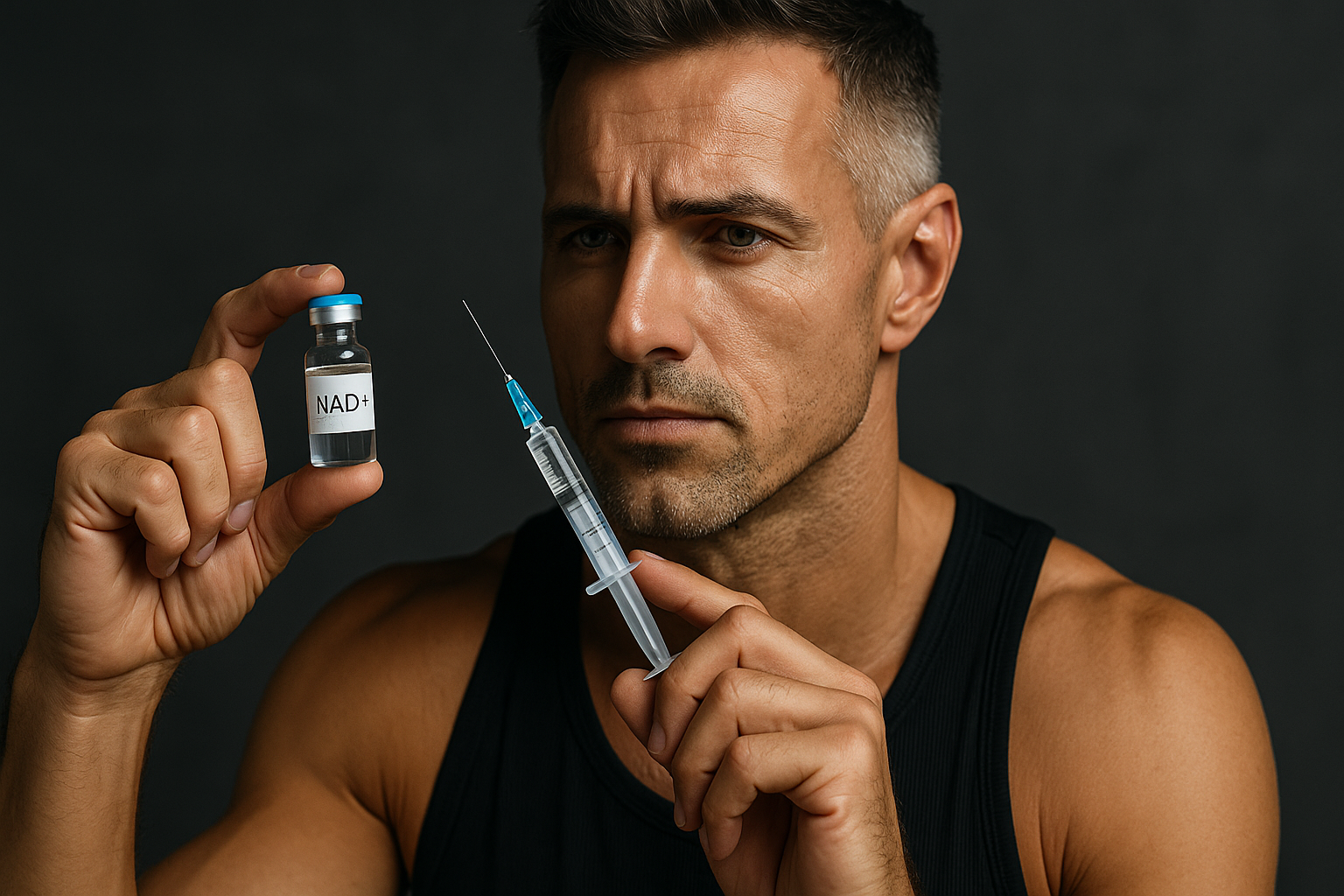
If you’re searching “nad peptide”, you’re probably running into confusion: many sellers and even some articles use “NAD peptide” when they’re really talking about NAD+ (nicotinamide adenine dinucleotide) injections or NAD+ boosting supplements. This safety-first guide clears up is NAD a peptide, explains what NAD+ is doing in your cells, and covers the most searched topics—nad peptide side effects, how to interpret a nad peptide dosing chart, and where to inject nad peptide (with harm-reduction focused guidance, not DIY procedure instructions).
Quick takeaway: NAD+ is a coenzyme/co-substrate found in cells—not a peptide. “NAD peptide dosing” and “where to inject NAD peptide” usually refer to NAD+ injections or NAD+ precursors/related products, which can still have real safety considerations.
NAD peptide vs NAD+ (what people are actually taking)
Is NAD a peptide? (NAD+ is not a peptide)
In most mainstream biology and clinical references, NAD (nicotinamide adenine dinucleotide) is described as a small molecule that’s present in nearly every living cell. It helps shuttle electrons and supports core energy and metabolic processes. It is not classified as a peptide (peptides are chains of amino acids).
This is why a lot of searchers ask is nad a peptide or is nad peptide: the internet commonly mixes terminology. If a product page says “NAD peptide” but claims it works like a peptide injection, you should pause and verify what the actual active ingredient is.
Cleveland Clinic: what NAD (NAD+) is and its role in cells
What is NAD peptide / what is NAD+ in the body?
When people say what is nad peptide online, they often mean one of these:
- NAD+ injections (sometimes marketed using “NAD peptide” language)
- NAD+ supplementation (pill/capsule forms or precursors like nicotinamide riboside or similar categories)
- Products whose labeling is unclear and blur “peptide” vs “NAD+” terminology
Biologically, NAD+ is involved in cellular processes that help convert nutrients into usable energy and support pathways that rely on NAD+ availability. The details matter because “NAD+ vs peptides” are different mechanisms.
What does NAD+ do? (high-level biology for searchers)
NAD+ supports multiple enzyme systems. Many of its well-known roles cluster around:
- Cellular metabolism (helping cells produce and manage energy)
- Enzymatic signaling through NAD+-dependent pathways
- DNA repair and stress response pathways that rely on NAD+-related enzymes (discussed in scientific literature)
In plain English: NAD+ is central to keeping cellular energy and repair systems running. When NAD+ levels decline with age or stress, researchers have explored whether boosting NAD+ signaling might support aspects of health. Importantly, that does not mean every marketed “NAD peptide” product has identical effects—or that supplements/injections are automatically safe for everyone.
PMC review: role of NAD+ in regenerative medicine and cellular pathways
NAD+ injection basics (without overpromising)
What is an NAD+ injection and who discusses it?
Some providers and communities discuss NAD+ injections as a way to raise NAD+ availability (or influence NAD+-dependent pathways) systemically. The marketing language may vary—sometimes you’ll see “NAD+ shots,” “NAD peptide,” or “NAD+ therapy” used interchangeably.
Because this is a medical-style intervention, you’ll want to treat it like one: discuss it with a clinician, confirm ingredient identity, and understand that “popular” doesn’t equal “proven for your goal.”
What is an NAD+ injection and who discusses it
NAD+ IV vs injection—what users mean by “injection” (clarify terminology)
Online searches for where to inject nad peptide often lump together different delivery methods. Be precise:
- Intramuscular (IM) injections (into muscle)
- Subcutaneous (SC) injections (under the skin)
- Intravenous (IV) infusions (into a vein)
These differ in medical logistics and risk profile. IV approaches typically require stricter clinical monitoring environments. If a site is vague about method, don’t assume safety—ask.
Important: This article is educational and does not provide DIY injection instructions. Injection carries risks (infection, injury, and complications from non-sterile technique). If you’re considering NAD+ injections, seek professional administration.
NAD peptide side effects and safety considerations
People searching nad peptide side effects are often looking for two things: (1) what’s commonly reported, and (2) what’s a red flag. Because “NAD peptide” terminology can be messy, focus on the actual active ingredient and the route (injection vs oral/supplement).
Commonly discussed side effects (categorized)
Across community discussions and general clinical caution around injections/boosting agents, commonly reported issues tend to fall into these buckets:
- Injection-site or local reactions: redness, tenderness, swelling, or irritation where the dose was administered
- Energy/stimulation-related effects: jittery feeling, changes in perceived energy, or sleep disruption (reported in some contexts)
- Head/neurologic sensations: headache or “wired” sensations (varies by person/product)
- Gastrointestinal effects: nausea or stomach upset (more often discussed with certain oral forms, but can come up in broader NAD-related use)
- Flu-like or fatigue changes: short-term malaise or unusual fatigue have been discussed by some users
Note: Side effects and severity vary by product formulation, dosing frequency, individual health status, and whether the intervention is truly NAD+ vs a different NAD-related substance.
Risk factors and red flags (when to stop and seek medical advice)
Stop and seek urgent medical advice if you experience:
- Signs of infection at an injection site (worsening redness, warmth, pus, fever)
- Allergic reactions (hives, facial/lip swelling, trouble breathing)
- Severe or persistent symptoms (intense headache, chest pain, fainting, severe dizziness)
Also talk to a clinician before starting if you have:
- Chronic medical conditions (especially metabolic, cardiovascular, liver/kidney conditions)
- History of adverse reactions to injections or supplements
- Pregnancy/breastfeeding or trying to conceive (speak with your clinician)
- Medication interactions concerns—always disclose your full medication/supplement list
Harm-reduction principle: If a product is marketed as “NAD peptide” but refuses to clearly state the ingredient identity, concentration, sterility practices, or clinical oversight, that’s a safety concern.
NAD peptide dosage and dosing chart (interpretation guide)
The search term nad peptide dosing chart is a big signal: readers want numbers. But in safety-focused guidance, the most responsible move is to teach you how to interpret “dosing chart” claims—because dosage is not one-size-fits-all.
NAD peptide dosage—why dosing varies
Whether you see nad peptide dosage charts online or clinic schedules, dosing varies due to:
- Product differences: NAD+ vs precursors vs blended formulations (and different concentrations)
- Route differences: injection vs oral may be discussed with different dosing patterns
- Clinician screening: baseline health, lab status, and goals influence decisions
- Starting conservatively: some providers adjust frequency based on tolerance
So if a chart is presented without details about product identity and clinician oversight, treat it as marketing—not a medical plan.
How to read a “dosing chart” responsibly
When you encounter a nad peptide dosing chart, look for these elements. If they’re missing, that’s your cue to verify before trusting it:
| What to check | Why it matters |
|---|---|
| Active ingredient clarity (is it NAD+ or something else?) | “NAD peptide” language can be inaccurate; you need the actual chemical and concentration |
| Route + frequency (SC/IM/IV vs oral) | Risk and pharmacologic exposure differ by route |
| Source quality (sterility, documentation) | Injections require strict handling and quality controls |
| Monitoring plan | A safety-first plan includes follow-up and symptom/lab review when appropriate |
| “Stop rules” for adverse reactions | Responsible guidance includes red flags and when to pause/seek care |
Bottom line: A dosing chart should be interpret-able as a clinical protocol. If it’s just “start high, then ramp” with no safety logic, don’t treat it as guidance you can copy.
Experience-driven approach we use at Forged Alpha: we don’t evaluate dosing claims by hype or screenshots. We look for (1) ingredient clarity, (2) route clarity, (3) sterility/handling documentation for injectables, and (4) whether there’s a credible clinician or reputable medical framework behind the guidance.
If you’re also comparing peptide-style compounds and dosing presentation, you may find these safety framing articles helpful:
- peptide side effects and dosage chart safety considerations
- reconstitution/safety-first peptide handling concepts
Where to inject NAD peptide (harm-reduction framing)
People ask where to inject nad peptide because they’re trying to reduce uncertainty. The safest answer is: don’t guess. Site selection depends on the route (SC vs IM), your anatomy, product volume, concentration, and clinician preference—and it also affects infection/irritation risk.
Injection site basics and technique considerations (high-level)
At a high level, clinicians generally select injection sites that are:
- Appropriate for the route (subcutaneous vs intramuscular)
- Within sterile-field handling
- Avoiding irritant-prone or injured tissue
- Rotated to reduce repeated local trauma
However, providing step-by-step “where exactly to inject” instructions in a blog isn’t appropriate for safety reasons. Instead, the harm-reduction focus is to help you ask the right questions of the clinician administering it.
Ask your provider: “What route are you using (SC/IM/IV), what site(s) are recommended for my situation, and what are the sterility and aftercare rules?”
Sterility, needle/syringe handling, and avoiding infection
If the product is injected, sterility and handling are non-negotiable. Risk categories include:
- Infection from non-sterile technique or contaminated supplies
- Skin and tissue injury from improper handling
- Adverse reactions from incorrect storage or product quality issues
For harm reduction, only consider NAD+ injections administered under appropriate medical oversight using properly prepared and documented sterile supplies. If you see “NAD peptide” sold with vague instructions and no clear quality control, that’s a major red flag.
NAD peptide Reddit—what people commonly ask (and what to verify)
Searches for nad peptide reddit usually mean one of two things: (1) users want to understand expectations and side effects, or (2) they’re trying to validate whether “NAD peptide” is legit.
Community themes (side effects, dosing, expectations, legitimacy)
Without treating Reddit as evidence, common discussion themes tend to include:
- Terminology confusion: people mixing “NAD peptide” with NAD+ injections or NAD+ boosters
- Side effect stories: reports of headaches, energy changes, GI upset, or injection-site irritation
- “Dosing chart” screenshots: users comparing frequency and dose amounts across providers
- Expectation mismatch: some anticipate dramatic, fast outcomes; others report subtle or variable experiences
- Legitimacy concerns: questions about product source, purity, and consistency
How to verify claims
If you’re reading community posts, verify by checking for:
- Ingredient identity: NAD+ vs precursors vs blended products
- Evidence of quality: manufacturer documentation (e.g., COA when applicable) and legitimate sourcing
- Clinician involvement: screening, monitoring, and clear stop guidance
- Consistency: multiple independent sources, not one viral thread
Then cross-check the biology and safety framing using reputable medical and peer-reviewed sources (like Cleveland Clinic and PubMed/PMC). Community experiences can inform what to watch for, but they can’t replace medical evaluation.
Bottom line + checklist
NAD peptide is a commonly used search phrase, but the most important correction is early: is NAD a peptide? In standard references, NAD+ is not a peptide. Many “NAD peptide” conversations are actually about NAD+ injections or NAD+ boosting supplements/precursors, which may still involve real side effects and real injection risks.
Who should talk to a clinician first
- Anyone with chronic conditions or complex medication regimens
- Anyone considering injection-based NAD+ use
- Pregnant/breastfeeding individuals (or those trying to conceive)
- Anyone who has had prior adverse reactions to injections or supplements
Checklist before starting (screening + monitoring)
- Confirm the ingredient: Ask what it is exactly (NAD+ vs precursor vs other product) and the concentration.
- Clarify route: SC vs IM vs IV (and where it’s administered).
- Check quality/handling: sterile handling for injectables; documentation for product identity.
- Discuss your meds and history: bring a full list to your clinician.
- Define monitoring: what symptoms to watch, and whether labs or follow-ups are planned.
- Know red flags: infection/allergy/severe symptoms should trigger immediate medical advice.
Medical disclaimer: This article is for educational purposes only and is not medical advice. NAD+ injections/supplementation should be discussed with a qualified clinician. Injection practices carry risks (infection, injury, and complications related to sterile technique). Do not start, stop, or change dosing based solely on information from this article.
FAQ
Is NAD a peptide or NAD+?
NAD (NAD+) is generally described as a cellular coenzyme/co-substrate (a small molecule), not a peptide. The term “nad peptide” is often a marketing/search confusion that can refer to NAD+ injections or related NAD-boosting products.
What is NAD peptide (and what do people mean by NAD+ injections)?
When people search what is nad peptide, they commonly mean NAD+ injections or NAD+ boosting approaches. In credible medical terms, you should verify whether the product is actually NAD+, a precursor, or a different substance.
What are NAD peptide side effects, and when should I stop?
Commonly discussed issues include local injection-site irritation, headache/feeling “stimulated,” GI upset, or short-term fatigue—varying by product and person. Stop and seek medical advice urgently for signs of infection, allergic reactions, or severe/persistent symptoms.
How is NAD peptide dosage typically discussed, and why does it vary?
Dosing varies because products differ in concentration/formulation and because route (oral vs injection), frequency, and clinician screening change what’s reasonable. Use any nad peptide dosing chart only as a prompt to ask your clinician what applies to your specific product and health profile.
Where to inject NAD peptide (and what safety precautions matter most)?
“Where to inject” depends on the route (SC vs IM), product volume/concentration, and clinical preference. Safety precautions that matter most are sterility, proper product handling, and professional administration—not DIY guessing. Ask your provider for site and aftercare guidance.
What are people saying on NAD peptide Reddit, and how can I verify those claims?
Reddit discussions often focus on side effects, expectations, and dosage comparisons, but it’s not medical evidence. Verify by confirming the actual ingredient, checking for quality documentation, and cross-referencing safety/biology with reputable sources like Cleveland Clinic and peer-reviewed literature.
Next step: If you’re considering NAD+ injections or supplements, start by writing down your goal (energy, recovery, general aging support, etc.), your medication list, and the exact product label (ingredient + concentration). Then book a clinician consult to review safety and realistic expectations.