
Safety first: This is general educational information, not medical advice.
Check with a healthcare professional before starting or changing exercise if you have a medical condition, are recovering from injury, or have been inactive.
Stop and seek medical advice for chest pain, dizziness/fainting, severe shortness of breath, or sharp/persistent pain. During exercise, aim for “working effort” rather than maximal strain; mild discomfort can differ from pain—if pain occurs, modify or stop.
Strength training for seniors doesn’t need to be complicated or punishing. The safest, most sustainable approach is a short routine you can repeat 2–3 times per week—built around controlled reps, stable positions (like a chair), and gradual progress. Below, you’ll get a 20 minute strength training for seniors and beginners plan (with chair-based options), a simple weekly schedule, and “what to do if it’s too easy/hard” scaling rules.
Because many people search for strength training for seniors videos or strength training for seniors youtube demos, I’ll also show you how to find useful form cues without guessing—so you can practice safely.
What strength training does for seniors (and what it helps you do day-to-day)
Muscle strength, function, and independence
With age, many adults lose muscle strength and the ability to produce force quickly. Strength training helps counter that by improving how your muscles coordinate with your joints—making everyday tasks feel more manageable.
In practical terms, consistent training can support:
- Getting up from a chair with less effort (sit-to-stand is a key movement)
- Stability while walking by strengthening hips, legs, and core support
- Carrying groceries and doing household tasks with better upper body strength
- Better posture by training muscles that support the upper back
Bone health and osteoporosis prevention (tie to CDC framing)
Strength training is commonly recommended in older adulthood because regular strengthening exercises can help prevent osteoporosis-related issues. For evidence-aligned guidance, use the CDC resource here: CDC guidance: Growing Stronger—strength training for older adults.
Important: This article focuses on safe, general programming. It’s not a guarantee of specific medical outcomes—think of it as a foundation that supports long-term physical capability.
Safety first: how to start strength training after 60 (or with low experience)
When to check with a clinician / contraindications (keep general)
Consider talking with a healthcare professional before starting if you:
- have known heart/lung conditions, uncontrolled blood pressure, or unexplained dizziness
- are recovering from injury or have persistent joint pain
- haven’t exercised in a long time
- take medications that significantly affect exercise tolerance (only mention to your clinician—don’t guess)
If you’re unsure, start with very light effort and stable movements (chair-supported work). You can still build strength safely over time.
Intensity cues (effort-based guidance; avoid medical directives)
Use effort rather than maximal strain. A simple cue:
- Working effort: you should feel like you could do a couple more reps if you had to (not all-out)
- Breath: avoid holding your breath during reps—breathe steadily
- Pain rule: muscle effort is okay; sharp, persistent, or worsening pain isn’t
Equipment options: chair, resistance bands, light dumbbells
You can do strength training for older adults with minimal equipment. Choose what you can use safely:
- Chair (or sturdy countertop): supports balance and helps you practice control
- Resistance bands: joint-friendly option for upper body strength training (light to medium tension)
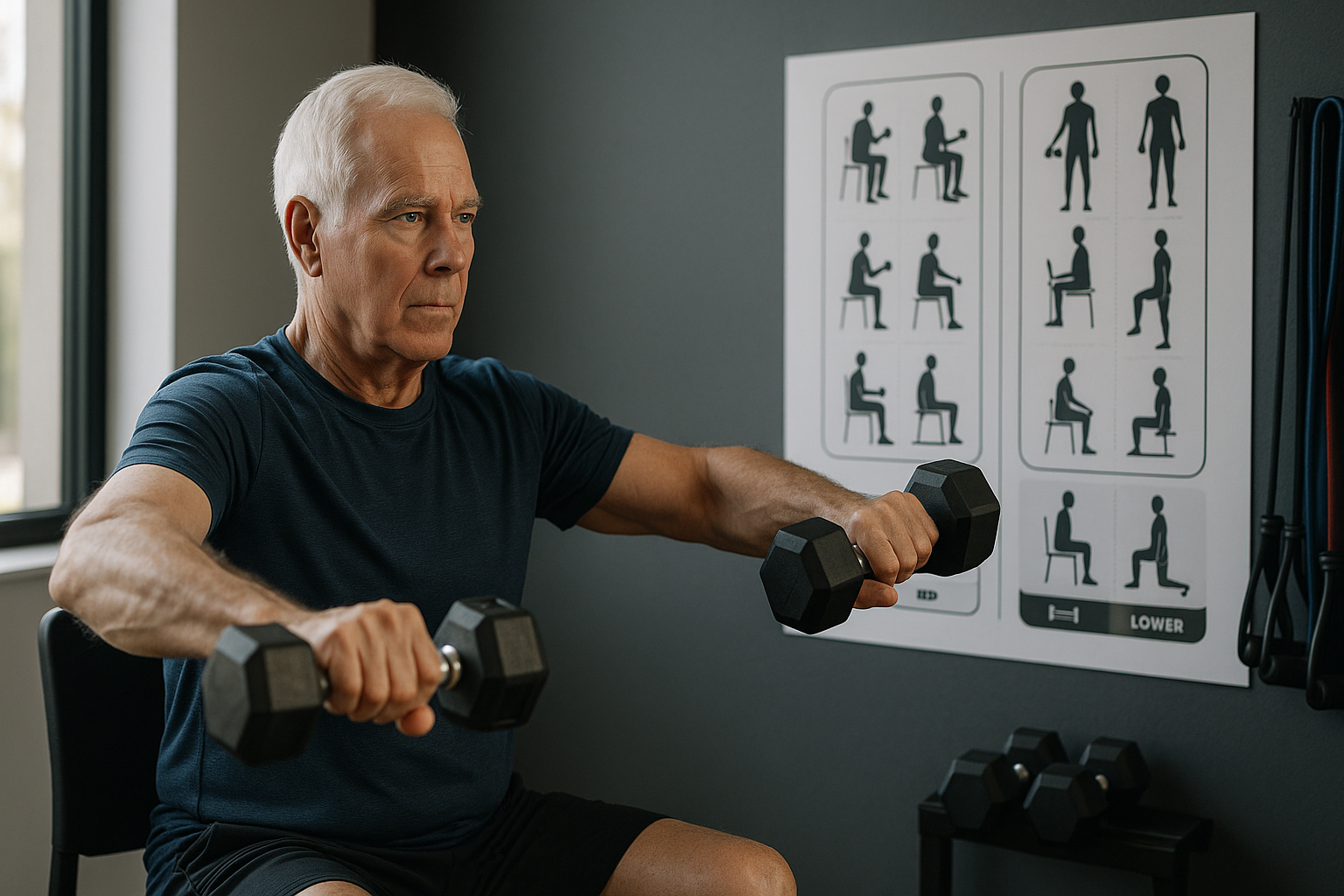
- Light dumbbells: great for progressive upper body and lower body strength training if you can control the weight
- Bodyweight: useful for movement patterns (but use chair support and range of motion limits as needed)
Quick equipment safety check: Make sure bands won’t snap back into your face, dumbbells are stable on the floor before picking up, and your chair won’t slide.
A 20-minute strength training routine for seniors and beginners (2–3x/week)
This routine is designed as a repeatable template: stable setup first, then a gradual progression pathway. If you’re searching for 20 minute strength training for seniors and beginners, this is the “do it today” plan.
| Block | Time | Focus | Goal |
|---|---|---|---|
| Warm-up | 3–5 minutes | Move joints, raise readiness | Easy effort |
| Main block A | 8–9 minutes | Lower body + sit-to-stand | Controlled strength |
| Main block B | 6–7 minutes | Upper body | Posture + strength |
| Cooldown + recovery | 2–3 minutes | Breathing + gentle mobility | Feel better afterward |
Weekly schedule (CDC-aligned style): Do this routine 2–3 days per week, spacing sessions out (example: Monday + Thursday, or Monday/Wednesday/Friday). On non-training days, walk gently or do light mobility if you like.
Warm-up (3–5 minutes)
- 1 minute: March in place (hold chair back if needed)
- 1 minute: Seated leg extensions (slow, controlled)
- 1 minute: Shoulder rolls + arm circles (small range)
- 30–60 seconds: Gentle sit-to-stand practice (half-range if you’re tight or new)
Effort: keep it easy. Think “waking up the body,” not “working out.”
Main workout block A (lower body + sit-to-stand focus)
Use a chair. Move with control. If you feel unsteady, place a second hand on a stable surface.
-
Chair sit-to-stand — 2 sets of 6–10 reps
- Beginner (easy): use a higher chair; pause briefly at the top
- Form cues: feet hip-width, lean slightly forward from the hips, stand tall without locking knees
-
Seated or standing heel raises — 2 sets of 8–12 reps
- Support: fingertips on chair back or countertop
- Focus: controlled up + slower down
-
Seated banded leg press (optional) OR glute squeeze — 1–2 sets of 8–12 reps
- Option A (bands): loop a band around thighs and gently push knees outward while keeping feet planted (light tension)
- Option B (no bands): seated glute squeeze hold 2–3 seconds, then relax
Target: working effort—finish most sets with 1–3 reps “in the tank.”
Main workout block B (upper body focus)
Choose one option per movement. If you’re doing strength training for seniors over 60, start conservative and prioritize pain-free range.
-
Seated row (resistance band preferred) OR supported dumbbell row — 2 sets of 8–12 reps
- Band setup: anchor band at a stable point, pull elbows back, squeeze upper back
- Beginner cue: keep shoulders “down and back,” avoid shrugging
-
Chest press (band) OR dumbbell press from a chair — 2 sets of 6–10 reps
- Range: stop where shoulders stay comfortable
- Control: slow lowering, smooth press
-
Seated biceps curl (dumbbells) OR band curl — 1–2 sets of 8–12 reps
- Stability: keep upper arms fairly still
- Optional: add 1-second pause at the top
Cooldown + recovery (2–3 minutes)
- 1 minute breathing: slow inhale/exhale, relax shoulders
- 1 minute gentle stretch: chest doorway stretch or supported arm across body (no pain)
- 30–60 seconds: easy walk around the room or march in place
After your session: you should feel like you worked, but you’re not wiped out. If you’re sore, it’s usually okay—just don’t increase intensity until you feel recovered enough to repeat the routine.
Before you progress: If you had joint pain (not normal muscle effort) during any rep, reduce range of motion or switch to the easiest variation for that movement next time.
Upper body strength training for seniors: best starting exercises
Upper body strength training for seniors is most effective when you include both push (front of shoulders/chest) and pull (upper back) patterns. That balance supports posture and daily tasks.
Push (chest/shoulders) options
- Seated band chest press (start light tension)
- Chair-supported dumbbell press (keep elbows at a comfortable angle)
- Wall or countertop push-ups (only if comfortable; use a higher surface for easier leverage)
If shoulders are sensitive: reduce range (don’t force deep movement), choose a neutral grip (palms facing each other with dumbbells), and consider bands for smoother resistance.
Pull (back/biceps) options
- Seated band row (squeeze shoulder blades gently)
- Supported dumbbell row (one knee/hand supported)
- Band pull-aparts (light tension, controlled)
- Seated biceps curls (dumbbell or band)
Key cue: avoid shrugging. Think “elbows back,” with a steady torso.
Progression plan: how to get stronger without overdoing it
Progress doesn’t have to be dramatic. For strength training exercises for older adults, it’s often about improving control and gradually adding a small dose of work.
Add reps vs. add resistance
Use a simple progression ladder for each exercise:
- Phase 1 (build consistency): Stay with the easiest variation and hit the low end of the rep range.
- Phase 2 (add reps): When the sets feel like you could do 2–3 more reps, increase to the high end of the range next time.
- Phase 3 (add resistance): After you reach the top of the rep range for all sets, increase band tension slightly or use a slightly heavier dumbbell.
Rule of thumb: Don’t chase heavier weight every week. Add reps first—then resistance.
How to scale if balance or mobility is limited
Scaling is part of safe form. Use these “if/then” options:
- If standing feels unstable: do the chair version of sit-to-stand, or shorten range and hold the chair back for support.
- If you can’t stand fully: stop at a comfortable partial stand and focus on a controlled return.
- If knees hurt during sit-to-stand: raise chair height, slow down the lowering phase, and reduce depth.
- If you struggle with shoulder comfort: switch to neutral-grip dumbbells (or lighter bands), reduce range, and prioritize rows over presses for a week.
- If fatigue is high: do 1 set instead of 2 for one or two exercises—finish the session instead of skipping.
Recovery support (adherence matters): if your sleep is poor, you may feel more sore and less motivated to return. Consider sleep habits that support muscle recovery so you can stay consistent with your training rhythm.
Best place to find form guidance (videos & playlists)
If you’re looking up strength training for seniors videos on YouTube, your goal isn’t just inspiration—it’s safe technique. The safest way to use online strength training videos for seniors is to treat them like cues, not replacements for your body’s pain signals.
How to choose senior-focused instruction (pain-free form, supervised options)
- Look for: chair-based demo, slow tempo, and modifications for balance limitations
- Avoid: videos that jump straight to heavy loads or “max effort” instructions
- Confirm: the exercise matches your available equipment (bands vs dumbbells vs machines)
- Filter for safety cues: “pain is not normal,” “keep breathing,” “stop if dizzy”
- Extra caution: if you have persistent symptoms, prioritize a physical therapist or qualified trainer for form review
When you watch strength training for seniors youtube content, pause and compare the demo’s setup (foot position, chair height, grip) to your own. If something doesn’t match, scale first.
If you want to support your training with nutrition basics, keep it simple: aim for high-protein snack ideas to support muscle gains—especially if you’re trying to stay consistent with training.
FAQ: strength training for seniors
How often should seniors do strength training?
For most older adults, a practical starting target is 2–3 days per week with rest between sessions. For frequency guidance framed for older adults, see CDC guidance: Growing Stronger—strength training for older adults.
What is a safe 20-minute strength training routine for seniors and beginners?
A safe template is the one in this article: 3–5 minutes warm-up, 8–9 minutes block A (lower body + sit-to-stand), 6–7 minutes block B (upper body push/pull + curls), and 2–3 minutes cooldown. Keep effort at “working effort,” not max strain.
What equipment is best for strength training for seniors (bands, dumbbells, machines, chair)?
Chair support is excellent for stability. Resistance bands are often joint-friendly and easy to adjust. Light dumbbells can work well for progressive upper body strength training if you can control the weight through a comfortable range.
How can I do upper body strength training for seniors if my shoulders are sensitive?
Use smaller, comfortable ranges and consider lighter bands or neutral-grip dumbbells. Choose stable, supported positions. Emphasize pull (rows) if pressing bothers your shoulders—then reintroduce presses gradually.
Is strength training safe over 60 if I’ve been inactive?
Often, yes—when started conservatively with effort-based intensity and stable movement options. If you have medical concerns or long inactivity, check with a healthcare professional first and begin with the easiest variations (chair-supported, lighter resistance).
What should I do if an exercise causes pain (not normal muscle effort)?
Stop that exercise and modify the range, reduce effort, or switch to an easier variation. If pain is sharp, persistent, or worsening, seek medical advice. Remember: mild muscle effort is different from pain.
Conclusion: your next step
If you want strength training for seniors that actually sticks, start with the 20-minute routine above and repeat it 2–3x per week. Your job for the next 2 weeks is consistency and form—then progress by adding reps first, and resistance only after the reps feel controlled.
Next step: Pick your days (for example, Monday/Thursday or Monday/Wednesday/Friday), set up a chair and your light resistance (band or dumbbells), and do your first session today.
Safety reminder: This is general educational information, not medical advice.
Stop and seek medical advice for chest pain, dizziness/fainting, severe shortness of breath, or sharp/persistent pain. Aim for working effort—if pain occurs, modify or stop.