
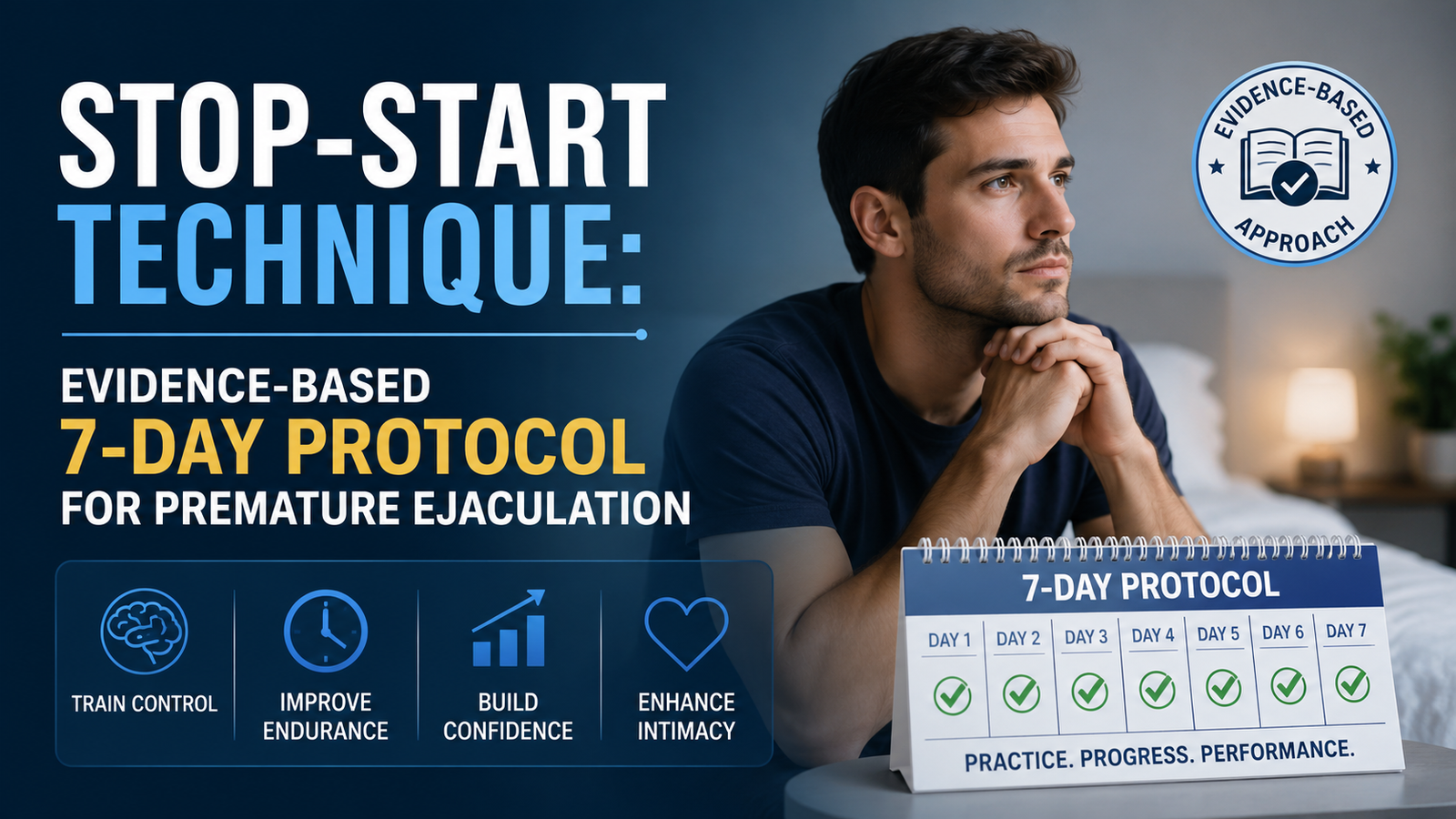
Premature ejaculation (PE) is more common than most men realize—and it can be addressed. In this action-first guide, you’ll learn what premature ejaculation looks like, why it happens, and exactly how to practice the stop-start technique premature ejaculation with a step-by-step protocol you can run this week. We’ll also cover relaxation techniques for premature ejaculation, options like desensitizing creams for premature ejaculation (with safety cautions), pregnancy risk, and—because search results get confusing—premature ejaculation in female terminology and when to see a clinician.
Quick note: This article is educational and not a substitute for medical advice. If symptoms are persistent, painful, newly started, or causing significant distress, consider speaking with a urologist or sexual health clinician.
What is premature ejaculation?
Premature ejaculation is when semen leaves the body (ejaculate) sooner than desired during sexual activity. People often describe it as difficulty controlling the timing of ejaculation, even when they want to last longer. The condition can cause embarrassment, anxiety, and relationship stress.
For foundational medical definitions and overview, see: Premature ejaculation definition and causes (Mayo Clinic).
What does premature ejaculation look like?
In real life, what it looks like usually shows up as an observable pattern—either for you, your partner, or both. Common “real-world” signs include:
- You consistently ejaculate sooner than you intend (during partnered sex or masturbation).
- You feel you “can’t quite slow it down” once arousal builds.
- You may stop starting again due to fear of losing control—which can actually raise anxiety.
- Your partner notices the speed or that ejaculation happens earlier than expected.
Importantly, “premature” is about control and timing relative to what you want, not about one universal number of minutes.
Typical timing/trigger patterns
Many men with premature ejaculation report the trigger is less about random chance and more about a predictable build-up: arousal rises, pressure increases, and ejaculation happens quickly once you reach a certain intensity. Some people notice it more during intercourse than other types of stimulation; others notice it most during certain positions, rhythms, or when they’re highly aroused.
Why it happens (common causes in plain language)
Premature ejaculation often isn’t caused by just one thing. Think of it as a “control + reflex + context” problem: your body’s arousal response, your learned pacing habits, and your mental state (like performance anxiety) can all interact.
Psychological vs physical contributors (overview)
Possible contributors include:
- Performance anxiety: fear of “going too fast” can increase arousal and reduce control.
- Learned patterns: if you’ve been ejaculating quickly for a long time, your body may respond with a fast reflex once you approach a threshold.
- Relationship and situational factors: stress, fatigue, novelty, or frequent interruptions can affect control.
- Physical sensitivity: some men are more sensitive and reach the ejaculation threshold quickly.
- Sexual pain or erection issues: these can complicate arousal regulation.
Serotonin/reflex factors
Clinicians sometimes describe PE in terms of how quickly ejaculation is triggered by arousal pathways—often involving neurotransmitter systems such as serotonin. You don’t need to manage the biology directly to benefit from behavioral training, but understanding that PE can involve a “reflex-like” response helps explain why skills like stop-start training can work.
For treatment overviews, see: Premature ejaculation treatment overview (Cleveland Clinic) and Premature ejaculation causes & treatment (UrologyHealth).
Start–Stop / Stop–Start technique (step-by-step plan)
This is the core skill-building section. If you only do one thing to improve, do stop-start technique premature ejaculation training consistently.
Goal: teach your body to recognize the “almost there” moment and give you enough pause to regain control, instead of riding the reflex all the way to ejaculation.
How to practice (setup, pacing, cueing)
- Choose the right practice environment: pick a time you’re not rushed and you can focus. Many people learn faster when they practice with fewer distractions.
- Start at a controlled intensity: begin stimulation below maximum intensity—aim for “comfortable high arousal,” not all-out.
- Define your “almost there” cue: use a consistent internal marker (a specific sensation, tightening feeling, or mental realization like “I’m about to lose control”). If you can, ask your partner to use a simple cue too.
- Start–Stop / Stop–Start loop:
- When you approach the “almost there” cue, stop stimulation immediately.
- Wait for arousal to drop enough that the cue fades.
- Restart stimulation at a slightly lower intensity.
- Repeat the cycle until you reach your training goal for the session (often multiple near-threshold cycles before ejaculation, rather than “go until it happens”).
Training principle: you’re not trying to “never ejaculate.” You’re training recognition + interruption + recovery.
What to do at the “almost there” point
Most people fail here because they stop too late. When you feel the moment arriving:
- Freeze the stimulation—don’t “keep going a little.”
- Shift your breathing into a slower rhythm (more on drills below).
- Mentally reset for 10–30 seconds: think “downshift” rather than “stop panicking.”
- Restart only when the cue drops—if it still feels imminent, you’re stopping too late.
Partner note (if applicable): it can help to agree on a simple “pause word” before starting. That reduces confusion and helps both of you follow the plan.
Training schedule (example cadence)
Instead of trying to “fix it in one night,” use gradual, skill-building practice. A practical approach:
- Frequency: practice a few sessions per week (consistent beats intense).
- Session structure: aim for several near-threshold cycles (for example, 3–6 stop-start loops) rather than one long sprint.
- Progression: as control improves, you can (a) get more time between the “almost there” cue and ejaculation, and/or (b) increase the number of loops before finishing.
- Intensity: don’t jump to maximum arousal immediately. Keep a level where you can reliably practice stopping in time.
If you’re prone to anxiety, start with more modest goals: “I will stop on time” is a win, even if time to ejaculation doesn’t change much yet.
Common mistakes that prevent improvement
- Stopping too late: once ejaculation is already underway, stop-start can’t “undo” the reflex. The skill is timing the stop earlier.
- Stopping for too short a time: if you restart immediately, arousal won’t drop enough.
- All-or-nothing practice: one “try hard” session per week tends to reinforce panic and failure cycles.
- Practicing only when you’re anxious: choose calmer sessions first so you can learn control under less pressure.
- Ignoring the breathing downshift: without calming arousal, stop-start becomes a struggle rather than a training skill.
If you want a mindset anchor for consistent practice, you may also like 5 Keys to Building Lasting Discipline for Consistent Success.
Relaxation techniques for premature ejaculation
Relaxation techniques for premature ejaculation work because they support arousal control. They won’t replace training, but they make stop-start easier by reducing “surge” behavior.
Deep breathing drill (simple, repeatable routine)
Try this before and during practice:
- Before you start: take 5 slow breaths (inhale through the nose, exhale longer than inhale).
- When you approach “almost there”: pause stimulation and do 3–5 “long exhale” breaths.
- During the restart: keep breathing steady (avoid holding your breath or hyperventilating).
Why it helps: longer exhales support a downshift in your body’s arousal state, making it easier to recognize and interrupt the surge.
Pre-sex calming / arousal control tips (non-medical)
- Reduce performance stakes: practice with the intention of training, not “proving yourself.”
- Warm-up more gradually: a controlled build often beats sudden high-intensity stimulation.
- Change the rhythm: steady, predictable stimulation can be easier to manage than erratic surges.
- Limit stimulants right before sex if they worsen anxiety/arousal intensity (for some men this includes heavy alcohol or excessive caffeine).
Topical options: desensitizing creams (what they’re for, who should be cautious)
Some people look for desensitizing creams for premature ejaculation because they may reduce sensitivity in the short term. These products typically aim to lower the sensation that contributes to reaching the ejaculation threshold too quickly.
How they may help (mechanism, not magic)
In practical terms, desensitizing agents can make it easier to tolerate stimulation longer by:
- reducing penile sensitivity, and/or
- slowing the escalation toward the ejaculation reflex.
They’re generally best used as a support to behavioral training (like stop-start), not as a stand-alone “cure.”
Safety cautions
Be careful with topical numbing products:
- Irritation risk: burning, redness, or numbness that feels uncomfortable means you should stop.
- Partner exposure: creams can transfer to a partner; that can cause temporary numbness or discomfort. Use per label directions and consider discussing with a clinician if you’re unsure.
- Condom compatibility: some products may affect condoms or sexual sensation. Always check the package instructions.
- Don’t combine randomly: avoid stacking multiple numbing products at once without medical guidance.
If you get persistent irritation or reduced sensation that concerns you, consult a clinician.
Premature ejaculation and pregnancy risk
PE itself doesn’t automatically determine whether pregnancy can happen. What matters for pregnancy is whether sperm is present and whether semen is deposited near the vagina around the fertile window.
Can premature ejaculation get you pregnant?
Generally speaking: yes, pregnancy can still happen if ejaculation occurs (even earlier than desired) and sperm reaches the vaginal canal. However, pregnancy depends on factors like ejaculation location, timing, and whether contraception is used—not simply on how quickly ejaculation occurs.
Actionable safety guidance: if pregnancy avoidance is important, use reliable contraception (e.g., condoms and/or other methods) and consider family-planning guidance from a healthcare professional.
Female-related questions & terminology (reduce confusion)
Search queries often mix up terms. To keep you on the right track:
- Premature ejaculation is typically used in medical contexts to describe ejaculation in men (semen leaving the body).
- Some people online use “premature ejaculation” when they really mean orgasm occurs quickly or female ejaculation/emission (which are different concepts).
Can women have premature ejaculation?
In standard medical usage, premature ejaculation refers to male ejaculation timing and control. Women may experience fast orgasm or other changes in sexual response, but that’s not usually labeled “premature ejaculation.” If you’re searching because you (or a partner) feels you reach orgasm too quickly, the best next step is a sexual health evaluation focused on your specific symptoms.
Premature ejaculation in female / “premature ejaculation female”
When people search “premature ejaculation in female” or “premature ejaculation female,” the underlying question is often about sexual response speed or fluid release. Those topics can involve different diagnoses and terminology. The safest approach is to get clarification from a clinician who can distinguish between:
- orgasm timing and control
- female emission (sometimes called “female ejaculation” in popular language)
- other sexual function concerns (pain, arousal issues, distress)
If your search concern includes pain, new onset symptoms, or significant distress, it’s worth speaking with a sexual health professional.
When to see a clinician (and coding/terms)
Behavioral training can help many people. Still, there are times to get professional assessment.
Premature ejaculation ICD-10
For people searching “premature ejaculation ICD-10,” clinicians often refer to standard diagnostic coding systems and related documentation. ICD-10 is a widely used reference standard (and coding can vary by country and clinical documentation). A clinician can confirm the appropriate code based on your exact symptom pattern and history.
If you want to connect this to broader medical context, you may also find useful ICD-10 and side effect safety as a general example of how coding relates to clinical reporting.
Red flags
Seek medical help promptly if you have:
- Pain with ejaculation or sex
- New onset PE (especially if you previously had normal control)
- Erectile dysfunction that’s affecting sexual performance
- Significant relationship distress or persistent anxiety
- Symptoms that worsen quickly or don’t improve with basic training
For more context on “when to get help,” see: Ejaculation problems and when to get help (NHS).
Premature ejaculation band: what it is (and why to be cautious)
Some people try a premature ejaculation band (often marketed as a constriction band) with the idea that reduced blood flow/sensation can delay ejaculation. While these devices may be used by some, results vary, and they can cause discomfort or numbness if used improperly.
Safety-first guidance: if you consider any device, follow manufacturer instructions, avoid excessive pressure, and stop if you feel pain or numbness beyond what’s reasonable. If you have pain, circulation problems, or erectile issues, ask a clinician before using bands or constriction devices.
FAQ
Can premature ejaculation get you pregnant?
It depends. Pregnancy risk is determined by whether semen containing sperm reaches the vagina around the fertile window. Since ejaculation can still occur (even earlier than desired), pregnancy is possible—so use reliable contraception if avoiding pregnancy matters.
What does premature ejaculation look like in real life?
It often looks like consistently ejaculating sooner than you intend, feeling like you can’t slow down once arousal rises, and having a predictable “almost there” moment you sometimes reach too late.
How do I practice the stop-start technique for premature ejaculation?
Begin stimulation at a controlled intensity. When you approach the “almost there” cue, stop immediately. Wait until arousal drops and the cue fades, then restart at slightly lower intensity. Repeat multiple loops in a calm, consistent training session.
Do relaxation techniques like deep breathing actually help with premature ejaculation?
They can. Deep breathing for premature ejaculation supports arousal downshifts, making it easier to recognize and interrupt the surge during stop-start training.
Are desensitizing creams for premature ejaculation safe to use?
They can be used by some people, but safety depends on the specific product, correct dosing, and potential irritation or transfer to a partner. Follow label directions, avoid if you get irritation, and be cautious with condom compatibility.
What is the ICD-10 code for premature ejaculation?
There isn’t one universal single code you should rely on without clinical context. ICD-10 codes depend on how your clinician documents the condition and related factors. A healthcare professional can confirm the appropriate code for your case.
Conclusion: what to do next
If you want the most practical starting point, run the stop-start technique premature ejaculation protocol consistently for a few weeks: practice the stop earlier, use long-exhale breathing when you pause, and track whether you’re better at catching the “almost there” moment.
Next step: choose a low-pressure practice session this week and schedule a simple goal (for example: “I will stop on my cue 3 times before finishing”). If symptoms are new, painful, or not improving, book a clinician visit for targeted assessment.