
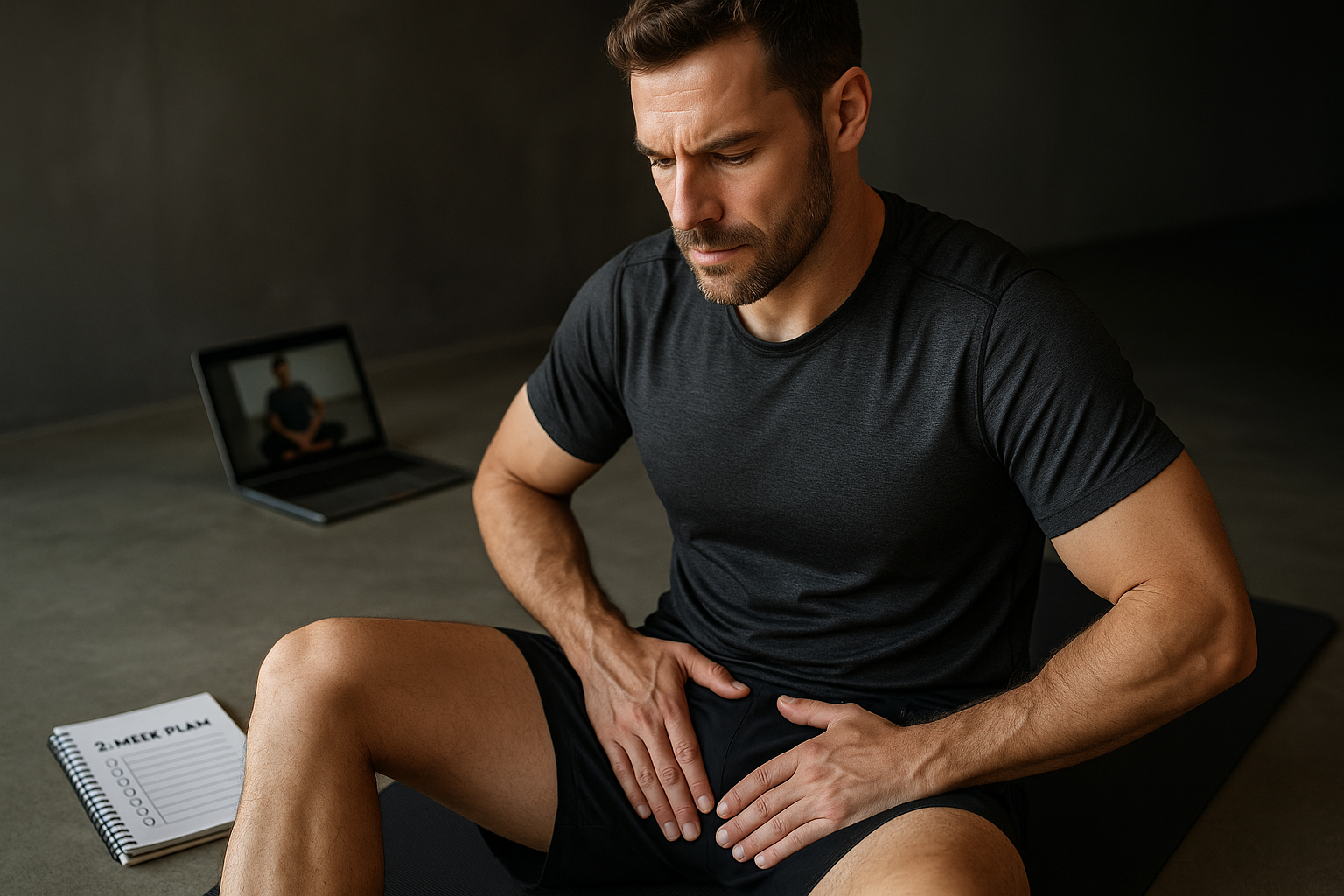
Important: This article is general education—not medical advice. Kegel exercises for men can help some people, but they’re not right for everyone. Stop and seek medical guidance if you feel pain, notice bleeding, or your urinary/bowel symptoms worsen. If you’re post–prostate surgery or in prostate cancer treatment, coordinate timing/intensity with your clinician.
If you’ve searched kegel exercises for men, you probably want three things fast: (1) what these exercises do, (2) how to do them correctly (without squeezing the wrong muscles), and (3) whether they help with issues like incontinence—and what to do if they hurt or feel “too tight.” This action-first guide gives you a clear muscle-spotting method, a 2-week beginner progression, and a practical reverse kegel exercises for men section (relaxation)—because pelvic floor balance matters as much as strength.
What Kegel exercises do for men (benefits & realistic expectations)
Kegels are exercises that train the pelvic floor—the “sling” of muscles that support the bladder, bowel, and help control pressure inside the pelvis. Done correctly, the goal isn’t to clench forever. It’s to improve coordination (timing), strength (control), and sometimes relaxation (so the system isn’t stuck in over-tightness).
Clinically, Kegels are commonly used to support bladder control. Mayo Clinic notes Kegels can help improve bladder control and may help sexual performance in some cases—without guaranteeing outcomes. (That realistic “may help” matters.)
Kegel exercises for men: Understand the benefits
Bladder/bowel control (incontinence support)
Many men searching “kegel exercises for men incontinence” are dealing with:
- Urgency (feels like you have to go now)
- Frequency (going more often)
- Leakage with coughing, lifting, or movement
Kegels can support coordination and strength of the pelvic floor so you have better control of pressure. Cleveland Clinic similarly describes Kegels as a way to help control urine and support pelvic floor function.
Kegel Exercises for Men – Cleveland Clinic
Real expectation: improvement often shows up as better control and less leakage/urgency—not instant “cure.” If symptoms worsen, pause and reassess (pain/tension is a key warning sign).
Possible sexual function support (avoid guaranteed claims)
Some men ask: “does kegel exercises work for men” when it comes to erections, stamina, or orgasm control. The pelvic floor contributes to sensation and pressure regulation, so improving pelvic floor function can support sexual health for certain individuals.
But ED is multifactorial (blood flow, nerves, hormones, psychological stress, medications). So Kegels should be viewed as pelvic floor training, not a standalone fix. If you have ED, consider discussing a complete plan with a clinician or pelvic floor physical therapist.
When Kegels help vs when they may not (e.g., pelvic floor tightness)
Here’s the part many competitors skip:
- Helpful pattern: weak/poor control, leakage, difficulty holding urine, poor endurance.
- Potentially unhelpful pattern: pelvic floor tightness, pain, burning, urethral/perineal discomfort, or trouble relaxing after you contract.
If you already feel tense or “locked up,” adding more squeezing can make symptoms worse. That’s where reverse kegel exercises for men come in.
How to find the right muscles (step-by-step, common mistakes)
Most “kegel exercises for men reddit” threads aren’t wrong about the goal—they’re wrong about the muscle. The most common mistake I see: people squeeze their abs, glutes, or hold their breath instead of using the pelvic floor.
Quick “stop the flow” test—what it’s for (and why not to use as a routine)
Yes, some guides suggest using the “stop the flow” test to locate the right muscles. It can help you identify the sensation briefly.
But don’t use it repeatedly. Stopping urination as a routine can irritate the bladder and condition awkward timing. Use it only as a one-time “find the sensation” experiment if needed, then switch to training outside the toilet.
Signs you’re using pelvic floor vs abs/glutes
Try a few cues:
- Good pelvic floor effort: a subtle lift/tightening around the base of the penis/testicles and anus (often described as an internal “zip-up”).
- Common wrong effort: your stomach hardens, you feel strain in the groin, your glutes clamp, or your breath gets held.
- Body rule: you should feel minimal movement in the abdomen and buttocks.
Experience-driven tip: If you’re not sure, try contracting while standing and keeping your ribs relaxed. If you can do the effort without abdominal bracing or butt clenching, you’re closer to the right muscle.
How long to hold and how to relax between reps
Two equally important skills:
- Contraction: controlled squeeze (no straining)
- Relaxation: full release back to baseline (don’t remain clenched)
A good beginner tempo is: squeeze for the prescribed time, then relax for the same or longer time before the next rep. If relaxation is hard, add reverse kegels (next sections).
Stop criteria (important): sharp pain, burning, worsening urinary urgency, pelvic pain, or increased tightness that doesn’t ease after stopping.
Kegel exercises for men: 3 core exercises (with sets/reps)
Below are three practical “building blocks.” You don’t need to do 7 different variations immediately. The goal is consistent, correct training.
General setup: Sit or lie down where you can relax your stomach. Breathe normally. Move slowly and focus on internal lift/tightening.
Squeeze-and-hold Kegels (timed holds)
Purpose: endurance and control.
How to do it:
- Identify the pelvic floor contraction (internal lift).
- Squeeze for the target time.
- Relax completely until you feel “back to normal.”
Beginner sets/reps:
- Week 1–2: 5 reps of 3–5 second holds, with 5–10 seconds rest between reps
Quick contractions (repeated pulses)
Purpose: fast coordination (often useful for leakage triggers).
How to do it: squeeze briefly (about 1 second), relax fully (about 1–2 seconds), repeat.
Beginner sets/reps:
- Week 1–2: 10 quick pulses, rest 30–60 seconds, repeat 1 more time if form stays clean
Endurance holds + progression
Purpose: build longer control without “max squeezing.”
How to do it: Use the same squeeze technique as holds, but stay submaximal (about 60–80% effort). You should feel work, not strain.
Progression idea: add 1 second to your hold time each week if you’re not getting pain/tension and relaxation remains comfortable.
Simple progression target:
| Week | Squeeze-and-hold | Quick pulses |
|---|---|---|
| Week 1 | 3 seconds x 5 reps | 1 set of 10 pulses |
| Week 2 | 5 seconds x 5 reps | 2 sets of 10 pulses (only if relaxation stays easy) |
Routine reminder: If you’re asking “do kegel exercises work for men?”—they often do, but only when the pelvic floor is doing the work and you’re progressing steadily.
Reverse Kegel exercises for men (relaxation to balance the pelvic floor)
Strength is only half the equation. If you’re always squeezing—intentionally or unconsciously—your pelvic floor can become “stuck.” Reverse kegels train you to let go and restore coordination between contracting and relaxing.
Why relaxation matters
Many men don’t realize they have a tight pelvic floor. Over-squeezing can contribute to:
- Pelvic/perineal tightness or discomfort
- Difficulty relaxing after urination
- Worsened urgency when trying to “control harder”
So if Kegels feel like they create more tension than control, don’t just “push through.” Add reverse kegel exercises for men and reassess.
Basic reverse kegel progression
Goal: gentle downward/expansion sensation while staying relaxed.
How to do it:
- Lie down or sit with your abdomen relaxed.
- Inhale normally (no forced breath holding).
- Think: “let the pelvic floor soften” or “allow the base to drop slightly.”
- Exhale and return to neutral.
Beginner prescription:
- Week 1–2: 5–8 reps, holding the relaxed “let go” sensation for 3–5 seconds
- Do it after your squeeze work (not immediately before) unless your clinician has advised otherwise
When to avoid over-squeezing and seek guidance
Avoid adding more Kegels and consider evaluation if you have:
- Pain (including painful urgency or perineal pain)
- Burning/tenderness that increases during or after training
- Symptoms that worsen week to week
- Known pelvic floor dysfunction, chronic prostatitis-like symptoms, or ongoing pelvic pain
In these cases, pelvic floor physical therapy can be a game-changer because your “program” needs to match your actual muscle behavior.
Kegel exercises for men before and after (prostate-related timing)
Men often ask for “kegel exercises for men before and after” prostate treatment timing. The correct answer depends on the type of issue (post-surgery vs other treatment) and your tolerance.
UCLA Health provides patient education on how to do Kegel exercises for men for prostate cancer contexts. Coordination with clinicians is essential—especially around postoperative windows.
How to Do Kegel Exercises for Men – Prostate Cancer (UCLA Health)
After prostate cancer treatment: how to think about “before/after”
Common scenarios:
- Before treatment: if urinary control is already a concern, clinicians may recommend pelvic floor training as part of preparation.
- After treatment (especially prostatectomy): pelvic floor coordination can change. Training is often introduced or adjusted based on healing status and symptom stage.
Real expectation: improvements in continence can happen, but timelines vary. “Doing Kegels hard” is not the same as “doing them right.”
When to start, when to pause, and what “success” feels like
When to start: follow your clinician’s guidance for your specific procedure and healing status.
When to pause: if you get pain, increased urgency, worsening leakage, or pelvic discomfort that doesn’t settle.
What success may feel like:
- Less leakage during coughing/lifting
- Improved ability to “hold” when you notice urgency
- More consistent control and less fear of sudden leakage
About sexual outcomes: some men notice improved confidence or pelvic sensation, but avoid guarantees. If you’re dealing with ED after prostate issues, ask about a comprehensive erectile/urinary plan rather than relying on Kegels alone.
Kegel routine (beginner plan you can follow)
Use this if you’re new or restarting. Consistency beats intensity.
Safety note (repeat): Stop and seek medical guidance if you have pain, bleeding, worsening urinary/bowel symptoms, or if symptoms get worse.
Week 1–2 progression (frequency + tempo)
Do this daily or 5 days/week (choose what you can keep consistent).
Day structure (about 8–12 minutes):
- Part A: Squeeze-and-hold (Week 1: 3 sec x 5 reps; Week 2: 5 sec x 5 reps)
- Part B: Quick pulses (Week 1: 10 pulses x 1 set; Week 2: 10 pulses x 2 sets)
- Part C: Reverse Kegels (5–8 relaxed reps, 3–5 sec each)
Tempo rules:
- No breath holding—breathe calmly.
- Relax fully between reps.
- Use submax effort (you’re training skill, not testing strength).
Tracking improvement (urinary urgency/frequency, control)
Use a simple tracker for 14 days:
- Urgency score (0–10): how urgent it feels when you first need to go
- Leakage events: count days with leakage or approximate frequency
- Bathroom frequency: rough number per day
If you notice improved control without increased tension, you’re on the right track.
Stop criteria (pain, worsening symptoms)
Stop and get checked if you have:
- Pain during exercises or pain that lingers
- New burning, bleeding, or pelvic pain flare
- Urinary symptoms worsening week-to-week
- Difficulty relaxing (feeling more tight after training)
And remember: if reverse kegel exercises for men improve how you feel, that’s a clue your program needs more relaxation balance—not more squeezing.
Kegel exercises for men video checklist (how to use video resources safely)
Many searches are explicitly for video: kegel exercises for men youtube, kegel exercises youtube for men, or “kegel exercises for men video checklist.” Video can help—if you evaluate form and fit.
Quick checklist before you copy any “7 kegel exercises for men video” routines:
- Breathing cue: Does the coach warn against breath holding?
- Relaxation cue: Does the video include full release between reps (not constant clenching)?
- Muscle targeting: Do they mention avoiding abs/glute clenching?
- Effort level: Do they say “submax,” “no straining,” or “shouldn’t hurt”?
- Progression: Is there a step-up plan (weeks/holds) rather than “do everything” immediately?
- Reverse Kegels included: Ideally yes—pelvic floor relaxation is rarely covered thoroughly, but it’s key for balance.
What to look for in a good video (form cues)
A good men’s pelvic floor video teaches you:
- Where you should feel it (subtle internal lift/softening)
- How to keep your abdomen and glutes from taking over
- How long to hold and how to fully relax
- How to adjust if you feel tightness
Don’t copy exercises that cause pain/tension
If a video tells you to push through discomfort, that’s a red flag. What to do instead:
- Stop the painful motion.
- Switch to reverse kegel exercises for men for relaxation for a few days.
- If symptoms persist or worsen, consult a clinician or pelvic floor physical therapist.
FAQ
What do kegel exercises do for men?
Kegel exercises help train the pelvic floor muscles that support bladder and bowel control. For many men, strengthening and coordinating these muscles can improve urine control (especially leakage) and pelvic floor function. Mayo Clinic notes potential benefits for bladder control and possibly sexual performance, but results vary. If symptoms worsen or you feel pain, stop and get guidance.
Are kegel exercises good for men with incontinence?
They can be helpful for some types of urinary incontinence because they improve pelvic floor coordination and strength. However, if your pelvic floor is already overly tight or you experience pain/urgency flare, more squeezing can make things worse. In those cases, adding reverse kegel exercises for men and getting assessed is often the better path.
Does kegel exercises work for men, and how long does it take to notice changes?
Yes, kegel exercises for men can work when you’re using the correct muscles and progressing consistently. Many people notice changes within a few weeks, but meaningful improvement can take longer—often measured in weeks to a few months. Track urgency/leakage patterns and reassess if you aren’t improving or symptoms worsen.
How to do kegel exercises for men correctly (without squeezing the wrong muscles)?
Start by finding the pelvic floor contraction (the goal is a subtle internal lift, not abdominal or glute squeezing). Keep breathing relaxed, avoid straining, and fully relax between reps. If you can’t relax or you feel tightness or pain afterward, switch to relaxation work (reverse kegels) and consult a clinician or pelvic floor specialist.
What are reverse kegel exercises for men, and when should I do them?
Reverse Kegels are relaxation-focused drills that teach the pelvic floor to soften and coordinate properly. Do them if you feel pelvic tightness, have trouble relaxing after contraction, or notice urgency gets worse with Kegels. In many programs, reverse kegels pair with squeeze work for better balance.
Should I do kegel exercises before and after prostate treatment—and when should I ask my clinician?
Many men do pelvic floor training around prostate issues, but the timing and intensity should match your specific treatment and healing status. Ask your clinician before starting or increasing Kegels if you’ve had recent prostate surgery, are actively in treatment, or have worsening urinary/bowel symptoms. UCLA Health provides patient guidance for prostate-related Kegel training, emphasizing individualized coordination.
Conclusion: your next step
If you want the fastest way to benefit from kegel exercises for men, focus on correct muscle activation, full relaxation, and a simple 2-week progression—not maximum squeezing. Start with the routine above (including reverse kegel exercises for men), track urgency/leakage for 14 days, and stop if you feel pain or symptoms worsen.
Next step: If you’re unsure whether you’re using the right muscles (or if you feel tightness/pain), consider scheduling a pelvic floor evaluation with a clinician or pelvic floor physical therapist to confirm your form and tailor your plan.