
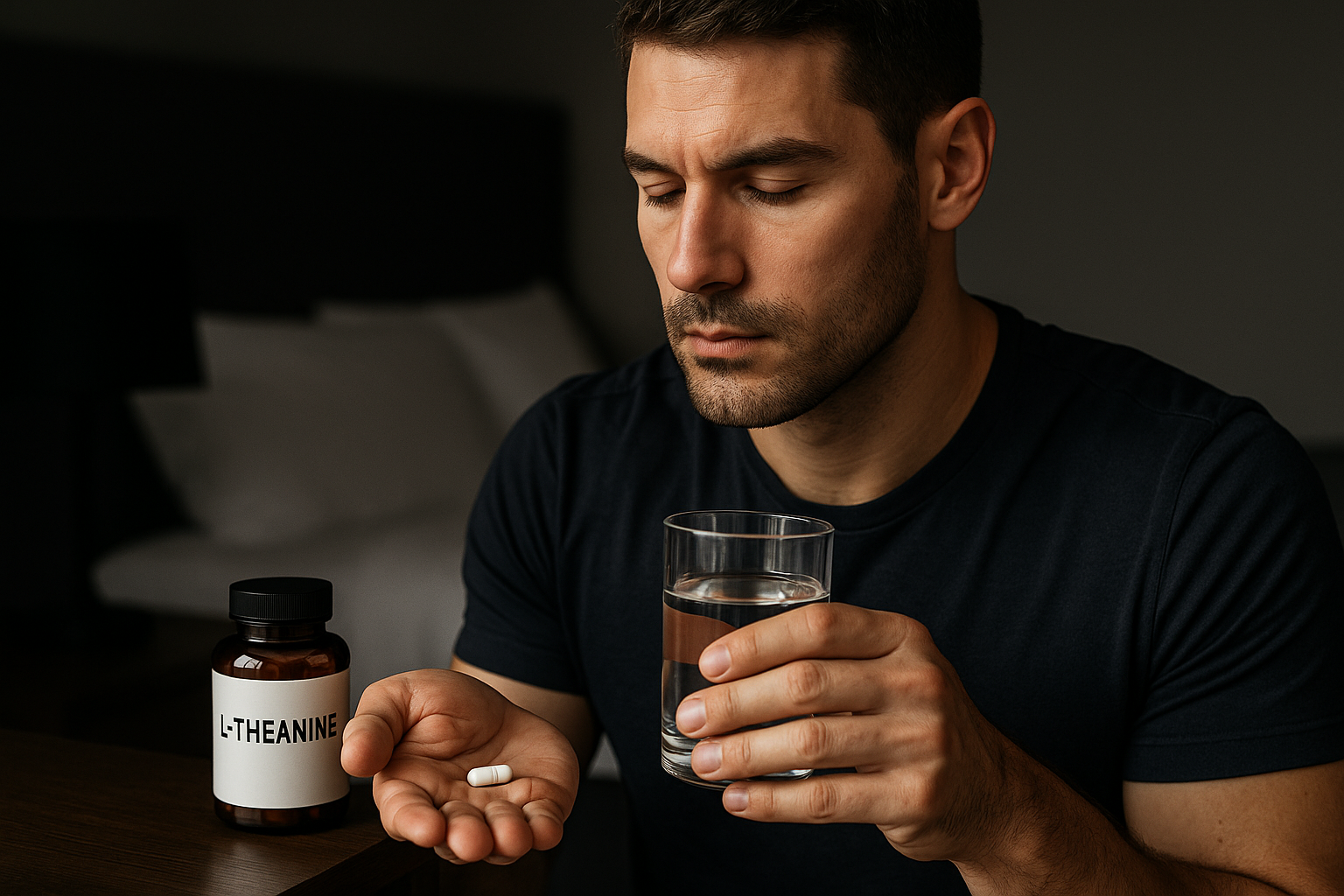
Does L-theanine make you sleep? For many people, l-theanine supplements for sleep don’t work like a classic sedative. Instead, research and sleep-aid guidance suggest it may help you relax and lower stress/anxiety, which can make it easier to fall asleep or improve some aspects of sleep. The practical takeaway: if your sleep problem is stress-driven (racing mind, tension, “can’t switch off”), l-theanine before sleep may be worth trying as an educational, low-risk experiment—while still keeping realistic expectations about results.
Medical note: This article is educational, not medical advice. If you have persistent insomnia, a sleep disorder, or take medications, talk with a healthcare professional before adding any supplement.
Does L-theanine make you sleep?
What people notice (sleep onset vs “sedation”)
When people search will l-theanine help me sleep or ask “does l theanine make you sleep,” what they usually mean is one of two things:
- Sleep onset help: “Will it help me fall asleep faster?” Many users describe feeling calmer or less “wired,” which can reduce the mental friction that delays bedtime.
- Sleep quality support: “Does it improve how I sleep?” Some evidence looks at changes in sleep parameters (e.g., aspects of sleep architecture) rather than a guaranteed “knockout” effect.
Importantly, L-theanine is commonly described as promoting relaxation rather than causing heavy drowsiness. That’s a key difference between relaxation/anxiolysis and sedation.
What research says (high-level evidence)
One of the better “does it work?” summaries is a meta-analysis of the effects of L-theanine consumption on sleep outcomes, which evaluates results across studies to understand whether sleep-related endpoints improve with L-theanine. You can review it here: The effects of L-theanine consumption on sleep outcomes (meta-analysis).
Sleep outcomes can differ study-to-study (some focus on difficulty falling asleep; others measure sleep parameters). Overall, the research direction supports the idea that L-theanine may help some sleep-related outcomes—most plausibly via stress reduction—rather than acting exactly like a traditional hypnotic.
For additional context, Sleep Foundation provides a practical overview of L-theanine for sleep, including what it may help with and what to watch for: L-Theanine for Sleep (Sleep Foundation overview).
How L-theanine helps sleep (mechanisms in plain English)
If you’re looking for how does l theanine help sleep, the simplest explanation is that L-theanine can promote a calm, less-stressed nervous system state. That matters because stress is a major driver of insomnia-like symptoms in otherwise healthy people.
Stress/anxiety reduction (anxiolysis) and relaxation
Sleep onset is often delayed by a “can’t downshift” state: rumination, sympathetic activation, muscle tension, and alertness. L-theanine is frequently discussed for its anxiolytic/relaxation potential—meaning it may help reduce the subjective feeling of anxiety or mental activation. That relaxation effect can indirectly make bedtime feel more attainable.
This “relaxation first” model is consistent with the way the supplement is commonly used in real life, and with how sleep aid guidance frames its role (supporting calm rather than forcing sleep).
Neurotransmitter pathways (what we can say without overclaiming)
Mechanistically, L-theanine has been associated with changes in neurotransmission pathways involved in arousal and relaxation (often discussed in terms of glutamate signaling and downstream effects on inhibitory/excitatory balance). Some studies and reviews also discuss how theanine-related compounds may influence systems linked to sleep regulation.
For example, a review/study on a related complex—Mg-L-theanine—reports improvements in sleep outcomes in the context of that combination and discusses possible receptor/expression changes: Mg-L-Theanine complex improves sleep outcomes (review/study on PMC).
However, it’s important not to overgeneralize from a complex back to L-theanine alone. The safe, evidence-respecting framing is:
- L-theanine appears best suited as a sleep-support tool when stress is a major factor.
- The sleep benefit, when present, is more consistent with relaxation and reduced arousal than with “sedation.”
How to take L-theanine before sleep
This is where many guides are vague. If your question is specifically l theanine before sleep—here’s a practical, low-risk approach aligned with the intent behind how people search for it.
Timing tips (before sleep, bedtime use)
General bedtime strategy:
- Choose a consistent “wind-down” window. Aim to take it when you’re already preparing for sleep (rather than right at the moment you get into bed).
- Test on a night with low pressure. Your goal is to evaluate relaxation and sleep onset—so avoid experimenting on nights with early obligations.
- Pair it with a downshift routine. Dim lights, reduce screen brightness, and keep caffeine cut-off earlier in the day. L-theanine can’t outmuscle poor sleep hygiene.
How long before sleep? The key is “before bedtime,” but exact timing can vary by product labeling and individual response. Instead of inventing a universal number, use your product’s instructions and keep the trial consistent (same time relative to your bedtime routine each night). If your label suggests “before bed,” follow that guidance and use the wind-down window described above.
What to expect (onset vs quality—no guarantees)
When L-theanine helps, the change you’ll most likely notice is:
- Reduced mental noise or tension
- Smoother transition into sleep (easier to fall asleep)
- Sometimes sleep quality improvements, depending on the study endpoint and the person
What you shouldn’t expect is a guaranteed sedative effect. If you’re hoping for the same kind of immediate “knockout” you might get from prescription sleep meds, you may feel disappointed.
Also remember: one night of testing isn’t enough. A reasonable “educational trial” can involve several nights while tracking how long it takes to fall asleep and how rested you feel the next day.
L-theanine supplement for sleep: what to look for
Because you’re specifically searching l-theanine supplement for sleep and l theanine supplements for sleep, it’s worth knowing the label details that matter.
Forms/labels (L-theanine vs combos)
On most shelves, you’ll see:
- L-theanine as a single ingredient.
- Complexes such as Mg-L-theanine (magnesium + theanine) in some products. Evidence exists for the complex in published work, but it’s not identical to L-theanine alone.
Practical checklist:
- Confirm it lists L-theanine clearly. Avoid vague blends if your goal is to evaluate theanine’s effect.
- Check the serving size and ingredient amounts. “L-theanine included” isn’t the same as “L-theanine at a meaningful amount.”
- Be cautious with “proprietary sleep blends.” If you don’t know what else is in the product, you can’t tell whether you’re reacting to L-theanine or something else.
If you’re comparing products, you can also use reputable sleep resources to understand how L-theanine is typically positioned as a sleep aid: L-Theanine for Sleep (Sleep Foundation overview).
Consistency and stacking with other habits
L-theanine stacks best with habits that support relaxation. Instead of layering multiple sleep supplements, consider “stacking” with behaviors:
- Evening caffeine cutoff: prevent later-stage arousal that can override any supplement benefit.
- Consistent sleep/wake schedule: helps train your circadian rhythm.
- Breathing/relaxation practice: reduce the stress component that L-theanine is most likely to address.
Remember: combining multiple sedating supplements without guidance can increase side effects. Keep the experiment simple if your goal is to understand whether L-theanine helps you.
Internal tip: If you struggle to “switch off” because your mind stays engaged, you might also benefit from building a more resilient mental shutdown routine. Start here: 3 Ways to Build Mental Toughness Every Day for Lasting Resilience.
Side effects, safety, and who should be cautious
Even though L-theanine is often described as a “natural” sleep aid, “natural” doesn’t automatically mean risk-free.
General tolerability and short-term caution
In general, published reviews suggest L-theanine is often well-tolerated in typical supplement contexts, but individual responses vary. If you notice headaches, unusual dizziness, stomach upset, or changes in mood/alertness, stop the trial and reassess.
A safety-focused review is: In Search of a Safe Natural Sleep Aid (review).
Interactions/conditions to discuss with a clinician
Talk with a healthcare professional if any of these apply:
- Pregnant or breastfeeding (or trying to conceive)
- Under 18
- Medical conditions (especially neurological, psychiatric, or sleep disorders)
- Prescription medications—particularly those that affect the nervous system or are used for sleep/anxiety
- Severe or persistent insomnia that isn’t improving
Important disclaimer: L-theanine is not a treatment for all sleep disorders and isn’t a substitute for medical evaluation. Do not combine L-theanine with other sleep aids (prescription or supplement) without clinician guidance.
L-theanine sleep Reddit—common questions answered
People often search for l theanine for sleep reddit or variants like l-theanine sleep reddit because they want quick, practical answers about what it feels like and whether it “works for everyone.” Below are the most common questions—answered in an evidence-based way using established sleep guidance and the clinical literature (not relying on Reddit as evidence).
“Will it help me sleep?” “Does it work for everyone?”
Will l-theanine help me sleep depends on why you’re not sleeping. If your issue is stress-related arousal—worry, mental tension, feeling “wired”—L-theanine may help you downshift and potentially improve sleep onset.
But “work for everyone” isn’t how sleep aids usually behave. Individual response varies, and some people may not notice meaningful changes.
“Does it make you drowsy?” Clarify the difference vs sedatives
Many users look for a sedative-like effect (“will it knock me out?”). L-theanine is generally framed as more relaxing/anxiolytic than a true sedative/hypnotic. That means:
- You may feel calmer rather than heavy.
- You may sleep more easily because your nervous system is less activated.
- It’s unlikely to feel identical to prescription sleep medication.
If your goal is to feel strongly sedated, L-theanine may not match your expectations.
FAQ: does l theanine make you sleep?
Does L-theanine help sleep, or is it just relaxing?
Evidence summaries and sleep-aid guidance suggest L-theanine may support sleep outcomes, likely by promoting relaxation and reducing stress/anxiety-driven arousal. In other words, it often acts more like a calming sleep support than a direct sedative. See: L-Theanine for Sleep (Sleep Foundation overview) and the meta-analysis link cited above.
Will L-theanine help me sleep if I struggle to fall asleep?
It may help some people with sleep onset, especially when racing thoughts or anxiety delay bedtime. If your insomnia has a different driver (e.g., sleep apnea symptoms, restless legs), L-theanine may not be the right tool—consider discussing symptoms with a clinician.
How does L-theanine help sleep?
In plain terms, how does l theanine help sleep comes down to relaxation: it can reduce stress/anxiety-related activation and may influence neurotransmitter pathways involved in arousal and calming processes. The best available evidence summaries discuss sleep outcomes in that context rather than guaranteeing sedation.
When should I take L-theanine before sleep?
Take it as part of your wind-down routine, following your product’s label directions. The intent is l theanine before sleep—not right as you’re trying to fall asleep in a high-stress moment. Keep timing consistent for a fair trial.
Is L-theanine a sedative?
Generally, it’s not considered a classic sedative. It’s more often positioned for relaxation and may help you fall asleep by lowering arousal. If you need sedation-level effects, that’s a different category and should be discussed with a healthcare professional.
Does L-theanine have side effects or safety concerns?
Most people tolerate it reasonably well, but side effects can still occur and responses vary. Review safety considerations and broader context here: In Search of a Safe Natural Sleep Aid (review). Avoid use without medical guidance if you’re pregnant/breastfeeding, under 18, have medical conditions, or take medications.
Conclusion: should you try L-theanine for sleep?
If your question is does l theanine make you sleep, the most evidence-aligned answer is: it may help, particularly when your insomnia is linked to stress and “can’t wind down” activation. It’s typically more about relaxation/anxiolysis than sedative-style sleep.
Next step: Choose a straightforward L-theanine product (not a complex proprietary blend), follow the label for l theanine before sleep, pair it with a consistent wind-down routine, and track whether your sleep onset and next-day rest improve over several nights. If sleep problems persist or are severe, prioritize a clinician conversation.
Optional internal read: If your sleep disruption is tied to lifestyle timing (like late eating or inconsistent schedules), consider aligning your routine with structured health habits. For example: Fasting for Beginners: Pick the Right Method (12-Hour Starter, 16/8 Plan).