
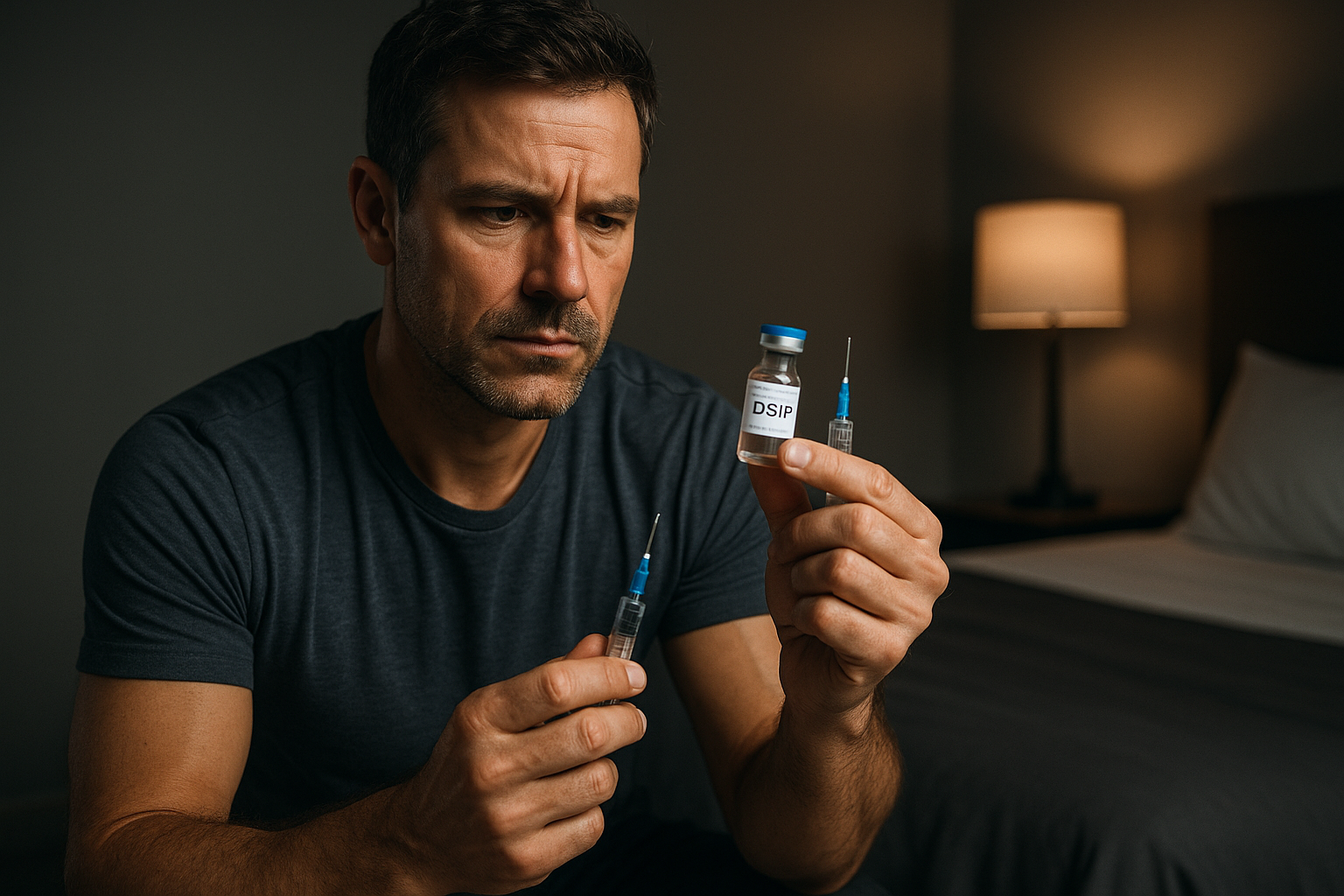
If you’re searching for dsip peptide for sleep, you’re probably trying to figure out two things fast: (1) what DSIP actually is, and (2) whether the real-world chatter is supported by research. DSIP stands for delta-sleep-inducing peptide—a neuropeptide studied mainly for how it may influence objective sleep patterns (like sleep efficiency, sleep latency, and slow-wave sleep-related measures). At the same time, many products sold online blur the line between investigational research and consumer-ready sleep claims.
This guide breaks DSIP down evidence-first: what the human research suggests, what it does not confirm, and how to evaluate safety and product quality before you consider anything peptide-related. (Quick note: this isn’t medical advice—if you have a sleep disorder, medication interactions, or underlying conditions, talk with a qualified clinician.)
What is DSIP (delta-sleep-inducing peptide)?
Where DSIP comes from (high-level background; keep it factual)
Delta-sleep-inducing peptide (DSIP) is a short peptide sometimes described as a “nonapeptide” in product literature. Peptides like DSIP are signaling molecules (made of amino acids) that can interact with biological pathways—sometimes through receptors or by influencing neurochemical systems involved in sleep-wake regulation. Background references often describe DSIP in the context of neuropeptides and sleep research rather than mainstream, clinically approved insomnia treatment.
For general background, see: Background on delta-sleep-inducing peptide (DSIP). For a technical product overview, see: Nonapeptide overview from ProSpec Bio (product/technical background).
What “sleep modulation” means vs sedatives
A common reason DSIP is discussed alongside sleep supplements is the difference between:
- Sleep modulation: shifting aspects of sleep architecture (e.g., promoting certain sleep-stage patterns) rather than simply knocking you out.
- Sedation: drug-like “sleepiness” or a direct calming effect that may reduce wakefulness.
Research summaries often emphasize that DSIP is discussed as a sleep-promoting concept, but it’s important not to assume that equals “same as an approved hypnotic medication.” Evidence exists, but it’s not the same level you’d see for widely regulated insomnia treatments.
What does the research say about DSIP and sleep?
Human evidence overview (reference the PubMed chronic sleep study result)
When people ask whether dsip peptide for sleep works, the best starting point is human sleep outcomes measured objectively.
A frequently cited PubMed record (focused on chronic sleep outcomes) is here: PubMed study on delta sleep-inducing peptide (DSIP) and objective sleep outcomes. While exact details (participant characteristics, intervention duration, and outcome metrics) matter for interpreting results, the key takeaway is that DSIP has been studied with measured sleep parameters rather than only subjective “I feel sleepy” reports.
In practical terms, research discussion often centers on sleep markers such as:
- sleep efficiency (how effectively time in bed translates into sleep)
- sleep latency (how long it takes to fall asleep)
- signals related to slow-wave sleep and delta-sleep concepts
However, “studied” does not equal “proven as an insomnia treatment.” The strongest responsible stance is: DSIP has evidence in sleep research settings, but it’s investigational and not a universal, guaranteed sleep fix.
EEG/sleep-wake modulation findings (reference the 2001 journal overview)
To understand the sleep physiology side—what scientists think DSIP may do in terms of brain activity—this peer-reviewed overview is useful: Peer-reviewed overview: delta sleep-inducing peptide (sleep-promoting vs sedative effects).
In broad strokes, sleep peptide research often uses EEG and related measures to distinguish:
- changes consistent with sleep modulation (sleep-stage/architecture effects), and
- changes consistent with sedation (general suppression of wakefulness).
This is a meaningful distinction for people who want better sleep rather than merely “knocked out.” But even with mechanistic discussion, you still need to treat consumer claims carefully—because the product you buy may not match the study compound, dose, purity, or administration route.
What the research does NOT confirm (avoid overstating)
To keep expectations grounded, here’s what DSIP evidence does not automatically establish:
- It is not an FDA-approved (or equivalent) insomnia medication based on the same standard of clinical validation as mainstream therapies.
- It’s not guaranteed to improve sleep efficiency or reduce sleep latency for every person.
- It does not automatically mean “safe to self-experiment”—especially given variability in peptide sourcing and product quality.
In other words: DSIP is a research peptide for sleep modulation, not a universally proven, consumer-benchmarked sleep drug.
DSIP peptide for sleep: potential benefits and how people use it (investigational lens)
Sleep timing/quality markers people discuss (keep descriptive, not guaranteed)
Online conversations around dsip peptide for sleep commonly focus on “sleep quality” in terms that map loosely to study-relevant markers. People often describe improvements they associate with:
- falling asleep faster (analogous to shorter sleep latency)
- staying asleep / feeling sleep is “more consolidated” (related in concept to sleep efficiency)
- deeper sleep or “restorative” nights (often linked to slow-wave sleep discussions)
Important: subjective experiences can be affected by placebo, lifestyle changes, stress, caffeine timing, and device-based “sleep scores.” That’s why it’s better to think of DSIP as something with studied sleep-modulating potential, not as a sure bet for every sleeper.
Expectations management (evidence level + variability)
If you’re considering DSIP, the most useful mindset is to separate:
- What studies measure (objective sleep parameters in controlled contexts)
- What consumer products promise (often broad and not always aligned to specific measured outcomes)
- How your response might vary (baseline sleep, stress, work schedule, and physiology)
A good practical expectation is: DSIP may influence sleep architecture-related signals in some contexts, but response is likely variable and product quality matters enormously.
DSIP for sleep safety, legality, and product quality checklist
Safety considerations (general supplement/peptide risk framing)
Peptide products can carry risks that aren’t solved by “it’s natural” or “it’s just a peptide.” Key safety realities include:
- Purity and contamination risk: peptides from different sources can vary widely.
- Incorrect dosing: mislabeled concentration or reconstitution errors are common failure points with peptide products.
- Unclear long-term data: many peptides used online do not have the same long-term safety profile publicly established for routine consumer use.
- Individual sensitivity: sleep and neurochemistry are complex—what helps one person could worsen sleep in another.
Medical disclaimer: This article is informational only. DSIP is discussed in a research context and is not a proven or universally approved treatment for sleep disorders. Consult a qualified healthcare professional—especially if you have a diagnosed sleep disorder, are pregnant/breastfeeding, have serious medical conditions, or take medications that affect the nervous system.
How to vet a DSIP supplier (COA/testing/documentation)
This is where many competitors miss the mark. If you’re evaluating dsip peptide for sleep products, don’t rely on marketing claims. Use a quality checklist.
DSIP product quality checklist (before buying):
-
Third-party testing documentation
Look for a Certificate of Analysis (COA) from an independent lab (not just “lab reports” hosted only by the seller). -
Assay/purity (and how purity is measured)
The COA should clearly state purity/assay results and test method where available. -
Identity confirmation
The report should include identity testing (e.g., method details consistent with peptide identity verification). -
Impurities/contaminants
Prioritize documentation for common contaminants and residual solvents/metals when the seller provides them. -
Lot traceability
Ensure results match the exact lot/batch you’d receive. -
Clear sourcing and storage guidance
You want transparent information about how it’s handled to maintain stability (and whether shipping conditions are appropriate). -
No “guaranteed” sleep claims
Be cautious with vendors that promise specific sleep outcomes (sleep latency reductions, “cures insomnia,” etc.). Responsible vendors frame it as investigational or research use and avoid medical-treatment language.
Legality note: Legal status can vary by country and intended use (and suppliers may market peptides under different regulatory frameworks). Availability may change quickly. If legality matters for you, verify current local regulations or consult a legal professional.
If you’re looking for a broader “peptide safety/legality thinking” framework that overlaps with DSIP considerations, see Forged Alpha’s safety-first approach to peptide categories: Peptides Like BPC-157: Evidence, Safety, and Legality for Athlete Recovery and BPC-157 for Athletes: Recovery, Risks and Legality.
DSIP vs other peptide-for-sleep approaches (high-level comparison)
When a sleep peptide concept is being discussed
DSIP is one concept among several “peptide for sleep” ideas that appear online. At a high level, these are often discussed as:
- neuropeptides aimed at sleep-wake regulation
- compounds framed as sleep architecture modulators versus sedative-like approaches
- research peptides compared by the type of outcomes they’re said to affect (latency, efficiency, deep sleep signals)
What matters for you as a consumer is not which category “sounds best,” but whether the specific compound has credible research, whether product quality is verified, and whether you understand the evidence boundary: studied in research settings ≠ proven for widespread self-use.
If you want context on how peptides are generally discussed in the fitness/wellness world (and why quality and evidence vary), you can browse: Best Peptides for Muscle Growth in 2026: A Complete Guide for Men. (This is general context and not a sleep recommendation.)
FAQ
What is DSIP (delta-sleep-inducing peptide) and how is it related to sleep?
DSIP (delta-sleep-inducing peptide) is a peptide studied in the context of sleep regulation. Research discussions often focus on objective sleep parameters and EEG-related sleep architecture, including concepts linked to delta/slow-wave sleep and sleep-wake modulation. Background: Background on delta-sleep-inducing peptide (DSIP).
Does dsip peptide for sleep improve sleep efficiency or sleep latency according to studies?
Some human sleep research (including the PubMed record linked above) examines objective sleep outcomes such as sleep efficiency and sleep latency. That said, responses may vary and the evidence base is not the same as for approved insomnia treatments. Treat DSIP as investigational rather than guaranteed.
Is DSIP a sedative or does it modulate sleep differently?
Research overviews discuss DSIP in relation to sleep-promoting vs sedative effects. The core idea is sleep modulation rather than simple sedation—though you should still be cautious about equating research mechanisms with what a consumer product does in real life.
What are the common safety and side-effect concerns with peptide sleep products?
Potential concerns include purity/contamination, incorrect dosing, and insufficient long-term safety data for routine self-use. Also consider personal sensitivity and medication interactions. If you have medical conditions or take prescriptions, consult a healthcare professional.
How can I evaluate the quality/testing of a DSIP product before buying?
Look for a COA from a third-party lab that includes assay/purity, identity confirmation, relevant contaminant testing where available, and lot traceability. Avoid vendors that only provide promotional materials or that cannot tie results to your exact batch.
Is DSIP legal to buy and use (and does availability vary by location)?
Legality and availability can vary by country and by regulatory interpretation. Because rules change, verify current local regulations and consider professional guidance for your situation.
Conclusion: should you care about DSIP for sleep?
DSIP peptide for sleep sits in an interesting space: it’s backed by sleep research that explores objective outcomes like sleep efficiency and latency, but it remains investigational rather than a universally proven or regulated sleep treatment. If you’re going to explore it, prioritize evidence-level thinking and—most importantly—product quality verification (COA, third-party testing, lot traceability).
Next step: If you’re considering DSIP, start by reviewing the linked research sources (PubMed + the 2001 journal overview) and then use the supplier quality checklist before you spend money or take risks.