
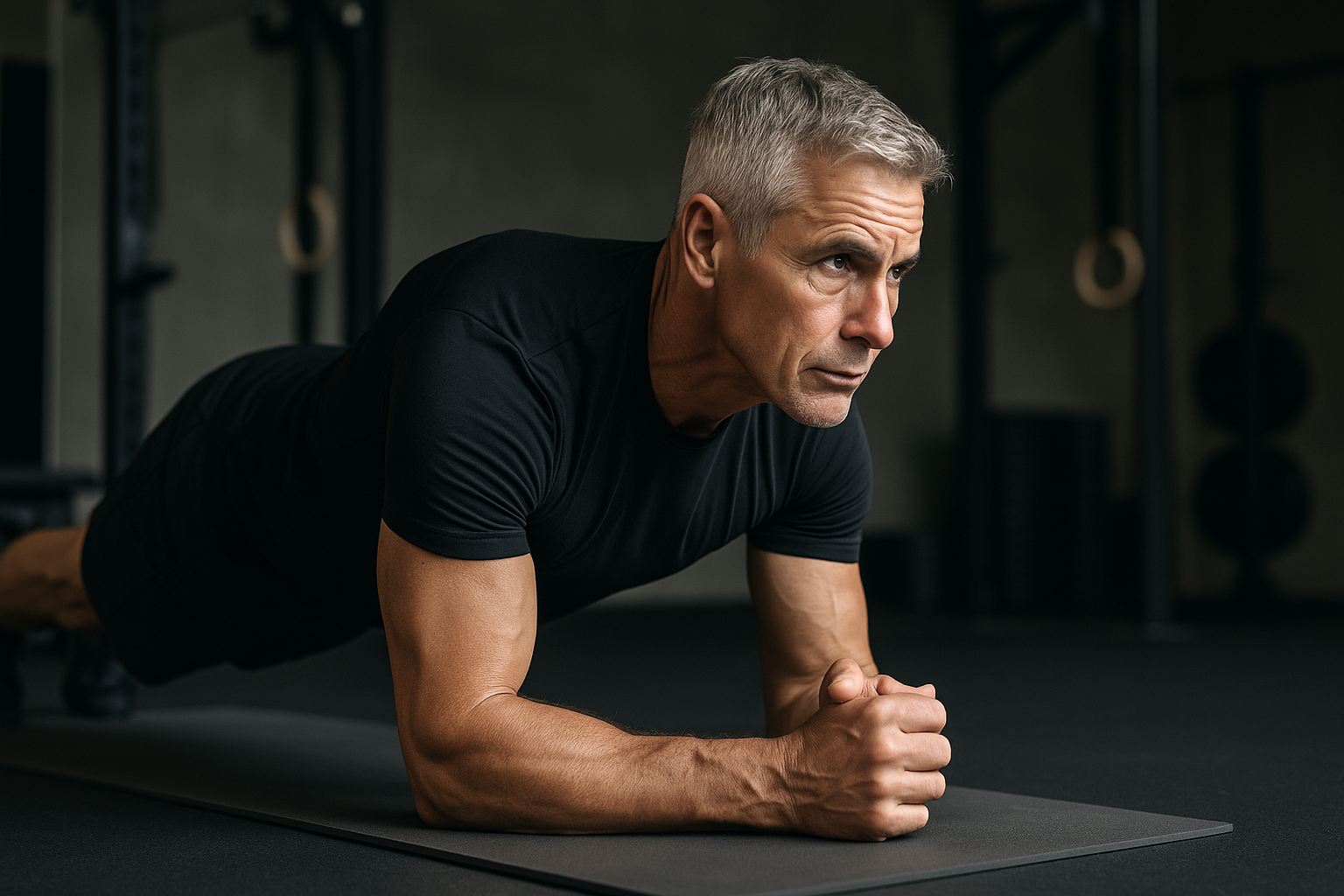
Quick answer: the best ab exercises for men over 50 are the ones that train your core to brace, resist unwanted movement, and support your spine—especially anti-extension and anti-rotation core exercises. If your lower back gets cranky, you’ll usually do better with controlled bracing drills (dead bug alternatives, planks that don’t jam your low back, and hip-hinge friendly lower-ab work) instead of heavy sit-ups.
Note: This is general fitness guidance, not medical advice. If you have cardiovascular issues, a hernia, recent surgery, or persistent/worsening back pain, check with a clinician or qualified trainer first. Stop any exercise that causes sharp pain, numbness/tingling, or symptom worsening—regress and prioritize form.
What makes ab training different after 50 (core function + safety)
After 50, the core is less about “crunching” and more about making your ribcage and pelvis work together—so you can stand tall, rotate and lift safely, and move without low-back compensation.
Core goals for men 50+ (stability, posture, bracing)
- Spine stability: resist arching and collapsing.
- Trunk control: resist twisting and shifting.
- Posture support: ribs down, pelvis neutral, shoulders relaxed.
- Force transfer: bracing that transfers to squats, carries, throws, and getting up from the floor.
Common issues to account for (low back sensitivity, hip mobility, grip/shoulder limits)
- Low back sensitivity: many “ab” moves actually load the lumbar spine through extension or flexion range you can’t control.
- Hip mobility limits: if your hips don’t flex well, leg-raise-style work can pull your pelvis into a losing position.
- Grip/shoulder limits: some plank variations (or long holds) can aggravate wrists/shoulders—so we’ll use progressions that keep joints happy.
How to cue “brace” (breathing + ribcage down)
Use a simple cue set you can repeat for every exercise:
- “Breathe out first.” Exhale like you’re fogging a mirror—then brace.
- Brace like you’re about to be poked. Imagine tightening your lower abs/around the waist.
- Ribs down, not flared. Keep your lower ribs from lifting toward your armpits.
- Hold without holding your breath forever. Brace for a rep/interval, then relax between reps.
Best ab exercises for men over 50 (ranked by joint-friendliness)
Below is a ranked list of men over 50 core exercises organized by what they train: anti-extension, anti-rotation, planks for 50+, and hip-hinge friendly lower-ab work. For each exercise you’ll get: what it trains, how to do it, a coach cue, a common mistake, and a regression/progression.
Anti-extension (protects spine): exercises + form cues
Anti-extension core exercises teach your trunk to resist arching—key if you feel your low back take over on “crunch” or leg-raise attempts.
1) Dead Bug (or dead bug alternative) – brace without arching
What it trains: low-back-friendly trunk bracing and coordinated breathing.
How to do it: Lie on your back, knees bent to tabletop (hips and knees at ~90°). Brace. Slowly lower one heel toward the floor without letting your low back lift. Return, switch sides.
Coach cue: “Ribs stay heavy; low back stays quiet.”
Common mistake: arching the lumbar spine as the leg lowers.
Regress: Keep the knees at tabletop and only move the arms (or move one inch with the legs).
Progress: Lower the leg farther, slow tempo (3 seconds down), or add a light dumbbell in the hands.
2) Heel Slides (ab-focused) – short range, pelvic control
What it trains: anti-extension core with hip + pelvic positioning (great ab exercises for back pain risk situations, if done well).
How to do it: Supine, knees bent. Brace. Slide one heel along the floor until you feel mild hamstring tension—without your back lifting—then return.
Coach cue: “Slide, don’t tip. Keep your pelvis level.”
Common mistake: losing neutral and extending the low back.
Regress: Shorten the slide length.
Progress: Increase range or slow to a 4-second slide.
3) Abdominal Bracing Hold (marching supine)
What it trains: isometric anti-extension endurance.
How to do it: Same starting position as dead bug. Brace and lift one knee slightly (2–3 inches) while keeping low back down; alternate slowly.
Coach cue: “Brace first, then move.”
Common mistake: turning it into a hip-flexor curl where your back arches.
Regress: Hold one knee up and breathe steadily for time.
Progress: Add arm reach overhead (only if ribs stay down).
Anti-extension “mini-set” recommendation
- Pick one exercise from #1–#3 to start each session.
- Goal: perfect bracing over range.
Anti-rotation (improves trunk control): exercises + form cues
Anti-rotation core exercises help your trunk resist twisting when you reach, swing, carry, or step uneven terrain.
4) Pallof Press (band or cable) – press without twisting
What it trains: anti-rotation stability through the abs and obliques.
How to do it: Stand sideways to the band/cable anchor (or front-facing depending on setup). Brace, then press arms forward to full extension while keeping shoulders and ribs stacked. Hold, return.
Coach cue: “Don’t let your torso chase your hands.”
Common mistake: letting your hips/shoulders twist to “help” the press.
Regress: Reduce range; hold for shorter time.
Progress: Add a slow 3–5 second hold, or do a slight staggered stance for more challenge.
5) Suitcase Carry (unilateral core) – stand tall
What it trains: unilateral core strength (anti-rotation + anti-lateral flexion) and trunk stiffness for walking.
How to do it: Hold a dumbbell/kettlebell at your side on one side. Brace. Walk tall without leaning. Switch sides.
Coach cue: “Ribs over hips—no side bend.”
Common mistake: leaning to the loaded side.
Regress: Use a lighter load or shorter distance.
Progress: Increase distance or add an overhead reach if shoulders tolerate it.
6) Side Plank Shoulder Tap (advanced anti-rotation)
What it trains: anti-rotation with dynamic control.
How to do it: From side plank (knees bent if needed), keep hips stacked. Tap the floor or shoulder lightly with the top hand without twisting.
Coach cue: “Move your hand, not your hips.”
Common mistake: letting your hips rotate open.
Regress: No taps—just hold side plank.
Progress: Increase hold time or tap farther (lower risk range first).
Front/side plank variations (progressions for 50+)
Planks are still effective after 50—when they’re done with rib control and smart regressions. Think plank variations for 50+ that build endurance without back crankiness.
7) Incline Plank (hands on bench/counter) – easiest to scale
What it trains: anti-extension endurance and shoulder/upper core coordination.
How to do it: Hands on a bench or counter, body straight, brace, hold.
Coach cue: “Push the floor away; ribs down.”
Common mistake: dropping hips or over-arching the low back.
Regress: Increase incline (higher surface).
Progress: Lower the incline closer to floor; move to forearms if wrists get irritated.
8) Forearm Plank (start on knees if needed)
What it trains: full anterior trunk stability.
How to do it: Forearms down, elbows under shoulders. Brace. If needed, start with knees on the ground while keeping a straight line.
Coach cue: “Long neck, steady breath.”
Common mistake: holding breath aggressively and letting form collapse.
Regress: Knees-down plank.
Progress: Straight-leg plank and longer holds.
9) Side Plank (knees bent) – hip stability and posture
What it trains: anti-lateral flexion and trunk endurance.
How to do it: Start with knees bent and stacked. Brace and hold.
Coach cue: “Press your top hip forward, don’t sag.”
Common mistake: letting the hips drop (turning it into a low-back stretch).
Regress: Knees down and shorter holds.
Progress: Straight-leg side plank or longer timed sets.
Hip-hinge friendly lower-ab options (controlled legs + pelvic position)
Lower-ab work after 50 should prioritize pelvic control—because many leg-raise variations trigger low-back extension if you don’t have the mobility/positioning yet.
10) Supine “Tabletop” Leg Extensions (dead bug alternative without arm chaos)
What it trains: controlled low-ab bracing while the hips move minimally.
How to do it: Start with knees at tabletop. Brace. Slowly extend one knee a few inches and return—keeping low back down.
Coach cue: “Move the knee, not your spine.”
Common mistake: taking the leg too far and arching the back.
Regress: Smaller range or slower tempo.
Progress: Extend farther or add a brief pause at the end range.
11) Marching Bridge (glute + core) – brace without losing pelvis
What it trains: core stability with a strong lower-body base.
How to do it: From a basic glute bridge (hips up), brace and march—lift one heel slightly while keeping hips level.
Coach cue: “Hips stay even; abs hold the line.”
Common mistake: twisting at the trunk or dropping one hip.
Regress: Hold the bridge without marching.
Progress: March higher slowly or longer holds.
12) Seated/standing core exercise: Cable/Band Pallof “reset” in place
What it trains: anti-rotation with less spinal demand if your lying position bothers you.
How to do it: Stand or sit tall, brace, press out and hold.
Coach cue: “Keep your spine stacked; pelvis still.”
Common mistake: over-rotating the torso to “complete” the rep.
Regress: Seated version with a lighter load.
Progress: Slight stance imbalance (one foot forward) if stable.
13) Seated Knee Lift with Bracing (small ROM, big control)
What it trains: controlled core engagement for men who can’t tolerate floor work.
How to do it: Sit tall on a bench/chair, brace, and lift one knee 2–4 inches without leaning back.
Coach cue: “Brace then lift—no rocking.”
Common mistake: leaning back and letting hip flexors do everything.
Regress: Do toe taps instead of knee lifts.
Progress: Increase knee lift slightly and slow down.
10–15 minute ab workouts for men over 50 (sample routines)
You don’t need 60 minutes. You need consistent, spine-friendly stimulus with bracing quality. Here are two ready-to-run templates.
Rule of thumb: Choose 4–5 exercises per session. Keep 1–2 reps in reserve (no grinding), and stop if you feel sharp pain.
Beginner routine (2 days/week template)
Time: ~10–12 minutes
- Dead Bug (or Heel Slides) – 2 sets x 6–8 reps/side (slow, brace the whole time)
- Incline Plank – 2 sets x 20–30 seconds
- Pallof Press – 2 sets x 8–10 reps/side (1–2 sec hold)
- Side Plank (knees bent) – 1–2 sets x 15–25 seconds/side
- Suitcase Carry – 1–2 trips x 20–40 steps/side (easy enough to keep ribs stacked)
Intermediate routine (add difficulty safely)
Time: ~12–15 minutes
- Dead Bug alternative (Tabletop leg extensions) – 3 sets x 6–10 reps/side (3 sec eccentric)
- Forearm Plank – 3 sets x 20–40 seconds (stop 1–2 reps short of losing form)
- Pallof Press – 3 sets x 10 reps/side or 20–30 sec holds
- Side Plank shoulder taps (regressed as needed) – 2 sets x 6–8 taps/side (or 10–15 sec holds)
- Marching Bridge – 2 sets x 8–12 reps/side (hips level)
Want structure guidance for training at 50+? The Men’s Health Max Muscle at 50 workout is a useful reference for how training can be organized without overcomplicating your weekly plan.
How to progress (without joint flare-ups)
Rep vs. time progressions
For many men 50+, time-under-tension is safer and easier than forcing more reps immediately.
- Planks/side planks: add 5–10 seconds each week (or every other week) until you hit your target hold time (often 45–60 sec).
- Anti-extension/anti-rotation drills: progress from smaller range to longer range, then to more reps—only when your low back stays quiet.
Add load/lever length only when form holds
- Suitcase carry: only increase weight if you can walk without leaning.
- Pallof press: only increase resistance if you don’t twist to “make it happen.”
- Planks: only lower incline or go straighter legs when your ribs stay down and hips stay level.
When to regress (pain/technique breakdown rules)
Regress immediately if:
- Low back discomfort increases during the set (not just muscle burn).
- Form changes: ribs flare, hips sag, pelvis tips, or you can’t breathe while braced.
- Numbness/tingling shows up—stop and get evaluated.
Smart programming for function matters too. For a broader framework on training that carries into daily life, see Functional strength training plan for men over 50.
Mistakes to avoid after 50
Swinging reps, crunching with a jammed low back
If your neck/hips take over, your trunk isn’t doing the job. Keep reps slow and controlled. If you feel your low back during dead bug alternatives or leg work, reduce range and rebuild bracing.
Holding breath improperly
Bracing is not “gasping and freezing.” Exhale to set tension, brace, move, and recover your breath between reps/sets.
Doing only flexion-based ab work
Crunches and sit-ups can be fine for some people—but many 50+ men do better with a balanced mix:
- Anti-extension (resist arching)
- Anti-rotation (resist twisting)
- Plank variations (stable endurance)
- Controlled lower-ab options (pelvic position first)
FAQ: best ab exercises for men over 50
What are the safest ab exercises for men over 50 if my lower back gets sore?
Start with exercises that prioritize anti-extension and keep your spine quiet: dead bug alternatives (heel slides, tabletop leg extensions), incline/forearm planks with rib control, and Pallof press. If a movement makes symptoms worse, regress range or swap to a seated/standing option.
Are planks still effective after 50, and how long should I hold them?
Yes—planks work because they train bracing and trunk stiffness. Start with incline planks or knees-down forearm planks. Aim for 20–30 seconds for beginners, then progress toward 30–60 seconds while maintaining ribs down and hips level.
How many days per week should men over 50 train abs/core?
For most men 50+, 2–3 days per week is ideal. Use 10–15 minute sessions, focusing on quality bracing. If you’re training heavy lifts, you may still only need 2 dedicated core days.
What’s the difference between anti-extension and anti-rotation core exercises?
Anti-extension exercises help you resist arching (protecting your low back). Anti-rotation exercises help you resist twisting (useful for carries, stepping, and controlling movement patterns).
Should I do crunches or sit-ups after 50, or focus on other ab movements?
You can include crunch-style work if it doesn’t irritate your back, but the safest “default” after 50 is a blend of bracing-focused movements: dead bug alternatives, Pallof press, planks, and unilateral core exercises like suitcase carries.
How do I progress ab exercises if I can’t maintain good form yet?
Progress range and time only when form stays consistent. Use regressions like higher incline planks, shorter heel slides, knees-down planks, and lighter Pallof resistance. Once you can brace and breathe through the full set, then increase difficulty gradually.
Conclusion: build your “spine-protecting” core next
If you want the best ab exercises for men over 50, prioritize anti-extension and anti-rotation core exercises, then support them with plank variations and controlled lower-ab work that preserves pelvic position. Your next step: choose one beginner template above, run it 2x this week, and track whether your back feels better—not worse—after training.
Next action: Pick Dead Bug (or Heel Slides), Incline Plank, Pallof Press, and one side-plank option for 10–12 minutes, and repeat weekly with small progressions.
Optional recovery support: If you’re aiming to improve training quality and consistency, see Mens Sleep Optimization: A 14-Night Plan for Falling Asleep, Staying Asleep.
Optional nutrition support: If you want better muscle recovery from your core and strength sessions, pair your plan with Cheap High Protein Meals for Muscle Gain.