
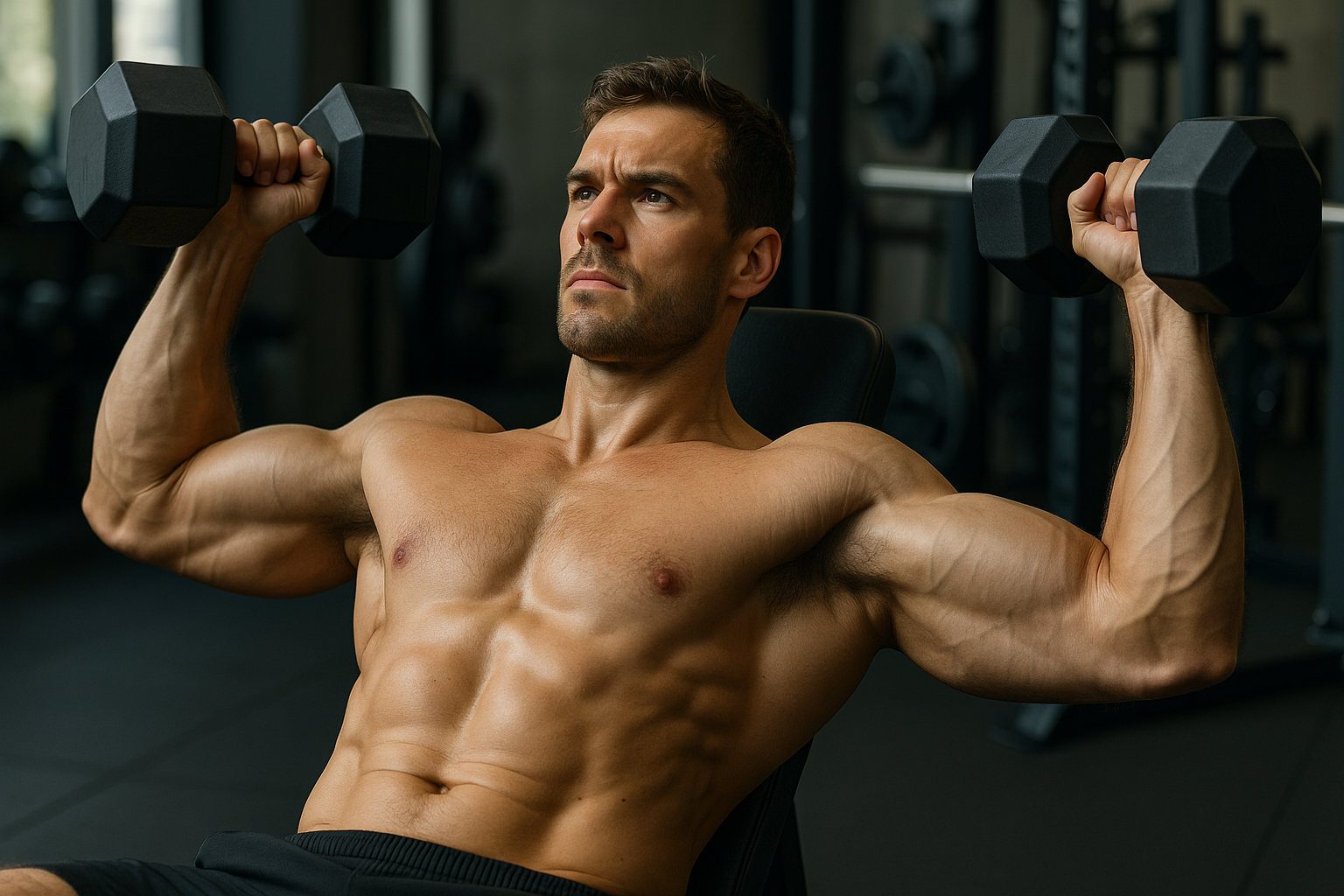
If you’re searching for a 20-minute upper body dumbbell workout, you probably want two things: a plan you can start today and a time-boxed routine that actually hits chest, back, shoulders, and arms without wasting rest time. Below is a complete, equipment-neutral (dumbbells required) upper-body circuit with exact sets, reps, rest times, and progression for 2–4 weeks—plus faster 15-minute upper body dumbbell workout and ultra-short 10 min upper body workout options, a seated upper body workout with dumbbells variation, and a dedicated upper body workout for swimmers focus.
Quick safety note: Stop if you feel sharp pain, numbness/tingling, or worsening discomfort. Consult a qualified healthcare professional if you have shoulder, neck, or back injuries. Use a weight that lets you complete controlled reps through a full range without form breakdown. If you’re new to training, start with the 10-minute version and build gradually.
Quick Upper Body Dumbbell Workout (20 minutes)
Equipment + setup (pair of dumbbells, bench optional)
- Dumbbells: 1–2 pairs if possible (lighter for isolation, heavier for presses/rows). Adjustable dumbbells work.
- Bench (optional): use for incline or supported rows. If you don’t have one, do supported chest-supported rows with a stable surface or use a bent-over row variation with strict torso control.
- Timer: phone timer is perfect. This routine is built around short, consistent rest times.
Warm-up (5 minutes: shoulder + scapular prep)
Do this as written. Move smoothly—no max effort.
- Arm circles + band-free shoulder warm-up (1 minute): 30 seconds forward, 30 seconds backward.
- Scapular push-ups (or wall scapular retractions) (1 minute): 2 seconds squeeze at the top.
- Dumbbell “empty” presses (1 minute): 8–10 light reps of dumbbell shoulder press (or overhead press with dumbbells) with slow control.
- Light rows (1 minute): 10–12 easy row reps to “wake up” the upper back.
- 2 ramp-up sets (1 minute total): do 4 reps at ~50% effort of your first press exercise, rest 30 seconds, then 2 reps at ~70% effort.
Main circuit (15 minutes): exercises with sets/reps/rest
This is designed so you can hit the 20-minute upper body dumbbell workout goal by using a tight circuit clock. You’ll complete 3 rounds of a 5-exercise sequence. Each round takes ~5 minutes.
How it works: 5 exercises × 3 rounds = 15 minutes of work. Rest times are included. Total time = warm-up (5) + circuit (15) = 20 minutes.
| Exercise | Sets × Reps | Tempo / Cues | Rest |
|---|---|---|---|
| 1) Dumbbell bench press (or floor press) | 3 × 8–10 | 2 seconds down, controlled press, no bouncing | 45 sec after each set |
| 2) One-arm dumbbell row (supported if possible) | 3 × 10–12/side | Pull elbow toward hip; 1-second pause squeezed at top | 45 sec after each set |
| 3) Overhead press with dumbbells (standing or seated—see seated section) | 3 × 6–8 | Ribs down; press up and slightly back to keep shoulders happy | 60 sec after each set |
| 4) Incline dumbbell fly (light) or rear-delt raise | 3 × 12–15 | Soft elbows; stop when chest/rear delts stretch comfortably | 30 sec after each set |
| 5) Triceps extensions (overhead) OR close-grip DB press | 3 × 10–12 | Elbows point forward; full lockout without shrugging | 30 sec after each set |
Time control tip: For the “split-side” row, keep it efficient: rest applies after you finish both sides (or do alternating reps and keep your time consistent). If you’re running long, reduce reps by 1–2 per set rather than skipping the warm-up.
Finisher (optional 2–3 minutes) to match time target
If you finish early and want a little extra burn without ruining recovery, do one short finisher. If time is tight, skip this.
- Option A (2 minutes): 2 rounds of 10–12 push-ups + 12–15 dumbbell curls (rest 30 seconds).
- Option B (2–3 minutes): “Swimmer stability” circuit: Wall slides 10 reps + rear-delt fly 12 reps + bandless scap pulls 12 reps (rest 45 seconds between rounds).
When to stop: If form breaks (arched back on presses, elbows flaring excessively, torso turning during rows), reduce load or cut the finisher.
15-minute and 10-minute versions (same exercises, fewer sets)
15-minute upper body dumbbell workout plan
Use the exact same exercise order and technique. Just reduce volume.
- Warm-up: 5 minutes (keep this).
- Circuit: 2 rounds instead of 3.
- Rest: keep the same rest times as above.
Result: Warm-up (5) + circuit (10–11) + short buffer = ~15 minutes.
10 min upper body workout (ultra-short)
Best for busy days. This is not a “max” workout—it’s a high-skill density session.
- Warm-up: 3 minutes (mini version): 30 sec arm circles + 30 sec scap push-ups + 1 minute light presses/rows.
- Circuit: 1 round only.
- Bench press: 1 × 6–8
- Row: 1 × 8–10/side
- Overhead press: 1 × 5–7
- Rear-delt raise (or fly): 1 × 10–12
- Triceps extension: 1 × 10–12
- Rest: 30–45 seconds between exercises.
Scaling shortcut: If your hands/shoulders fatigue early, keep the order but choose slightly lighter dumbbells for the finisher muscles (rear delts + triceps).
How to scale difficulty (lighter/heavier + reps)
- Choose weight by “reps in reserve”: you should finish most sets feeling like you have 1–2 reps left in the tank (not a failure set).
- If too easy: add 1–2 reps per set for one week, then add load the next.
- If too hard: keep the load and reduce reps by ~20%, or swap overhead press for a safer variation (see shoulder-strain FAQ).
Seated upper body dumbbell workout (for limited mobility)
If standing overhead work irritates your lower back or you want a more stable base, a seated upper body workout with dumbbells is a smart tweak. It often improves control for pressing and rows.
Seated pressing + rows format
Do 2 rounds (15–20 minutes depending on rest, or 1 round for 10 minutes). Keep rest the same as the 20-minute plan.
- Seated dumbbell shoulder press (dumbbell shoulder press): 3 × 6–8
- Seated dumbbell row (chest supported on thighs or bench): 3 × 10–12/side
- Seated incline press or dumbbell floor press: 3 × 8–10
- Rear-delt raise: 3 × 12–15
Triceps + biceps add-on (short superset)
Optional, but it takes less than 5 minutes and gives you balanced elbow work.
- Superset:
- Overhead triceps extension: 2 × 10–12
- Dumbbell curls: 2 × 10–12
- Rest: 30 seconds after the superset.
Upper body workout for swimmers (back + shoulders emphasis)
Swimmers tend to need more upper back strength, rear-delt endurance, and shoulder stability—so your pressing doesn’t become “all front delts, no posture.” Here’s a focused mini-program you can run after the main dumbbell circuit (or as a standalone 15–20 minute session).
Swim-specific focus: lats/upper back + rear delts
Complete 3 rounds. Rest 45–60 seconds between exercises.
- One-arm dumbbell row: 3 × 10–12/side (pause 1 second at the top)
- Rear-delt raise: 3 × 12–15
- Overhead press with dumbbells (lighter): 3 × 6–8 (focus on posture, ribs down)
- Triceps extensions: 2–3 × 10–12 (swimmer-friendly elbow extension strength)
- Optional lats finisher: 12–15 dumbbell pullovers (light, controlled) for 1 set
“Upper body swim workout” finisher (pull + shoulder stability)
Choose one:
- 2-minute stability: 10 wall slides + 10 scap pull variations + repeat once.
- 2-minute endurance: 3 sets of 30 seconds: controlled rows (slow) with 30 seconds rest.
Why this helps: swimmers usually need consistent scapular control and durable shoulder capacity—not just heavier pressing.
External reference for exercise selection variety: If you want more ideas for upper body exercise options, see Upper Body Workout for Women: 10 Best Exercises. (Use it for exercise discovery; technique still matters most.)
Progression plan (2–4 weeks)
Most “lists of upper body exercises” fail at progression. This one doesn’t. Your goal is to earn the right to add weight by first improving reps with the same load.
When to add reps vs. add weight
- Weeks 1–2 (reps-first): keep the weight the same and add +1 rep per set (or +2 reps total per exercise) as long as reps stay controlled.
- Weeks 3–4 (load-first): when you reach the top of the rep range for all sets (for example, 10 reps on bench when you planned 8–10), then increase weight by the smallest jump you can (often 1–5 lb per dumbbell) and return to the lower end of the rep range.
Recovery guidance (how often to train)
- 2 days/week: ideal for most people—e.g., Monday and Thursday (or Tuesday/Saturday).
- 3 days/week: do one full session and one seated/limited-mobility session, and keep the third day lighter (10-minute version or swimmer emphasis only).
- Deload week (optional): every 4th week, reduce sets by 25–40% to stay consistent and reduce joint irritation.
Training tip I’ve found helpful: If your overhead pressing quality drops (more upper trap shrugging, uneven reps, elbows drifting), that’s a sign to reduce load for that movement, not “push through.”
Common form mistakes (quick checklist)
Shoulder positioning + scapular control
- Overhead press shrugging: keep shoulders down and press “through” the arms, not up into your ears.
- Scapula becomes an afterthought: aim for a smooth shoulder blade set—especially during rows and presses.
- Over-arching on presses: ribs down. If your lower back takes over, lighten the weight.
Elbow path + torso stability
- Rows turning your body: lock your torso and pull with your back, not your hips.
- Bench pressing elbow flare: keep elbows at a controlled angle (often roughly 30–60 degrees from your torso, depending on comfort).
- Rear-delt raises “wristy” reps: let the movement be driven by shoulders/rear delts with a soft elbow.
FAQ: Upper body dumbbell workouts
How many days per week should I do an upper body dumbbell workout?
Most men do best with 2 days/week. If you want more, add a third lighter session using the 10-minute upper body workout or the seated/swimmer-focused variant to avoid overloading shoulders.
What dumbbells weight should I use for a 20-minute upper body workout?
Pick weights so you can complete the planned reps with 1–2 reps in reserve on most sets. If you miss the rep range or your form breaks early, go lighter—especially for overhead press with dumbbells and rear-delt work.
Can I do this workout if I only have adjustable dumbbells?
Yes. You can keep one “press” setting and one “row/isolation” setting. To save time, pick a weight that works for the majority of reps, then adjust only when needed for overhead press or fly/rear delts.
What’s the difference between a general upper body workout and an upper body workout for swimmers?
A general routine balances pressing and pulling for overall size/strength. An upper body workout for swimmers emphasizes upper back (lats/upper back), rear delts, scapular control, and shoulder stability—often using lighter overhead pressing and more row/rear-delt volume.
Is a seated upper body workout with dumbbells effective for building the shoulders and back?
Absolutely. Seating can improve torso stability and reduce lower-back compensation, which often makes pressing and rowing more controlled. Pair seated shoulder press with supported or seated rows for strong shoulder/back mechanics.
What should I do if my shoulders feel strained during overhead pressing?
Stop the movement if you feel sharp pain or worsening discomfort. Try one of these safer adjustments: reduce weight immediately, switch to seated pressing for better bracing, or replace overhead press temporarily with an incline press or chest-supported dumbbell press. Prioritize scapular control and elbow path—then reassess after a few sessions.
Optional: simple recovery boost that supports training
Progress is easier when recovery is consistent. If your sleep is inconsistent, consider reading Melatonin Sleep Aid Supplement: Sleep Aid vs Melatonin + Safe Dose Timing for a practical, safety-first overview.
Conclusion: use the plan, then earn progression
Here’s the simple next step: run the full 20-minute upper body dumbbell workout twice this week. If you’re short on time, use the 15-minute upper body dumbbell workout (2 rounds) or the 10 min upper body workout (1 round). After 2 weeks, use the reps-first progression to decide when to add weight—your shoulders (and your results) will thank you.
Want it even more specific? Tell me your equipment (bench? adjustable dumbbells? approximate dumbbell weights) and how many days/week you can train upper body, and I’ll tailor the sets/reps and weekly schedule around your constraints.